Why Defence Mutual Funds Are Booming


Defence as a Theme
If you step back and look at what has been happening globally over the last few years, defence spending has not increased in isolation. It has moved alongside changes in geopolitics, trade, and how countries think about security.
Conflicts like Russia-Ukraine and ongoing instability across the Middle East and the Indo-Pacific have pushed governments to treat defence spending as a fixed commitment. Modern militaries need electronics, surveillance systems, cyber capabilities, and drone technologies, all of which require continuous investment rather than a single purchase.
The result is global military expenditure crossing $2.7 trillion in 2024 and still climbing.
The world has been shifting from one dominated largely by the US to one where multiple powers are competing for influence. In that kind of environment, countries cannot afford to stay underequipped. Old equipment needs replacing, newer defence technology demands continuous upgrades, and with active conflicts still ongoing, procurement cannot be paused. Governments are also pushing domestic manufacturing harder, partly to build local industry and partly because depending on foreign suppliers during a conflict is a risk most are no longer willing to take.
India mirrors these trends with its own priorities. The defence budget has grown from ₹2.53 lakh crore in 2013-14 to ₹6.81 lakh crore in 2025-26. The government has opened the sector to private participation, pushed domestic manufacturing, and defence exports have crossed ₹23,000 crores.
For investors, this creates clearer visibility on demand and participation across the value chain. The sector is being shaped by both global demand and domestic execution and that combination is what makes it worth paying attention to.
Challenges While Investing in the Defence Sector
Even when the broader direction looks favourable, stock selection within defence remains complicated. Unlike a consumer goods company whose sales you can track through distributor reports or channel checks, a defence company's revenue often depends on the timing of government procurement decisions that happen behind closed doors. The information like contract pipeline, procurement timelines, indigenisation policy changes is sometimes slow-moving and opaque. A few challenges that come up repeatedly:
- Technical opacity: Whether a shipbuilder's margins are sustainable or a missile systems company's order book is solid requires domain knowledge that isn't available through standard research.
- Valuation judgement: Defence stocks have traded at elevated multiples for years. Deciding whether a particular valuation is justified requires understanding order book duration and margin trajectory, neither of which is easy to assess from the outside.
- Concentration risk: Investing two or three names means carrying company-specific risk on top of sector risk.
- Policy sensitivity: Revenues here depend on government budgets, procurement rules, and import restrictions. A shift in any of these can affect earnings well before it shows up in results.
These challenges can be easily addressed by index funds.
An Easier Way in: Defence Index Funds
A defence-themed index fund addresses the stock-picking problem directly. Nifty India Defence Index selects companies from the Nifty Total Market universe classified under Aerospace & Defence, Explosives, or Shipbuilding & Allied Services, or those on the SIDM member list earning at least 10% of revenues from defence. Stocks are weighted by free-float market capitalisation, individual weights are capped at 20%, and the index rebalances every March and September. An investor gets exposure to a basket that represents the sector with built-in diversification, without needing a view on which individual company will win the next big tender.
Performance in the Last Few Years
The interest in defence funds has picked up alongside strong index performance. The Nifty India Defence TRI has delivered notable annualised returns across time periods.
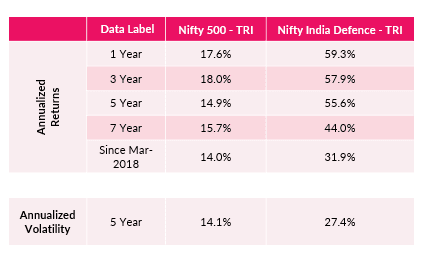
Data as of 28-Feb-2026. Past performance may or may not be sustained in the future. The above information should not be construed as promise, guarantee or forecast of returns. Table / Charts mentioned above are used to explain the concept and is for illustration purpose only. *Nifty India Defence Index start of index values from 28-Mar-2018.
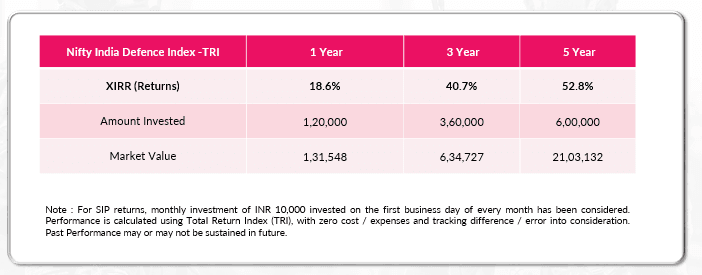
Data as of 28-Feb-2026. Past performance may or may not be sustained in the future. The above information should not be construed as promise, guarantee or forecast of returns. Table / Charts mentioned above are used to explain the concept and is for illustration purpose only.
Alongside these returns, two things deserve attention.
- Five-year annualised volatility for the Defence index was 27.4%, against 14.1% for the Nifty 500.
- In 2019, the Defence index returned just 2.3%* while the Nifty 500 delivered 9%*.
The five-year return potentially went to investors who stayed invested through years like 2019.
Why Are Defence Funds Booming
The returns connect to a set of policy, budget, and global developments that have been compounding over several years.
- India's Budget Commitment: The Ministry of Defence holds the largest share of expected central government expenditure at 15% for FY2026-27. Capital outlay on defence services constitutes roughly 23.6% of the overall defence allocation. The government has set a target to grow domestic defence manufacturing to INR 3,00,000 crore by 2029, doubling from current levels.
- Atmanirbhar Push: India has progressively tightened import restrictions on defence equipment, with a positive indigenisation list mandating domestic procurement for a growing catalogue of systems. The sector now allows 100% private sector participation and FDI up to 74%. These policy changes have created durable order flows for Indian manufacturers that did not exist five years ago.
- Export Momentum: India now exports defence equipment to over 85 countries. The US buys aircraft and helicopter parts; Armenia has ordered Akash missiles, Pinaka rocket systems, and Swathi radars; the Philippines purchased BrahMos cruise missiles. The government is targeting INR 50,000 crore in annual defence exports by 2029, roughly double FY25 levels.
- Global Spending Environment: Worldwide military expenditure crossed US$2.7 trillion in 2024. Europe grew 12.6% year-on-year in 2025, anchored by NATO's 5% of GDP commitment by 2035. Asia, led by China's sustained modernisation programme, accounted for US$573 billion.
How to Capture Growth in the Sector?
For most investors, the challenge is not identifying the opportunity. It is participating in a way that remains manageable over time.Axis Nifty India Defence Index Fund follows this route by tracking the Nifty India Defence TRI and maintaining exposure to companies linked to defence activity.
Key Features:
- Defined stock universe: Includes companies meeting defence revenue and industry criteria.
- Periodic rebalancing: Portfolio reviewed semi-annually to reflect changes in the sector.
- Weight limits: 20% caps on individual stocks help avoid excessive concentration.
- Accessible entry: Minimum investment is low which makes it easier to start small and build the allocation gradually over time.
Potential Benefits:
- Broad exposure: One fund covers aerospace, shipbuilding, explosives, electronics, and components. You don't need separate views on each sub-sector.
- Process-led allocation: The index has a defined set of rules for which stocks get in and how much weight they get.
- Lower monitoring effort: As an investor you are tracking one theme and not the internal workings of each company inside it.
- Cost efficiency: Passive funds cost less than actively managed ones, and that difference potentially compounds over time.
Potential Risks:
- Valuation risk: The fund stays fully invested regardless of where valuations are. If the sector gets expensive, there's no automatic pullback.
- Policy sensitivity: The entire basket depends on government budgets and procurement rules staying broadly intact. A policy reversal hits everything at once.
- Short-term volatility: Defence stocks react sharply to budget announcements, contract news, and geopolitical events, sometimes before the fundamentals have actually changed.
- Event-driven reactions: A ceasefire or diplomatic shift can reprice the sector quickly, well before earnings reflect any change.
Defence as a theme has moved into a space where investors can study it with more clarity than before. With defence funds like Axis Nifty India Defence Index Fund, investors can seamlessly access the entire defence spectrum and participate in the theme.
Sources:
https://www.sipri.org/sites/default/files/2025-04/2504_fs_milex_2024.pdfhttps://www.iiss.org/online-analysis/military-balance/2026/02/global-defence-spending-continues-to-grow-amid-geopolitical-uncertainty/https://www.pib.gov.in/PressReleasePage.aspx?PRID=2191937®=3&lang=2https://www.niftyindices.com/Factsheet/Factsheet_NiftyIndiaDefence.pdfhttps://www.indiabudget.gov.in/https://www.pib.gov.in/PressReleasePage.aspx?PRID=2191937®=3&lang=2https://visionias.in/current-affairs/monthly-magazine/2025-05-17/security/indias-defence-exports-1https://www.govconexec.com/2026/02/global-defense-spending-2025/
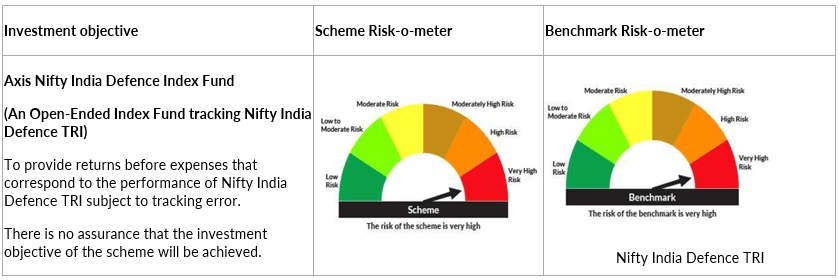
Investors should consult their financial advisors if in doubt about whether the product is suitable for them. The product labelling assigned during the New Fund. Offer is based on internal assessment of the Scheme Characteristics or model portfolio and the same may vary post NFO when actual investments are made.
Statutory Details: Axis Bank Limited is not liable or responsible for any loss or shortfall resulting from the operation of the scheme.
This article represents the views of Axis Asset Management Co. Ltd. and must not be taken as the basis for an investment decision. Neither Axis Mutual Fund, Axis Mutual Fund Trustee Limited nor Axis Asset Management Company Limited, its Directors or associates shall be liable for any damages including lost revenue or lost profits that may arise from the use of the information contained herein. No representation or warranty is made as to the accuracy, completeness or fairness of the information and opinions contained herein. The AMC reserves the right to make modifications and alterations to this statement as may be required from time to time.
The article is based upon information that we consider reliable, but we do not represent that it is accurate or complete, and it should not be relied upon as such. Opinions, if any, expressed are our opinions as of the date of appearing on this material only. While we endeavor to update on a reasonable basis the information discussed in this material, there may be regulatory, compliance, or other reasons that prevent us from doing so. Recipient shall understand that the aforementioned statements cannot disclose all the risks and characteristics. The recipient is requested to take into consideration all the risk factors including their financial condition, suitability to risk return, etc. and take professional advice before investing.
The sector mentioned herein are for general assessment purpose only and not a complete disclosure of every material fact. It should not be construed as investment advice to any party. The schemes may or may not have any investments in stocks under these sectors
NSE Disclaimer: It is to be distinctly understood that the permission given by NSE should not in any way be deemed or construed that the SIDs / Schemes of Axis MF has been cleared or approved by NSE nor does it certify the correctness or completeness of any of the contents of the SIDs. The investors are advised to refer to the SIDs for the full text of the 'Disclaimer Clause of NSE. The fund manager(s) may or may not choose to hold the stock mentioned, from time to time. Investors are requested to consult their financial, tax and other advisors before taking any investment decision(s).
Mutual Fund Investments are subject to market risks, read all scheme related documents carefully.
Calculator
View All