Dissecting the Indian Capital Market Ecosystem and the Underlying Opportunity


When we talk about investing in India's growth story, most of us think about picking the right stock or the right fund. We think about what to put our money into, but rarely do we think about the machinery that runs the show. That is, the exchanges, the depositories, the asset managers, and the brokers. The reality is that these companies that earn every time we trade, invest, or simply stay invested.
Have we piqued your curiosity? Let’s understand all about how markets work and who benefits when they grow, and whether owning a slice of that is worth considering.
How Capital Markets Actually Work
Capital markets move money from people who wish to invest into businesses and governments who accept these investments for various purposes. To say it simply:
- Providers: Individual investors, HNIs, mutual funds, pension funds, and FPIs. The sources of capital.
- Seekers: Corporates raising equity, governments issuing bonds, financial institutions accessing funds.
- The infrastructure in between1:
- Exchanges (BSE, NSE, MCX): Where buyers and sellers meet and trades take place.
- Asset managers: Who pool money from investors and deploy it at scale.
- Depositories & clearing corporations: The back-office that ensures every trade actually settles.
- Brokers & depository participants: The last-mile interface for retail investors.
- RTAs, custodians, investment banks: Record-keeping, asset custody, deal structuring.
- Advisors, analysts & distributors: Professionals helping investors decide where to put their money.
Each entity in this ecosystem earns revenue when markets are active and grows when more money flows through the system.
The Growth of India’s Capital Markets:
Twenty-five years ago, this market ran on paper certificates and settlement that could stretch into weeks. It has since gone through three phases2:
- 1990s Building the foundation (1990s): Electronic trading, dematerialisation, SEBI becoming regulatory authority, and the launch of NSE.
- Deepening the market (2000-15): Products multiplied, retail participation grew, and foreign institutional money came in at scale.
- Digital changes the game (2015 onwards): Aadhaar, e-KYC, UPI, and discount brokers reduced time for account opening from days to minutes and eliminated barriers like cost of entry.
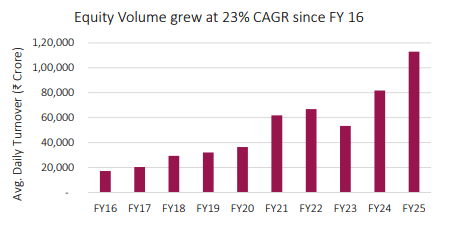
Demat accounts grew steadily until 2020, then grew explosively through 2025 (Source: Axis Capital Research Report, April 2026 (Behind the Trades). Further, equity average daily turnover grew at 23% CAGR since FY16 and derivatives at 67% CAGR3.
The businesses at the centre of that activity like brokerages, exchanges, and depositories saw volumes they had never seen before.
The Savings Story and Why This Is a Decade-Long Opportunity
India's gross domestic savings are approaching US$1 trillion annually. The IMF projects GDP crossing US$6.7 trillion by 2030, at a 30% savings rate, that is, roughly US$2 trillion in annual savings, about 80% higher than 2024 levels4.
For most of India's history, it went into gold and real estate. This pattern is changing for reasons like:
- Ease of access to capital markets: You can invest in the markets in a matter of minutes digitally, which wasn’t possible a decade ago.
- Smaller ticket sizes: Mutual funds introduced the micro-SIPs starting from ₹100.
- Regulatory trust: SEBI's track record has made the system credible to first-time investors.
- Lower costs: Discount brokers brought brokerage to near zero for equity delivery. Further, passive funds and direct mode of investing in mutual funds are cost-effective options.
- Return potential: With deposit rates frequently trailing inflation, equities and mutual funds present opportunities for growth.
Now let’s look at an example: Every rupee moving from traditional savings into capital market instruments like mutual funds generates fee income for asset managers, trail income for a distributor, AUM-based revenue for an RTA, and transaction flow through a depository. Thus, the financialization of household savings directly expands revenue for every business in the capital markets chain.
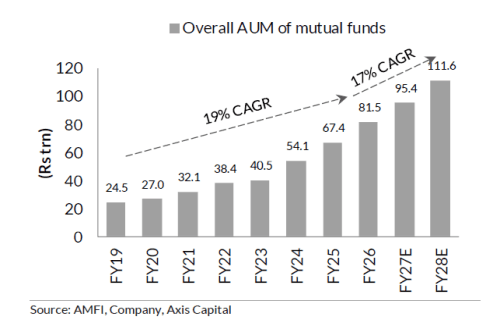
Mutual fund AUM stood at ₹81.5 trillion as of FY26, growing at 19% CAGR since 2010 (Source: MF Industry AUM Growth - AMFI, Emkay Research Report BFSI – Capital Markets, as of 13 April 2026; SIP Gross Flows – Jefferies Report Dt Feb 5 2026). Further, India's Mutual Fund AUM-to-GDP ratio is roughly 20% against a global average of 64%. Active demat accounts are around 5 crores, while UPI users are 49 crores5.
From the data, this just seems to be the beginning, and the growth potential in this space is massive in the coming decade.
The Index That Tracks The Capital Market Ecosystem
The Nifty Capital Markets Index was built to capture the companies running this infrastructure. It draws from the Nifty 500 universe, selecting stocks from relevant industry categories like exchanges, asset managers, depositories, brokerages, clearing houses, RTAs, and wealth managers.
Top 10 Holdings: Nifty Capital Markets Index (as of 30-Mar-2026)
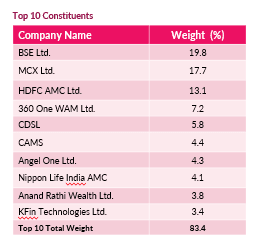
Source: Nifty Indices. Data as of 30-Mar-2026. Past performance may or may not be sustained in the future. The above information should not be construed as promise, guarantee or forecast of returns. Table / Charts mentioned above are used to explain the concept and is for illustration purpose only. The Stocks mentioned herein are for general assessment purpose only and not a complete disclosure of every material fact. It should not be construed as investment advice to any party. https://niftyindices.com/indices/equity/thematic-indices/nifty-capital-markets
Sector breakdown: The index is roughly 40% in exchanges and data platforms, 23% is in asset management, 19% in stock broking, with smaller allocations in depositories and distribution businesses6.
By market cap, the index is predominantly mid and small cap (around 84% combined). The index is free-float market cap weighted, caps any single stock at 20%, and rebalances semi-annually7.
How the Nifty Capital Markets Index Has Performed
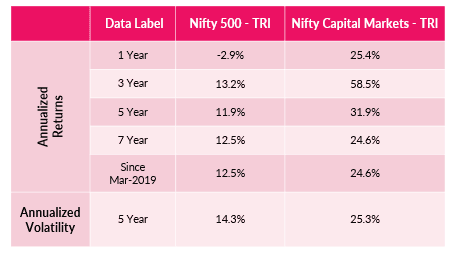
Data as of 30-Mar-2026. Past performance may or may not be sustained in the future. The above information should not be construed as promise, guarantee or forecast of returns. Table / Charts mentioned above are used to explain the concept and is for illustration purpose only. *Nifty Capital Market Index start of index values from 28-Mar-2019.
Presenting Axis Nifty Capital Markets Index Fund
Axis Nifty Capital Markets Index Fund is an open-ended passive fund that tracks the Nifty Capital Markets TRI. It gives investors direct exposure to the businesses running India's capital markets infrastructure without having to pick individual stocks or time the market.
Key Features:
- Broad ecosystem exposure: One fund covering stocks representing exchanges, AMCs, depositories, brokers, and wealth managers, essentially the full capital markets value chain.
- Passive, rules-based management: Tracks the index with no active stock-picking and keeping costs low and strategy transparent.
- Experienced passive team: Axis AMC's passive research team has 15+ years of experience with NSE, BSE, and S&P Dow Jones Indices.
Who May Consider This Fund:
- Long-horizon investors: Those with at least a 3 to 5 year view on India's capital markets deepening.
- Investors comfortable with concentration: The index is thematic and sector-specific; it works as a satellite allocation within a diversified portfolio.
- Very High Risk Appetite: Investors with very high risk profile
Conclusion
The question we need to ask ourselves before investing is a direct one: Do we believe more Indians will participate in capital markets over the next decade? Do we think mutual funds, exchanges, and brokerages will process meaningfully more transactions in 2035 than they do today? If yes, the companies in this index grow alongside that activity. Axis Nifty Capital Markets Index Fund gives investors a way to own that outcome!
Sources:1 https://www.investopedia.com/terms/c/capitalmarkets.asp2 https://www.nism.ac.in/blog/indias-capital-markets-3-0-opportunities-and-way-forward/3 https://www.mstock.com/articles/indian-stock-market-evolution#growing-relevance-of-capital-markets-in-indias-economy4 https://data.worldbank.org/indicator/NY.GDS.TOTL.CD?locations=IN5 https://www.valueresearchonline.com/learn/stocks/207-million-demat-accounts-india-real-investing-gap/6 https://www.niftyindices.com/Factsheet/Factsheet_NiftyCapitalMarkets.pdf7 https://www.niftyindices.com/Factsheet/Factsheet_NiftyCapitalMarkets.pdf

Investors should consult their financial advisors if in doubt about whether the product is suitable for them. The product labelling assigned during the New Fund Offer is based on internal assessment of the Scheme Characteristics or model portfolio and the same may vary post NFO when actual investments are made
Statutory Details: Axis Bank Limited is not liable or responsible for any loss or shortfall resulting from the operation of the scheme.
This document represents the views of Axis Asset Management Co. Ltd. and must not be taken as the basis for an investment decision. Neither Axis Mutual Fund, Axis Mutual Fund Trustee Limited nor Axis Asset Management Company Limited, its Directors or associates shall be liable for any damages including lost revenue or lost profits that may arise from the use of the information contained herein. No representation or warranty is made as to the accuracy, completeness or fairness of the information and opinions contained herein. The AMC reserves the right to make modifications and alterations to this statement as may be required from time to time.
This article has been prepared and issued on the basis of internal data, publicly available information and other sources believed to be reliable. The information contained in this document is for general purposes only and not a complete disclosure of every material fact and terms and conditions. The information / data herein alone is not sufficient and shouldn’t be used for the development or implementation of an investment strategy. It should not be construed as investment advice to any party. Past performance may or may not be sustained in the future.
Any calculations made are approximations, meant as guidelines only, which you must confirm before relying on them. The information given is for general purposes only. Past performance may or may not be sustained in future. The current investment strategies are subject to change depending on market conditions. All opinions, figures, charts/graphs, estimates and data included in this presentation are as on date and are subject to change without notice. The statements contained herein may include statements of future expectations and other forward-looking statements that are based on our current views and assumptions and involve known and unknown risks and uncertainties that could cause actual results, performance or events to differ materially from those expressed or implied in such statements. Readers shall be fully responsible / liable for any decision taken on the basis of this presentation. Investments in Securities are subject to market and other risks and there is no assurance or guarantee that the objectives of any of the Schemes will be achieved. The scheme may not be suited to all categories of investors.
The material is based upon information that we consider reliable, but we do not represent that it is accurate or complete, and it should not be relied upon as such. Opinions, if any, expressed are our opinions as of the date of appearing on this material only. While we endeavor to update on a reasonable basis the information discussed in this material, there may be regulatory, compliance, or other reasons that prevent us from doing so. Recipient shall understand that the aforementioned statements cannot disclose all the risks and characteristics. The recipient is requested to take into consideration all the risk factors including their financial condition, suitability to risk return, etc. and take professional advice before investing.
NSE Disclaimer:
It is to be distinctly understood that the permission given by NSE should not in any way be deemed or construed that the SIDs / Schemes of Axis MF has been cleared or approved by NSE nor does it certify the correctness or completeness of any of the contents of the SIDs. The investors are advised to refer to the SIDs for the full text of the 'Disclaimer Clause of NSE.
The fund manager(s) may or may not choose to hold the stock mentioned, from time to time. Investors are requested to consult their financial, tax and other advisors before taking any investment decision(s).
Mutual Fund investments are subject to market risks, read all scheme related documents carefully.
Calculator
View All