Capital Market 3.0: How India's Financial Ecosystem Is Being Rebuilt for 1 Billion Investors


Article 1: Capital Market 3.0: How India's Financial Ecosystem Is Being Rebuilt for 1 Billion Investors
Header: The Dawn of a New Era: India's Capital Market 3.0 and the Billion-Investor Dream
Body:India is entering Capital Market 3.0 — a major overhaul of its financial system that could bring investing to 1 billion people, driven by strong growth, digital platforms, supportive rules and rising savings.
The Evolution: From 1.0 to 3.0
To truly appreciate Capital Market 3.0, it’s essential to look back. India’s capital markets have evolved significantly:
- Capital Market 1.0 (1990s): The Foundation. This era laid the groundwork with the introduction of electronic trading, dematerialization of shares, the establishment of depositories, SEBI’s empowerment, and the launch of the NSE. It brought transparency and efficiency, moving away from archaic paper-based systems.
- Capital Market 2.0 (2000-2010s): Increased Access and Innovation. This period saw product innovation (like index and stock derivatives), the emergence of the SME Exchange, and a significant increase in Domestic Institutional Investor (DII) and Foreign Portfolio Investor (FPI) participation. Robust IPO issuances became a common feature, expanding investment avenues.
- Capital Market 3.0 (Present): The Digital Revolution and Retail Surge. We are now witnessing a "Sharpe rise in retail participation," an increasing scale of operations, global integration (GIFT City, Global Bond Index inclusion), and the introduction of new instruments like REITs, InvITs, and Green Bonds. Crucially, this era is defined by "technology led platforms" that are democratizing access to financial markets like never before.
India's Economic Scaling: A Global Powerhouse
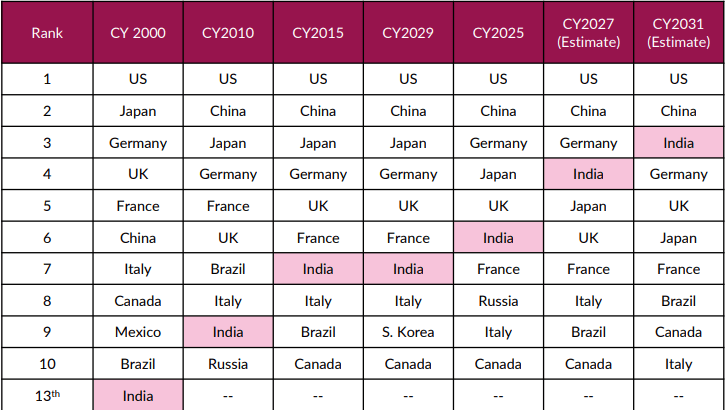
Source link: https://www.imf.org/external/datamapper/datasets/WEO
A vibrant capital market has played a key role in fuelling India's economic growth. India has climbed from being the 13th largest economy in the 2000s to being projected to be the 6th largest by 2025 and potentially even higher by 2031. This remarkable scaling is underpinned by a transition from a savings to an investment economy, facilitated by a strong, well-regulated capital market. This emergence has opened new avenues for fundraising through equity and bond issuances, accelerating India's economic growth trajectory.
The Digitisation Catalyst: Bridging Gaps, Building Trust
The ultimate catalyst for India's financialization of savings is digitisation. The "JAM Trinity" - Jan Dhan (financial inclusion), Aadhaar (digital identity), and Mobile Connectivity (universal access) has fundamentally reshaped the landscape.
- Digital Identity at Scale: Aadhar, with over 1.44 billion IDs generated, provides a foundational layer for secure and verifiable digital transactions.
- Mobile Connectivity: With over 1.25 billion wireless telephone subscribers, India boasts a massive digitally connected populace.
- UPI Revolution: The Unified Payments Interface (UPI) has revolutionized digital payments, making instant, paperless, and cashless transactions ubiquitous, significantly increasing retail investor participation. Currently, there are over 49 crore UPI users.
- Data Exchange: Digital data exchange further streamlines processes, enhancing efficiency and reducing friction.
(Source : JAM https://www.pib.gov.in/ PressReleasePage.aspx?PRID=2235812®=3&lang=2, UPI Users July 2025 -https://static.pib.gov.in/WriteReadData/specificdocs/documents/2025/jul/doc2025720589601.pdf ; Active Demat Account - https://www.valueresearchonline.com/learn/stocks/207-million-demat-accounts-india-real-investing-gap/ ; Mutual Fund Subscribers - https://www.angelone.in/news/mutual-funds/mutual-fund-industry-adds-7-64-lakh-unique-investors-in-february-total-crosses-6-09-crore
This digital infrastructure has addressed critical frictions of geography, time, and cost, allowing fintech platforms like Zerodha, Groww, Upstox, and Dhan to flourish, expanding the reach and efficiency of the capital market.
The Rise of the Demat Account and Mutual Fund Ecosystem
The impact of digitisation is nowhere more evident than in the explosive growth of demat accounts. From a moderate growth phase driven by traditional brokers, the market saw a "sharp uptick led by discount brokers and heightened retail participation post-COVID." Demat account grew at a steady rate from 2015 to 2020; and digitisation helped explosive growth since 2021 till 2025. While demat penetration is still below global peers (10.6% in India vs ~60% in USA), this significant gap represents a massive white space for future growth.
Simultaneously, the mutual fund industry has witnessed robust growth. India's mutual fund AUM hit ₹76.81 lakh crore by March 2026, growing at a 22% CAGR since March 2016. SIP contributions have been particularly impressive, growing at a 26% CAGR to reach ₹3.49 lakh crore for FY26. The penetration ratio of MF AUM to GDP has doubled from 9% in FY15 to approximately 20% in FY25, though it still remains significantly lower than the global average of ~64%. This underscores the immense potential for further expansion.
(Source: Ace MF & AMFI; Data as of March 2026.)
Increasing Participation, Deepening Markets
Retail and institutional participation has boomed, driving exchange volumes. Equity volume grew at a 23% CAGR, and derivative volume at an astonishing 67% CAGR since FY16. India is emerging as one of the most dynamic retail investor markets globally, characterized by:
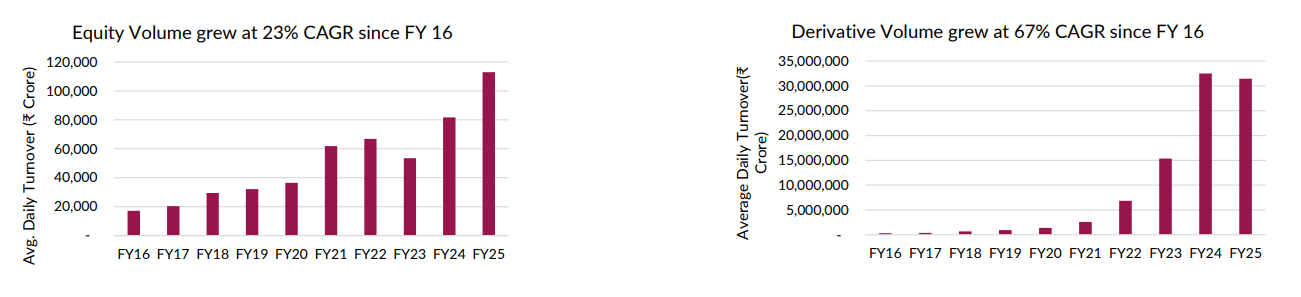
(Source links: https://www.mstock.com/articles/indian-stock-market-evolution#growing-relevance-of-capital-markets-in-indias-economy ; *Median age https://www.valueresearchonline.com/stories/228193/rs-100-lakh-crore-opportunity/ )
- Rapid Adoption: Quick embrace of new financial products and platforms.
- Youthful Investor Base: A median age of 32 years in 2024, indicating long-term engagement potential.
- High Digital Trust: Confidence in online platforms and digital transactions.
- Strong Regulatory Frameworks: SEBI’s strong surveillance and risk management frameworks foster trust and stability.
- Growing Financial Awareness: Increasing education and understanding of investment opportunities.
The Road Ahead: Towards a Billion Investors
India is moving toward Capital Market 3.0 — a faster, more digital and inclusive market that could bring investing to a billion people as savings shift from physical to financial assets.
To participate in this structural growth, consider the Axis Nifty Capital Markets Index Fund NFO — an open‐ended index fund that invests in the constituents of the Nifty Capital Markets TRI and aims to deliver the index’s total return (subject to tracking error).

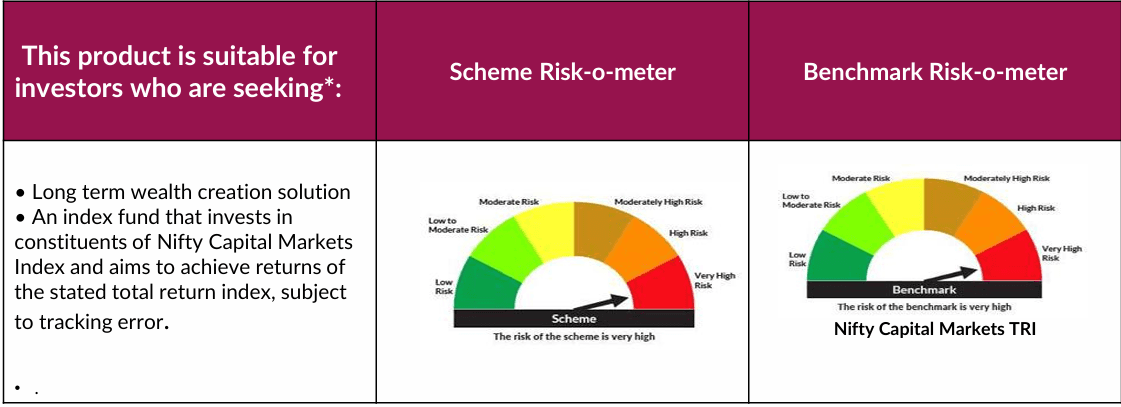
Investors should consult their financial advisors if in doubt about whether the product is suitable for them. The product labelling assigned during the New Fund Offer is based on internal assessment of the Scheme Characteristics or model portfolio and the same may vary post NFO when actual investments are madeAxis Bank Ltd, is not liable or responsible for any loss or shortfall resulting from the operation of the schemeMutual Fund Investments are subject to market risks, read all scheme related documents carefully.
Calculator
View All