India's ₹6.81 lakh crore defence budget. What it means for defence sector mutual funds in 2026


The defence theme has been one of the more talked-about investment ideas in India over the past few years. The Nifty India Defence Index returned 91.1% in 2023, 56.5% in 2024, and 20% in 2025. (Data as of 28-Feb-2026. Axis Mutual Fund Research). The question here is whether the opportunity is still ahead or whether those returns have already captured most of the value.
The ₹6.81 lakh crore defence budget for FY 2025-26 can be very well a starting point when making the case for this sector. (https://www.pib.gov.in/PressReleasePage.aspx?PRID=2191937®=3&lang=2). But a large budget number by itself doesn't tell you much because what matters is how the money is allocated, whether it translates into earnings for listed companies, and if those earnings can keep growing from here.
Where the mega defence budget is allocated
India's defence budget grew from ₹2.53 lakh crore in FY 2013-14 to ₹6.81 lakh crore in FY 2025-26. (https://www.pib.gov.in/PressReleasePage.aspx?PRID=2191937®=3&lang=2). That's roughly 2.6 times growth over those twelve years, compounding at about 9% annually. As of FY 2026-27 estimates, defence accounts for approximately 15% of all central government expenditure, making it the single largest ministry allocation ahead of roads, railways, and home affairs. (https://www.indiabudget.gov.in/).
The budget breaks down roughly as follows:
- Revenue expenditure (salaries, fuel, maintenance): 45.7%
- Capital outlay on defence services: 23.6%
- Defence pensions: 26.4%
- Ministry of Defence civil expenses: 4.2%
Capital outlay is the portion that directly funds new procurement, platforms, and systems. It's what creates order books for manufacturers. Of this capital budget, the government has mandated that roughly 75% be reserved for domestic industry. (https://www.indiabudget.gov.in/).
So while the headline number is ₹6.81 lakh crore, what actually flows toward listed Indian companies is the domestic capital procurement slice, and tracking whether that slice is growing and being deployed consistently tells you far more than what the headline figure alone will.
Global outlook for the defence sector
Global military spending crossed USD 2.7 trillion in 2024 and this growth has been broad-based. (https://www.sipri.org/sites/default/files/2025-04/2504_fs_milex_2024.pdf). Heightened geopolitical tensions like the Russia-Ukraine war and ongoing instability across the Middle East have pushed countries to expand defence budgets in a more structured and with a long-term view.
For Indian defence companies, this changes the demand environment as their earnings are no longer purely a function of domestic procurement decisions. While domestic orders remain important, export demand is also becoming relevant.
Domestic policy is changing how the sector operates
The increase in spending is only one part of the shift. The structure of participation has also changed.
- 100% private participation is allowed.
- Up to 74% FDI is permitted.
- There is an active push toward defence exports.
This is reflected in production numbers too. India’s defence production has increased from around ₹80,000 crores in FY20 to ₹1,50,000 crores in FY25. The government has set a target of ₹3,00,000 crores by 2029. (https://www.pib.gov.in/PressReleasePage.aspx?PRID=2191937®=3&lang=2).
India now exports defence equipment to more than 85 countries. The product mix includes missile systems such as Akash, BrahMos, and Pinaka, along with aircraft, radars, naval platforms, and components.
Domestic spending provides the base but export growth adds another layer of demand that can scale over time.
What does this mean for investors?
Getting exposure to this theme through individual stocks requires ongoing tracking of order books, procurement announcements, export licences, and government policy. For most of us, that's just not practical. A mutual fund tracking a defence themed index follows a defined methodology for a more manageable entry point.
This is where the Nifty India Defence Index comes in. The index uses a clear eligibility screen: companies must either belong to Aerospace and Defence, Explosives, Shipbuilding and others.Weighting is by free-float market cap with a 20% cap per stock, and rebalancing happens every six months.
By market capitalisation, the index is roughly 55% large cap, 26% mid cap, and 19% small cap.
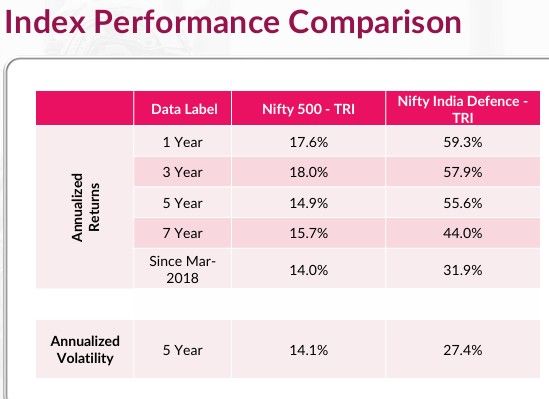
The index's historical performance numbers are (Data as of 28-Feb-2026. Axis Mutual Funds):
- 1-year return: 59.3%
- 3-year CAGR: 57.9%
- 5-year CAGR: 55.6%
Most defence companies operate in segments where competition is genuinely thin. Getting into this industry takes years of regulatory approvals, specialised technology, and government trust that doesn't transfer overnight. That gives established players predictable order books and pricing power that may not exist in most sectors.At the same time, valuations remain sensitive to:
- Changes in government policy
- Delays in large projects
- Shifts in geopolitical conditions Apart from this, the five-year annualised volatility of the defence index is 27.4%, compared to 14.1% for the Nifty 500 TRI, so the higher returns have not come without the higher risk. (Source: https://www.niftyindices.com/ Data as of 28-Feb-2026.Past performance may or may not be sustained in the future. The above information should not be construed as promise, guarantee or forecast of returns. Table / Charts mentioned above are used to explain the concept and is for illustration purpose only.Nifty India Defence Index start of index values from 28-Mar-2018.)
How to Access This Theme: Axis Nifty India Defence Index Fund
Axis Nifty India Defence Index Fund is an open-ended passive fund that tracks the Nifty India Defence TRI, giving you exposure to the sector without requiring you to make individual stock calls.
Key features of the fund:
- Passive Index Tracking: You get almost what the index holds as it mirrors the Nifty India Defence TRI without a fund manager deciding what goes in or out.
- Sector-Focused Exposure: Puts your money into a curated basket of Indian defence and allied companies, so your allocation stays focused on the theme.
- Low-Cost Structure: Because there is no active stock picking involved, the cost of running this fund stays lower than most actively managed alternatives.
- Simple Access: You don't need to track procurement contracts or read defence ministry circulars. The index does the selection work, and the fund simply follows it.
Conclusion
India's defence sector is backed by a budget that has grown 2.6x over a decade, a manufacturing base that is producing at scale, and export demand that is still in its early stages. In this evolving landscape, Axis Nifty India Defence Index Fund offers a structured way to capture the sector’s growth trajectory. The policy direction is clear, the companies are executing, and the runway ahead is long. 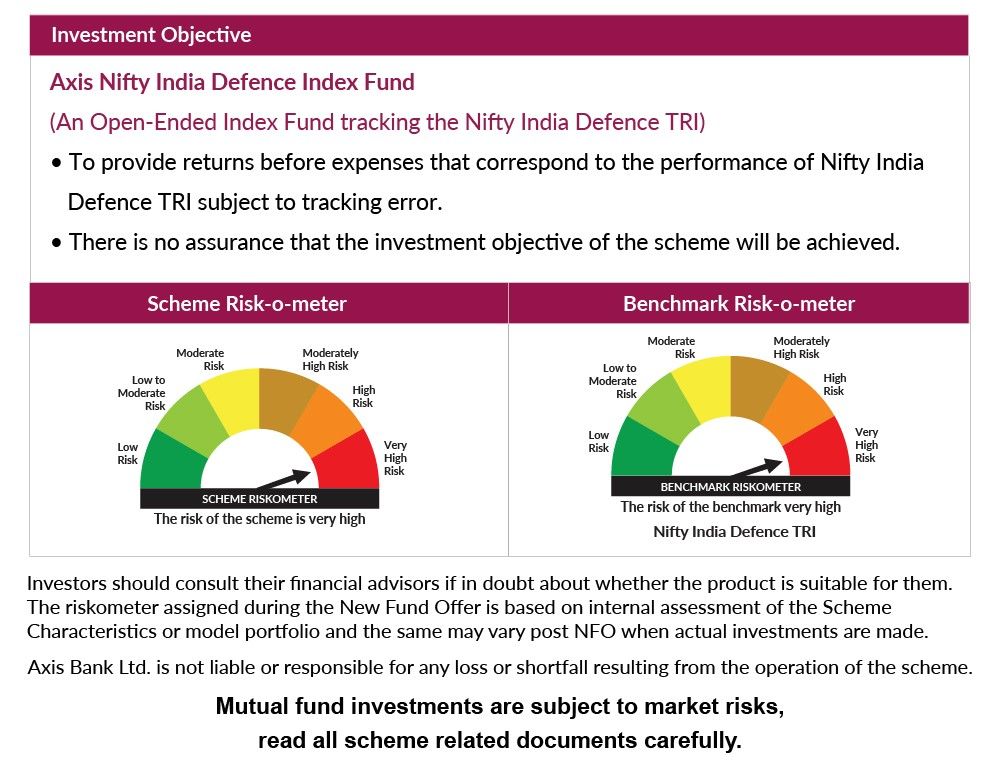
Calculator
View All