Axis Nifty EV & New Age Automotive Index Fund

banner-image

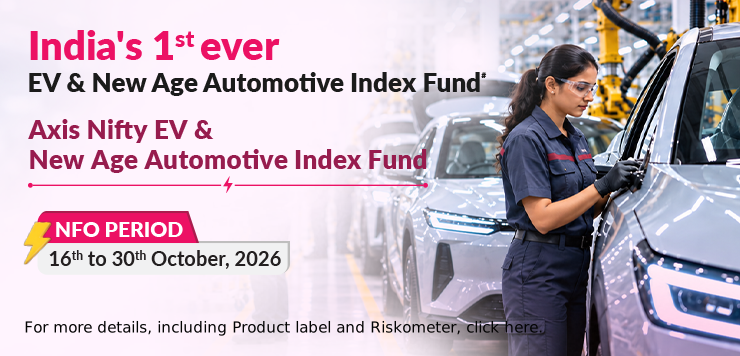
INDIA'S 1st Ever EV & NEW AGE AUTOMOTIVE INDEX FUND*

NFO Period 16th to 30th October 2026.

Over 25 lakh EVs were registered in India last year. Is your portfolio ready for India's electric mobility shift?1

India's electric mobility revolution is already on the road. India's full EV ecosystem starting from EV makers, battery companies, component suppliers and automotive technology businesses in one place. For the first time, you can own that entire chain in one index fund.

Axis Nifty EV & New Age Automotive Index Fund

An open-ended scheme replicating/tracking Nifty EV & New Age Automotive Index.

~1,000x
growth in India's EV registrations in a decade1
9 stages
Complete EV value chain, from battery to vehicle makers
Performance
7 Year CAGR: 23.8% vs 14.2%(Nifty 500 TRI)^^
NFO Period
16 October – 30 October 2026

INVEST IN INDIA'S EV GROWTH STORY

THE EV SHIFT IN INDIA

India's EV growth story is no longer a forecast. It is visible on roads across the country.

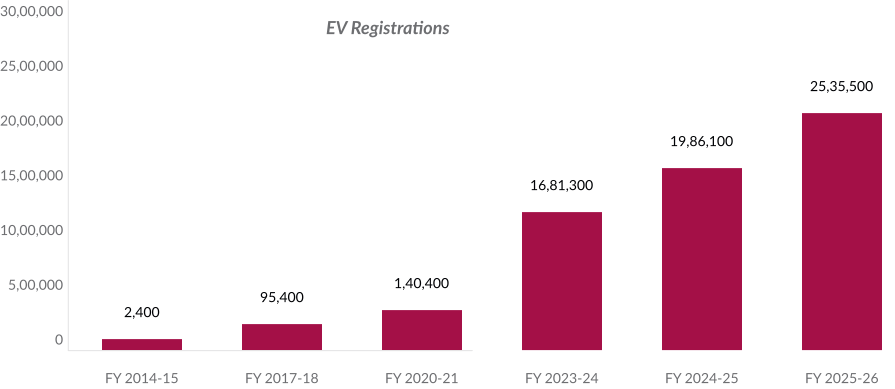
From 2,400 EVs a decade ago to 25 lakh last year1

A decade ago, an electric vehicle in India was something you pointed at. Last year, India registered 25,35,500 EVs, roughly 1,000 times more than in FY 2014-15.1 The auto you took this morning, the scooter your neighbour bought, the e-bus on your route: the shift is no longer coming. It's here.

EV Registerations

WHY NOW?

Three forces are accelerating India's shift to electric mobility.

Macro pressure. Simple economics. A better experience.

1. Energy security: reducing India's oil dependence

India meets about 88% of its crude oil needs through imports. In May 2026 the rupee touched a record low of ₹96.84 per US dollar, which made every barrel more expensive. About 52% of India's crude imports passed through the Strait of Hormuz in early 2026, a route exposed to conflict. And every $10 rise in crude adds $14–16 bn to India's annual oil import bill.2

2. Better economics: lower running costs and improving affordability3

Parameter Electric vehicle Petrol/diesel vehicle
Energy turned into motion 85–90% ~30%
Running cost: scooter ₹0.25–0.35 per km ₹2–2.5 per km
Running cost: car ₹1.5–2.0 per km ₹8–10 per km

Add 93% lower battery prices since 2010, 5% GST on EVs, lower registration fees and home charging overnight, and the total cost of owning an EV keeps improving.3

3. Smarter mobility: connected, software-defined vehicles

A modern EV is quieter, quicker, software-defined and upgradeable over the air. Cars are becoming computers on wheels. Every new feature arrives as an update, and that changes what people expect from every vehicle they buy next.

INDIA'S EV PENETRATION OPPORTUNITY

The ladder is long, and India has only started climbing.

EV share of new sales: FY26 actual vs HSBC estimates.4

Segment FY26 FY30e FY35e
Three-wheelers 31.6% 60% 80%
Two-wheelers 6.8% 18% 40%
Light commercial vehicles 3.0% 12% 35%
Passenger vehicles (cars) 4.4% 16% 25%
Buses (MHCV) 8.1% 15% 25%
Trucks (MHCV) 0.2% 1.5% 5%

The opportunity in one line: today, fewer than 1 in 20 new cars in India is electric. On HSBC's estimates, that could be 1 in 4 by FY35. Every rung India climbs means new demand for the vehicle makers, battery makers and component suppliers in this index.4

GLOBAL EV ADOPTION IS ACCELERATING

One in four new cars sold globally is already electric5

1 in 4
new cars sold worldwide in 2025 were electric
1 in 2
new cars globally could be electric by 2035
380 km
average EV range, against a ~40 km daily drive
50%
lower lifetime emissions than a petrol car

Electric share of global passenger vehicle sales6

2020 2026 2030 (outlook)
~5% 27% 60%

Every vehicle category is electrifying (global share of sales)7

Category 2026 2035 (outlook)
Two- & three-wheelers 46% 57%
Buses 43% 74%
Passenger cars 27% 52%
Vans & trucks 13% 50%

INDIA IS BUILDING THE EV ECOSYSTEM

A nation and an industry, investing together.

Policy support. ₹1.4 lakh Cr of carmaker capex. A battery ecosystem taking shape8

India's carmakers are investing for an electric future8

~₹1.4 lakh Cr combined capex announced over the next 3–5 years by four leading carmakers

Maruti Suzuki ₹77,500 Cr FY27–FY31: new plants can build EVs, hybrids and petrol cars on the same line
Hyundai India ₹45,000 Cr By FY30; first locally made electric SUV by 2027
M&M ₹12,000 Cr FY25–FY27, dedicated to its electric SUV business
Tata Motors ₹4,000–5,200 Cr/yr 7–9% of revenue; EV output rising from 10,000 to 15,000 a month

Index Snapshot

Do not depend on one winner. Invest across the EV ecosystem. The opportunity extends far beyond vehicle makers.

Remember the smartphone boom? Brands rose and fell, but every phone needed a battery, a chip and a screen. EVs work the same way. Whichever badge wins your garage, the same families of companies build what's inside. This fund invests across that chain:9

Stage Part of the chain Where India stands
1 Raw materials & mining Import-dependent
2 Battery materials & chemicals Building up
3 Battery cells Early stage
4 Battery packs, BMS & recycling Building up
5 Motors & power electronics Building up
6 Auto components Well placed
7 Software & electronics Well placed
8 Charging & battery swapping Building up
9 Vehicle makers (OEMs) Well placed

The insight: much of the value chain is still being built in India. That's where the next phase of growth could come from, and this index spreads across all of it.

WHAT DOES THE NIFTY EV & NEW AGE AUTOMOTIVE INDEX INCLUDE?

Index Componentsi

40%
Vehicle makers
10%
Battery Makers
20%
Component Makers
9%
Raw Material Suppliers
14%
Advance Automotive Technology
8%
Eligible firm under PLI, FAME, etc

Top 10 constituentsi

Company Weight
Maruti Suzuki India Ltd. 8.1%
Mahindra & Mahindra Ltd. 8.0%
Sona BLW Precision Forgings Ltd. 4.1%
Samvardhana Motherson International Ltd. 4.0%
Bosch Ltd. 4.0%
Sansera Engineering Ltd. 4.0%
Reliance Industries Ltd. 4.0%
CG Power & Industrial Solutions Ltd. 4.0%
UNO Minda Ltd. 3.9%
KEI Industries Ltd. 3.9%
Top 10 total 48.0%

Market-cap mixi

44%
Large cap
29%
Mid cap
27%
Small cap

INDEX PERFORMANCE

Different journey, stronger destination.

Nifty EV & New Age Automotive TRI vs Nifty 500 TRI^

17.9%
5-year CAGR vs 9.0% for Nifty 500 TRI^
23.8%
7-year CAGR vs 14.2% for Nifty 500 TRI^
3.2x
₹1 lakh in Apr-2018 → ~₹3.3 lakh by Sep-2026^

Annualised returns (CAGR)^

Period Nifty EV & New Age Automotive TRI Nifty 500 TRI
1 Year 0.5% −2.0%
3 Years 12.8% 9.5%
5 Years 17.9% 9.0%
7 Years 23.8% 14.2%
Since inception* 15.1% 12.3%
Volatility (5Y, annualised) 17.3 14.4

The index outperformed the Nifty 500 TRI in 6 of 8 calendar periods since inception^

Why This Fund ?

India's 1st*

India's 1st*

The first index fund tracking the Nifty EV & New Age Automotive TRI. So you can invest like any mutual fund, without a demat account.

Own the race, not one racer

Own the race, not one racer

The fund spans vehicle makers (37.2%), EV components and equipment (35.6%) and EV enablers (27.3%). You don't have to guess which brand wins, because you own the companies behind all of them.i

More than battery EVs

More than battery EVs

The index also covers hybrids, hydrogen and software-defined vehicles. Every new way India moves.

A shift that's already on our roads

A shift that's already on our roads

India's EV registrations grew from 2,400 in FY 2014-15 to over 25 lakh in FY 2025-26, about 1,000 times in a decade.1

The economics now favor EVs

The economics now favor EVs

An e-scooter costs ₹0.25–0.35 per km to run, against ₹2–2.5 for petrol. Battery prices have fallen 93% since 2010, which makes EVs viable at scale.3

A strong long-term track record

A strong long-term track record

Over 5 years, the index returned 17.9% a year against 9.0% for the Nifty 500 TRI. Over 7 years it was 23.8% against 14.2%, and it was ahead in 6 of 8 calendar periods.^

Diversified by design

Diversified by design

Each vehicle maker is capped at 8% and every other stock at 4%. The fund spans large (44%), mid (29%) and small caps (27%), and the top 10 holdings make up about 48%.i

A nation building the industry

A nation building the industry

Four leading carmakers have announced about ₹1.4 lakh Cr of investment. PLI schemes worth ₹25,938 Cr (auto) and ₹18,100 Cr (battery cells) are backing it, and PM E-DRIVE now runs till March 2028.8

Simple, transparent and easy to start

Simple, transparent and easy to start

It's passive and rules-based, with no fund-manager stock picking. You can start a SIP or lumpsum from ₹100.

EV index fund vs EV ETF: Understand the Difference

Axis Index Fund EV ETFs on the same index
Demat account Not needed Required
SIP from ₹100 Yes Via broker, or a separate FoF
Price End-of-day NAV Market price; can differ from NAV
Best for SIP & first-time thematic investors Traders with demat accounts

Is This Fund For You ?

icon

Starting out (25–35)

icon

Building wealth (35–50)

icon

Auto & tech enthusiasts

icon

Thematic builders

icon

Long-term wealth creators

icon

SIP investors

icon

Passive investing enthusiasts

icon

First-time thematic investors

How To Invest ?

Start investing in four simple steps.

1
KYC
Already an Axis MF investor? Skip this. New? Finish KYC online in minutes.
2
Choose
SIP or lumpsum, from ₹100 (then in multiples of ₹1).
3
Invest
Before the NFO closes on 30 October 2026. Units are allotted at ₹10.
4
Track
The fund reopens for continuous buying and selling after allotment.

Why Axis AMC ?ii

₹4 lakh Cr+
overall AUMii
1 crore+
active investor accountsii
40+
passive funds across equity, debt & commodities

A committed leadership team focused on passive funds.

Research led by professionals with 15+ years of experience at NSE, BSE and S&P Dow Jones Indices.

Continuous research and data insights on established and emerging investment ideas.

Regulatory Info

Axis Nifty EV & New Age Automotive Index Fund

(An Open-Ended scheme replicating/tracking Nifty EV & New Age Automotive Index)

Benchmark:Nifty EV & New Age Automotive TRI

  • Long term wealth creation solution
  • An index fund that invests in constituents of Nifty EV & New Age Automotive TRI and aims to achieve returns of the stated total return index, subject to tracking error.

*Investors should consult their financial advisers if in doubt about whether the product is suitable for them.

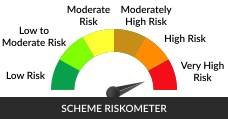
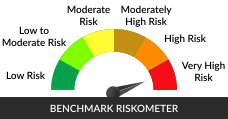
(The risk-o-meter assigned during the New Fund Offer is based on internal assessment of the Scheme Characteristics or model portfolio and the same may vary post NFO when actual investments are made)

Investors are advised to refer to the Statement of Additional Information (SAI) for details of the Axis MutualFund, Standard Risk Factors, Special Considerations, Tax and Legal issues and other general informationon www.axismf.com

riskometer
riskometer

Fund Manager

Mr. Nandik Malik
Mr. Rohit Gautam

Documents

Schemes pdf
Schemes pdf
Schemes pdf
Schemes pdf

FAQs

How can I invest in EV stocks in India?
up arrow

The simplest way is through an EV index fund. Axis Nifty EV & New Age Automotive Index Fund invests in companies across India's EV value chain (carmakers, battery makers, auto-component, electrical and auto-tech companies) in one fund. You can start with ₹100 through SIP or lumpsum, without a demat account.

What is an EV mutual fund?
arrow

Which mutual fund invests in electric vehicle companies?
arrow

What is the future of the EV sector in India?
arrow

Why are EVs growing so fast in India?
arrow

What is Axis Nifty EV & New Age Automotive Index Fund?
arrow

Is this India's first EV & New Age Automotive index fund?
arrow

When does the Axis Nifty EV & New Age Automotive Index Fund NFO open and close?
arrow

What is the minimum investment in the Axis Nifty EV & New Age Automotive Index Fund?
arrow

Can I start a SIP in an EV fund with ₹100?
arrow

Who manages Axis Nifty EV & New Age Automotive Index Fund, and what is the exit load?
arrow

What is the Nifty EV & New Age Automotive Index?
arrow

What does 'New Age Automotive' mean?
arrow

Which stocks are in the Nifty EV & New Age Automotive Index?
arrow

Is the Nifty EV & New Age Automotive Index only about car companies?
arrow

How diversified is the Nifty EV & New Age Automotive Index?
arrow

What are the Nifty EV & New Age Automotive Index returns?
arrow

EV index fund vs EV ETF: which is better for me?
arrow

Index fund vs actively managed fund: what's the difference?
arrow

How is the Nifty EV & New Age Automotive Index different from Nifty Auto Index?
arrow

What are the risks of investing in EV funds?
arrow

How much should I invest in a thematic fund?
arrow

How are EV index funds taxed in India?
arrow

How do I invest in the Axis Nifty EV & New Age Automotive Index Fund NFO?
arrow

Can I switch from another Axis MF scheme into this Axis Nifty EV & New Age Automotive Index NFO?
arrow

Can I invest in Axis Nifty EV & New Age Automotive Index Fund after the NFO closes?
arrow

How can I invest in EV stocks in India?

The simplest way is through an EV index fund. Axis Nifty EV & New Age Automotive Index Fund invests in companies across India's EV value chain (carmakers, battery makers, auto-component, electrical and auto-tech companies) in one fund. You can start with ₹100 through SIP or lumpsum, without a demat account.

What is an EV mutual fund?

An EV mutual fund invests in companies linked to electric vehicles and new age automotive companies. An EV index fund, like this one, does so passively by tracking an index, here the Nifty EV & New Age Automotive TRI, rather than relying on a fund manager's stock picks.

Which mutual fund invests in electric vehicle companies?

Axis Nifty EV & New Age Automotive Index Fund invests in the constituents of the Nifty EV & New Age Automotive TRI: about 38 companies such as vehicle makers, battery makers, auto-component suppliers and auto-tech firms. It is India's first index fund on this index*.

What is the future of the EV sector in India?
India registered ~25 lakh EVs in FY 2025-26, up from 2,400 in FY 2014-15. HSBC estimates EV share of new car sales could rise from 4.4% in FY26 to 25% by FY35, and of two-wheelers from 6.8% to 40%. Estimates are not guaranteed.1
Why are EVs growing so fast in India?
Three reasons: economics (an e-scooter costs ₹0.25–0.35/km to run vs ₹2–2.5 for petrol)3, energy security (India imports ~88% of its crude) and policy support (PLI schemes, PM E-DRIVE and 5% GST on EVs).2
What is Axis Nifty EV & New Age Automotive Index Fund?

An open-ended index fund that aims to provide returns, before expenses, corresponding to the Nifty EV & New Age Automotive TRI, subject to tracking error. There is no assurance that the objective will be achieved.

Is this India's first EV & New Age Automotive index fund?

Yes. It is India's first index fund tracking the Nifty EV & New Age Automotive TRI. Until now, the index was accessible only through ETFs and ETF fund-of-funds that need a demat account or add a second layer of costs.

When does the Axis Nifty EV & New Age Automotive Index Fund NFO open and close?

The NFO opens on 16 October 2026 and closes on 30 October 2026. Units are allotted at ₹10 during the NFO. After that, the scheme reopens for continuous purchase and redemption at NAV.

What is the minimum investment in the Axis Nifty EV & New Age Automotive Index Fund?

₹100, and in multiples of ₹1 thereafter, for both SIP and lumpsum, during the NFO and after it.

Can I start a SIP in an EV fund with ₹100?

Yes. You can start a SIP of ₹100 in Axis Nifty EV & New Age Automotive Index Fund. A SIP helps average your purchase cost over time, which suits a thematic fund that can be volatile.

Who manages Axis Nifty EV & New Age Automotive Index Fund, and what is the exit load?

The fund is managed by Mr. Nandik Malik and Mr. Rohit Gautam. The exit load is 0.25% if redeemed or switched out within 15 days of allotment, and nil thereafter.

What is the Nifty EV & New Age Automotive Index?

An NSE thematic index of Nifty 500 companies involved in electric and new-age vehicles, batteries, components, raw materials and automotive technology. It spans across such as vehicle makers, battery makers, component makers, raw material suppliers, advanced automotive technology & eligible firm under PLI, FAME etc.

What does 'New Age Automotive' mean?

Beyond battery-electric vehicles, it covers hybrid vehicles, hydrogen fuel-based vehicles, green hybrids and autonomous-vehicle technology, along with the companies that supply their parts and software.

Which stocks are in the Nifty EV & New Age Automotive Index?
As of 30-Sep-2026, the top 10 included Maruti Suzuki, Mahindra & Mahindra, Sona BLW, Samvardhana Motherson, Bosch, Sansera Engineering, Reliance Industries, CG Power, UNO Minda and KEI Industries, together about 48% of the index. The scheme may or may not hold these in future.i
Is the Nifty EV & New Age Automotive Index only about car companies?
No. Vehicle makers are less than 40% of the index. The rest is spread across battery makers, auto-component suppliers, electrical equipment, materials and auto-tech companies.i
How diversified is the Nifty EV & New Age Automotive Index?
Each vehicle maker is capped at 8% and every other stock at 4%. The index spans large caps (44%), mid caps (29%) and small caps (27%), and the top 10 make up about 48%.i
What are the Nifty EV & New Age Automotive Index returns?
As of 30-Sep-2026, the Nifty EV & New Age Automotive TRI delivered 17.9% CAGR over 5 years vs 9.0% for the Nifty 500 TRI, and 23.8% over 7 years vs 14.2%. Past performance may or may not be sustained in future.^
EV index fund vs EV ETF: which is better for me?

Both track the same index. An index fund needs no demat account, allows ₹100 SIPs and transacts at end-of-day NAV. An ETF trades on the exchange at market price and needs a demat account. Index funds generally suit SIP investors; ETFs suit those who trade.

Index fund vs actively managed fund: what's the difference?

An index fund follows a published index methodology with no discretionary stock picking, which typically means lower costs and full transparency. An actively managed fund relies on a fund manager's choices.

How is the Nifty EV & New Age Automotive Index different from Nifty Auto Index?
Nifty Auto Index is made up mainly of vehicle makers. The Nifty EV & New Age Automotive Index caps vehicle makers below 40% and adds battery makers, component suppliers, electrical equipment and auto-tech, covering the wider value chain.i
What are the risks of investing in EV funds?
Concentration in one theme, battery-import restrictions, subsidy reductions, input costs and technology shifts. The index is more volatile than the broad market (5-year volatility 17.3 vs 14.4 for Nifty 500 TRI).^
How much should I invest in a thematic fund?

Thematic funds are usually a limited satellite portion of an equity portfolio, alongside a diversified core. The right amount depends on your goals and risk profile; consult your financial adviser.

How are EV index funds taxed in India?
As an equity-oriented scheme, it follows equity mutual fund tax rules. Under current laws, gains held over 12 months are long-term (12.5% above ₹1.25 lakh a year); gains within 12 months are short-term (20%). Tax laws can change; consult your tax adviser.iii
How do I invest in the Axis Nifty EV & New Age Automotive Index Fund NFO?

Through the Axis Mutual Fund website or app, your mutual fund distributor, or supported investment platforms during the NFO period. Complete KYC, choose SIP or lumpsum, and invest before the NFO closes.

Can I switch from another Axis MF scheme into this Axis Nifty EV & New Age Automotive Index NFO?

Yes, switches are allowed from eligible Axis MF schemes, subject to the source scheme's exit load and tax rules.

Can I invest in Axis Nifty EV & New Age Automotive Index Fund after the NFO closes?

Yes. It is open-ended, so after allotment it reopens for continuous purchase and redemption at the applicable NAV, through SIP or lumpsum.

Disclaimer

*First Fund in the Index Category tracking the Nifty EV & New Age Automotive Index as on 7 October, 2026

1Roads Reimagined: The Rise of India's Electric Vehicles Ecosystem https://www.pib.gov.in/PressReleaseDetail.aspx?PRID=2294688


^Source: Nifty Indices. Data as of 30-Sep-2026. Past performance may or may not be sustained in the future. The above information should not be construed as promise, guarantee or forecast of returns. Table / Charts mentioned above are used to explain the concept and is for illustration purpose only. *Nifty 500 – TRI is rebased to 1000 as of 02-Mar-2018 for comparison purpose. https://www.niftyindices.com/indices/equity/Thematic-indices/nifty-ev-new--age-automotive


2https://sansad.in/getFile/annex/270/AU4124_gs8kNF.pdf?source=pqars | Crude at $115 per barrel could raise India's oil import bill by $64 billion Business Standard | Reference Rate Archive | Official Website of Reserve Bank of India | Home | Petroleum Planning & Analysis Cell | Government of India


3FOTW #1360, Sept. 16, 2024: A Typical EV is 87%–91% Efficient Compared to 30% for a Conventional Gas... https://www.energy.gov/cmei/vehicles/articles/fotw-1360-sept-16-2024-typical-ev-87-91-efficient-compared-30-conventional https://www.goldmansachs.com/insights/articles/electric-vehicle-battery-prices-falling


4Source: HSBC Estimates, Vahan


5Sources: IEA analysis based on country submissions and data from ACEA, EAFO, EV Volumes and Marklines. https://about.bnef.com/insights/clean-transport/new-record-lows-for-battery-prices/ https://iea.blob.core.windows.net/assets/8995fa9b-3808-4440-ae33-b32f4f240adb/GEVO-2026_Webinar-28-forPDF.pdf https://iea.blob.core.windows.net/assets/e75c9a13-3753-4677-933f-c7f9ae38cfdb/EVBatterySupplyChainSustainability.pdf


6https://about.bnef.com/insights/clean-transport/electric-vehicle-outlook/#executive-summary-preview


7Note: All figures are BloombergNEF's outlook for 2026 and 2035. Percentages are the electric vehicle share of new sales in each segment. Includes battery electric and plug-in hybrid vehicles.; https://about.bnef.com/insights/clean-transport/electric-vehicle-outlook/#executive-summary-preview


8Maruti Suzuki Capex to Rise 40% to ₹14,000 Crore in FY27 | Autocar Professional; Hyundai Motor lines up ₹45,000 cr investment in India: 26 launches in 2030 | Business Standard; Mahindra & Mahindra to invest ₹12,000 crore on EV expansion over the next three years | CNBC TV18; Tata Motors EV Investment 2026: Production Expansion and Future Plans | CarBike360


9Source: India EV Value Chain Report Internal (2026). Table / Charts mentioned above are used to explain the concept and is for illustration purpose only


iSource: Nifty Indices, Data as of 30-Sep-2026. Past performance may or may not be sustained in the future. The above information should not be construed as promise, guarantee or forecast of returns. Table / Charts mentioned above are used to explain the concept and is for illustration purpose only. The Stocks/Sectors/Industries mentioned herein are for general assessment purpose only and not a complete disclosure of every material fact. It should not be construed as investment advice to any party. * Entire list of basic industry: https://www.niftyindices.com/indices/equity/Thematic-indices/nifty-ev-new--age-automotive


iiPast performance may or may not be sustained in the future. The above information should not be construed as promise, guarantee or forecast of returns. Table / Charts mentioned above are used to explain the concept and is for illustration purpose only. Date: 31 Aug 2026. https://www.axismf.com/1/5/464/555/2819/Q1.pdf https://www.axismf.com/1/5/464/4333/Scheme_AUM_Geography_August_2026_409a67abff.pdf


iiiFor individual nature of tax implications, investors are requested to consult their tax advisors before investing.

Axis Bank Ltd. is not liable or responsible for any loss or shortfall resulting from the operation of the scheme.

Mutual Fund investments are subject to market risks, read all scheme related documents carefully.