Why is Now the Right Time to Invest in the Defence Index Fund


Seen through the lens of national security and government spending, defence was seen as a slow-moving space. Today, it is turning into something different. It is becoming a mix of manufacturing, technology, exports, and policy support all working together. The confluence of these factors is transforming the defence sector from a theme to a long-term structural growth story. With the upcoming launch of the Axis Nifty India Defence Index Fund, investors have a unique opportunity to capitalise on this transformation.
A Shifting Global Order
In the last decade, the global geopolitical landscape has been gradually shifting from a unipolar world order to a multipolar world order. This has economic and budgetary implications which matter in investing.
Conflicts like the one in Russia-Ukraine and the Middle East have forced nations to rethink their security investments. As a result, defence budgets are rising across Europe and Asia. In 2024, global military spending reached a record $2.7 trillion (https://www.sipri.org/publications/2025/sipri-fact-sheets/trends-world-military-expenditure-2024). Compared to the previous decade, many countries are anchoring their spending at a higher percentage of GDP in the coming decade. For example, NATO’s commitment to spend 5% of GDP on defence by 2035 (https://www.nato.int/en/what-we-do/introduction-to-nato/funding-nato) is likely to precipitate a multi-year investment cycle.
What does this mean for India? Two things:
- India itself is likely to continue to spend more on defence.
- Other countries will also look for new suppliers instead of relying on a few traditional partners.
This creates an opportunity for Indian companies not just locally, but globally.
“Aatmanirbhar Bharat”: Building More at Home
While global factors provide the backdrop, India’s internal policy shift is becoming more and more visible in the order books of defence companies. The following data points indicate that the vision of “Aatmanirbhar Bharat” is translating to structural reforms.
- Domestic Reservation: In the FY 2026-27 Union Budget, around 75% (https://www.pib.gov.in/PressReleseDetailm.aspx?PRID=2191937®=3&lang=2) of the capital acquisition budget is reserved for the domestic industry. This is a far cry from the era of import dependence.
- Defence Production: India’s defence production has nearly doubled in the last five years, rising from ₹79,071 crore in FY20 to ₹1,50,590 crore in FY25 (https://www.pib.gov.in/PressReleasePage.aspx?PRID=2154551®=3&lang=2). The government’s goal is for this figure to hit ₹3,00,000 crore by 2029.
- FDI and Private Participation: By allowing 100% private participation and up to 74% FDI through the automatic route, the government is enabling competition in the defence sector. Competition drives efficiency in research, capital expenditure, and supply chains as companies compete for contracts to deliver efficient execution.
The 30X Surge: India as a Defence Exporter
An insight that might come as a surprise to many investors is the emergence of India as an exporter. India’s defence exports surged from just ₹686 crores in FY14 (https://www.pib.gov.in/PressReleseDetailm.aspx?PRID=2114546®=3&lang=2) to a record ₹23,622 crore in FY25 (https://www.pib.gov.in/PressReleasePage.aspx?PRID=2191937®=3&lang=2). India now exports military equipment to 85+ nations and that includes major powers like the US and France.
From BrahMos missiles and Akash air defence systems to Dornier aircrafts and advanced light helicopters, Indian platforms are gaining global acceptance. Because exports bring in foreign revenue and are not dependent on Indian government spending, they bring in an additional source of growth. The government’s goal of reaching ₹50,000 crores in exports provides a sustainable roadmap for companies in this index.
Defence is becoming a Technology Story
When one thinks of defence, the images that pop in our minds are tanks, ships, and aircraft. But modern warfare is changing. It is moving towards technology-led systems. Companies in the Nifty India Defence index are leaders in systems like avionics, radars, and precision guided munitions. With the PLI scheme for drone components, India is also building a “drone for every soldier ecosystem.”
As technology businesses have higher margins and scale better over time, this shift is likely to create strong competitive advantage for companies in the index.
The Strategic Moat and Past Performance
Defence businesses often have what is called a “moat” in investing. They have specialized intellectual property rights and long-term contracts that provide excellent revenue visibility. New players often face high barriers to entry in regulations, and capital and technical requirements. This loads the die in favour of the incumbents.While not indicative of future results, past performance reflects this strength.
- The Nifty India Defence TRI boasts an exceptional 59.3% return over the last year (as of Feb 2026). This outperforms the broader Nifty 500 TRI (17.6%) by a factor of 3.35.
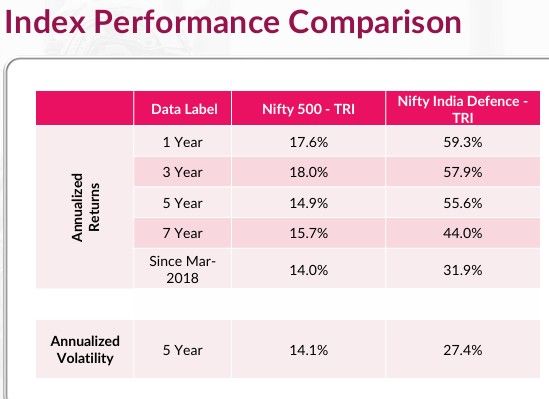
Data as of 28-Feb-2026. Past performance may or may not be sustained in the future. *Nifty India Defence Index start of index values from 28-Mar-2018. (https://www.niftyindices.com/Factsheet/Factsheet_NiftyIndiaDefence.pdf )
Having said that investors must also consider that the fund carries a higher risk than a diversified equity fund. If the defence sector undergoes a downturn, the entire fund is affected as no other sectors can cushion the fall. Defence projects are also complex and delays in tender approvals and technical milestones can lead to lumpy earnings and sudden swings in defence stocks. Therefore, the defence index has also experienced sharper drawdowns during a correction.
Why an Index Fund?
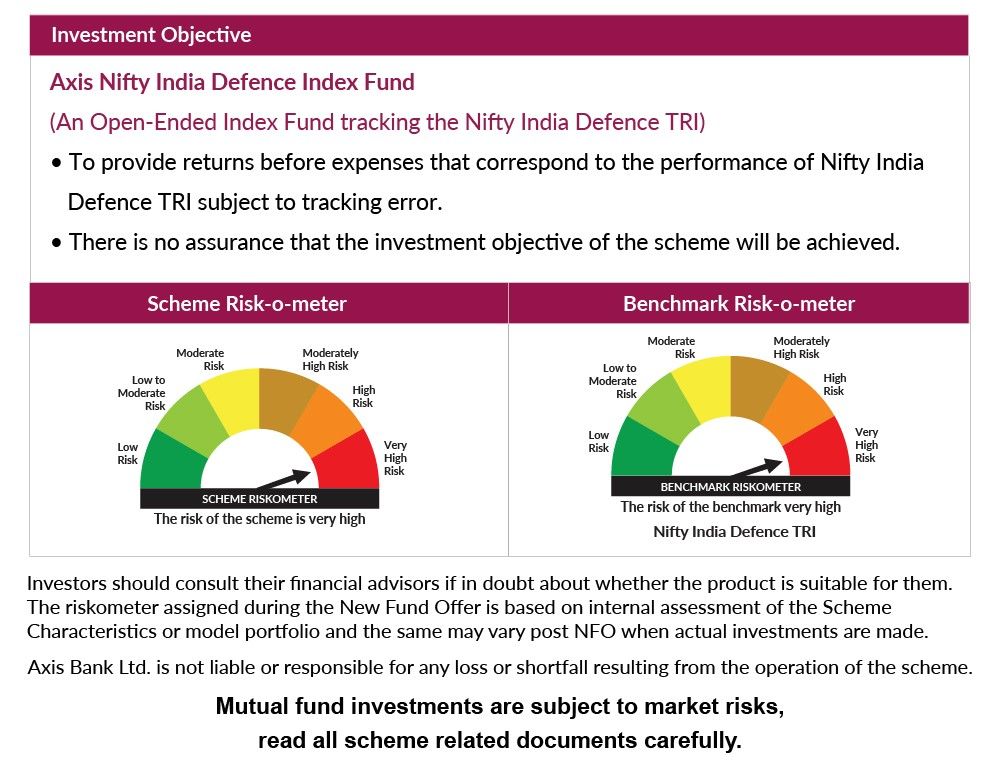
Picking an individual winner in defence can be complex. It requires deep expertise in government procurement cycles and technical specifications. Axis Nifty India Defence Index Fund offers the following benefits which are similar to the benefits of a sector-concentrated index fund.
- Rules-based: The fund simply tracks the Nifty India Defence TRI. So, there’s no fund manager bias.
- Diversification: Exposure is to a basket of 18+ stocks, reducing the risk to a single company or a project.
- Low Cost: As a passive fund, it offers a cost-effective route to a specialized theme.
- Capped Exposure: Stock weights are capped at 20%. This ensures the fund isn’t overly concentrated in just one or two names.
Conclusion
The defence sector is benefitting from a rare triple-engine growth coming out of rising domestic budgets, aggressive indigenisation, and growth in global exports. What makes this interesting is that the drivers here are not temporary. They are structural which gives the story longevity.
Over time, as more of this spending stays within the country and Indian companies scale both locally and globally, the sector could become a more meaningful part of the broader market landscape.
For those looking to invest in this shift, Axis Nifty India Defence Index Fund offers a simple, diversified, and rules-based way to track the sector and help stay aligned with its direction.
Calculator
View All