


Floater Funds: Floater Mutual Funds Benefits, Returns, Types, and More


Mutual fund investors build their investment portfolios based on their risk tolerance. Investors know that diversification mitigates investment risk. Generally, investors invest in equity mutual funds and debt mutual funds to diversify their investment portfolios adequately. While investors with a very high risk appetite have an equity heavy portfolio, investors with moderate to low risk appetite invest more in debt funds.
Among the several investment options available under debt funds, investors can consider diversifying their portfolios with floater funds.
What is a floater fund?
A floater fund is an open ended debt mutual fund scheme that invests a majority of the investible corpus in floating rate instruments. As per SEBI guidelines, floater funds must invest a minimum of 65% of their overall assets in floating rate instruments. A floating rate instrument can vary from a corporate bond to a company loan or any debt instrument that has floating interest rates. Unlike fixed income securities, floating securities do not have a fixed coupon rate. any fluctuations in the interest rates determine the interest offered by these floating securities.
A slight change in the repo rates can also affect the rate of interest offered by floating rate instruments. The repo rates are regulated by the Reserve Bank of India (RBI). When the repo rates increase, the underlying floating securities of a floater fund may also deliver high interest rates.
Floater funds are available in SIP and lumpsum investment option
Retail investors who consider floater funds for their investment portfolio can either make a lumpsum investment or opt for a Systematic Investment Plan. A lumpsum investment is made by investors at the beginning of the investment cycle. The minimum investment sum might be a bit high and not every investor might be comfortable with investing such a high amount.
Such investors can consider investing in floater funds via SIP. Systematic Investment Plan or SIP is a simple and easy way to invest in mutual fund schemes. Once investors have decided on which floater fund to invest in, they can opt for the SIP investment option. In SIP, investors have to decide on a fixed sum which they want to invest in floater funds and then decide a date on which this sum will be deducted every month. If they automate their transactions, every month on the fixed date the predetermined SIP sum is debited from the investor’s savings account and they can buy floater fund units in quantum with the sum invested. New investors can even use the SIP calculator, a free online tool where they will come to know the approximate returns which their investments can offer in a limited time frame.
Axis Floater Fund – A debt scheme by Axis Mutual Fund
An open ended debt scheme predominantly investing in floating rate instruments. A relatively high interest rate risk and moderate credit risk.. The investment objective of this fund is to offer regular income over short term investment horizon by predominantly investing in floating rate instruments (including fixed rate instruments converted to floating rate exposures using swaps/derivatives).
Benefits of investing in Axis Floater Fund
Rates are likely to rise: We are at the cusp of a new growth cycle as well as at the bottom of the interest rate cycle.
Market rates adjust quickly: Markets tend to price changing economic conditions and policy actions swiftly.
Managing interest rate risk: Floating rate strategies aim to manage interest rate risks by investing in bonds where the coupon is linked to market movements.
Portfolio structure: The investment portfolio of this fund will have a mix of 80% AAA/SOV and 20% AA to capture opportunities across the debt market.
Who should consider investing in Axis Floater Fund?
Investors looking to park short term surplus funds or those looking to limit the interest rate risks in their debt portfolio may consider investing in Axis Floater Fund.
Investors should consult their financial advisers if in doubt about whether the product is suitable for them.
Axis Floater Fund
(An open ended debt scheme predominantly investing in floating rate instruments. A relatively high interest rate risk and moderate credit risk.)
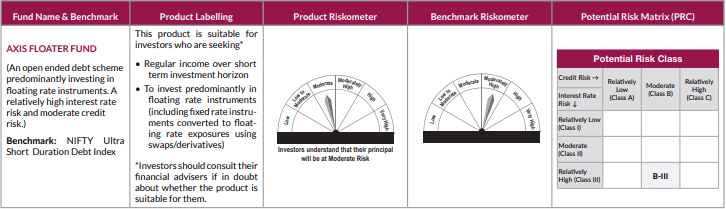
* Investors should consult their financial advisers if in doubt about whether the product is suitable for them.
Mutual Fund Investments are subject to market risks, read all scheme related documents carefully.
Calculator
View All