Axis Nifty500 Low Volatility 50 Index Fund: How the Index Strategy Works


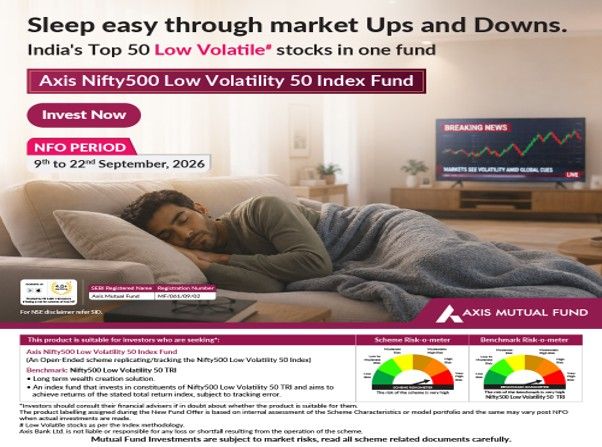
Most equity investors know the feeling: the market drops 5% in a week, your portfolio turns red, and the temptation to sell becomes hard to resist. What if you could stay invested in India's growth story but with fewer of those stomach-churning swings? That's the idea behind the Axis Nifty500 Low Volatility 50 Index FundAxis Nifty500 Low Volatility 50 Index Fund, whose NFO is open from 9 to 22 September 2026. Let's break down exactly how its index strategy works - and why 'boring' stocks can be surprisingly powerful.
First, what does 'low volatility' actually mean?
Volatility is simply how much a stock's price jumps around. A stock that swings from ₹100 to ₹140 and back to ₹90 in a year is highly volatile. A stock that drifts quietly between ₹100 and ₹112 is low volatility.
Think of two cars on the same highway heading to the same city. One weaves aggressively between lanes, braking and accelerating hard. The other cruises steadily. Both may arrive around the same time, but the second ride is far calmer - and you're less likely to jump out halfway. Low volatility investing is that second car.
Importantly, this is a rules-based, factor strategy. No fund manager is making gut calls about which stocks to buy. A fixed set of rules picks the stocks automatically, which keeps the approach transparent and predictable.
How the 50 stocks are chosen - step by step
The index follows a clear, mechanical recipe. Here's the full selection process:
1. Start with a universe. The pool is the Nifty 500 - India's 500 largest listed companies.
2. Filter out illiquid names. Stocks that score poorly on liquidity (i.e., are hard to trade) are removed. This ensures the index only holds stocks that can be bought and sold easily.
3. Score every stock on stability. Each remaining stock gets a'Low Volatility Score.' This is calculated as the inverse of the standard deviation of the previous one year's daily price returns (log-normal). In plain English: the calmer a stock's price has been over the past 12 months, the higher its score.
4. Pick the top 50. The 50 highest-scoring (i.e., calmest) stocks make the cut.
5. Weigh them by calmness, not just size. Unlike a normal Nifty 50 fund - where the biggest company automatically gets the biggest weight - here stocks are weighted by their Low Volatility Score combined with free-float market cap. To avoid over-concentration, no single stock can exceed the lower of 5% or 5× its free-float market-cap weight.
6. Refresh twice a year. The index rebalances semi-annually, in June and December. If a once-steady stock becomes jumpy, it can be dropped; a newly calm stock can enter. This keeps the portfolio 'true to label' over time.
A quick example to tie it together
Imagine three Nifty 500 stocks over the past year:
• Stock A: price barely moved, ranging ₹200–₹215 → low standard deviation → high score ✅
• Stock B: swung wildly from ₹200 to ₹300 to ₹180 → high standard deviation → low score ❌
• Stock C: moderate movement → medium score
The index would favour Stock A, likely skip Stock B, and Stock C would depend on where it ranks against the other 497 companies. Multiply this across the whole Nifty 500, take the 50 calmest, and you have the portfolio.
What the portfolio actually looks like
Because the rules chase stability rather than hype, the resulting basket is well-spread and quality-tilted. The fund is predominantly large-cap (~80%), with a meaningful mid-cap (~18%) and a small small-cap (~1%) allocation.*
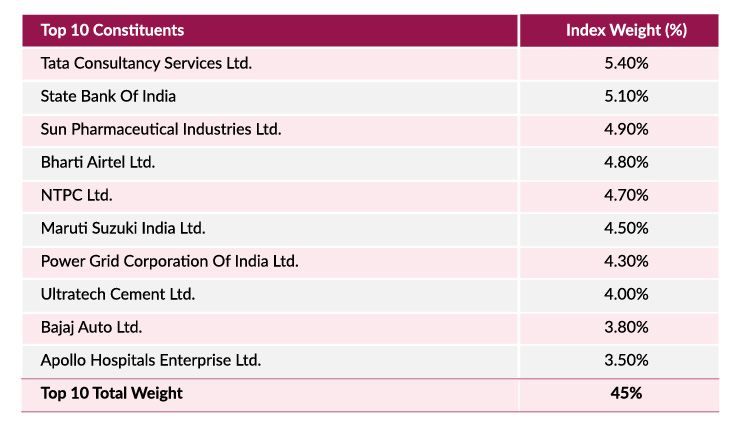
The top 10 stocks make up roughly 45% of the index, with no single name dominating - the largest, TCS, sits at just 5.4%:*
Sector-wise, it's led by Healthcare (~22%), Consumer Discretionary (~18%) and Financial Services (~13%), followed by Utilities (~11%), IT (~9%), FMCG (~8%), Commodities (~7%), Energy (~7%) and Telecom (~5%). This spread across defensive and stable sectors is what helps smooth the ride.*
*Source : https://www.niftyindices.com/indices/equity/strategy-indices/nifty500-low--volatility-50 Date : 11-JAug-2026;. The Stocks/Sectors mentioned herein are for general assessment purpose only and not a complete disclosure of every material fact. It should not be construed as investment advice to any party. The stocks are constituents of Nifty500 Low Volatility 50 Index.
Does calmer mean lower returns? Not historically.
This is the counter-intuitive part - sometimes called the'low volatility anomaly.' Conventional wisdom says higher risk = higher reward. But history for this index tells a different story.
₹1 lakh invested in the Nifty500 Low Volatility 50 TRI in March 2005 would have grown to about ₹31.33 lakh by July 2026 - a CAGR of 17.5%, versus 14.2%# for the broader Nifty 500 TRI over the same period. So the calmer index didn't just match the market; it out-compounded it, and with less risk.
# Performance is calculated using Total Return Index (TRI), with zero cost / expenses and tracking difference / error. Source :Nifty indices. Date : 31-Jul-2026; Past performance may or may not be sustained in the future. The above information should not be construed as promise, guarantee or forecast of returns. Table / Charts mentioned above are used to explain the concept and is for illustration purpose only. Rebased to 1000 both as of 31-Mar-2005.
The tortoise-and-hare of investing
There's a neat analogy on the page: high-beta stocks are like the hare - they sprint ahead in bull runs and everyone talks about them, but they crash hardest and can need years just to recover. The low-volatility approach is the tortoise - it moves less, falls less, and quietly compounds ahead over a full cycle.
For disciplined SIP investors, this steadiness compounds beautifully. A ₹10,000 monthly SIP over 20 years (₹24 lakh invested) would have grown to about ₹1.41 crore at a 15.5% XIRR, versus roughly ₹1.04 crore (13.0% XIRR) for the Nifty 500 TRI.ii
Past performance may or may not be sustained in the future.
iiSource: Nifty Indices Data as 31-Jul-2026, for SIP returns, monthly investment of INR 10,000 invested on the first business day of every month has been considered. Performance is calculated using Total Return Index (TRI), with zero cost / expenses and tracking difference / error. Past Performance may or may not be sustained in future. The above information should not be construed as promise, guarantee or forecast of returns. https://www.niftyindices.com/indices/equity/strategy-indices/nifty500-low--volatility-50
Conclusion
The Axis Nifty500 Low Volatility 50 Index Fund isn't trying to pick tomorrow's multibagger. Its strategy is deliberately simple: from the Nifty 500, mechanically select the 50 calmest, most liquid stocks, weight them toward stability, and rebalance twice a year. The result is a diversified, transparent, rules-based equity core that has historically delivered competitive returns with a smoother ride - and you can start with as little as ₹100.
Invest Now - Axis Nifty500 Low Volatility 50 Index Fund
For disclaimers refer banner above
Mutual Fund investments are subject to market risks, read all scheme related documents carefully.
Calculator
View All