Axis Flexi Cap Fund - An open ended dynamic equity scheme investing across large cap, mid cap, small cap stocks


Retail investors who astutely seize long term investment opportunities may find success in the long run. Long term investment allows retail investors to reshuffle their portfolio so that it remains in sync with the changing market trends. Schemes like multi cap funds and flexi cap funds are designed in such a way that they try to adapt to changing market cycles by realigning their portfolio from time to time. A plus point about these two funds is that the fund manager can maneuver across the mid cap, small cap, and large cap stocks to leverage the current performance of any of these market caps. Although both multi cap and flexi cap funds can build their investment portfolio by investing in top stocks across market capitalization, there are a few intricacies that distinguish multi cap funds from flexi cap funds.
What is the difference between flexi cap funds and multi cap funds?
Investors seeking exposure across market capitalization through a single investment can consider both flexi cap funds and multi cap funds. Multi cap funds have been around for a while whereas flexi cap funds are a new addition to the equity scheme category.
As per SEBI guidelines, multi cap funds have a minimum exposure of 25% each to small cap, mid cap, large cap stocks. This is a mandate which all multi cap fund managers must comply with. The asset allocation to each of the market caps should remain a minimum of 25% throughout.
| Flexi Cap | Multi Cap | |
| Exposure to equity markets | Flexi cap funds have a minimum of 65% exposure to equity and equity related instruments | Multi cap funds have a minimum of 75% exposure to equity and equity related instruments |
| Asset allocation across market capitalization | No mandate, the fund manager has the leeway to invest across market cap. There is no restriction of investing a minimum percentage in any of the market cap stocks | As per market regulator SEBI’s mandate, the scheme must invest a minimum of 25% each in small cap, mid cap, and large cap stocks |
| Fund manager investment leeway | The fund manager can invest in any stock that has growth potential to lower overall investment risk through diversification | The fund manager must ensure that the investment portfolio is maintained with a minimum exposure of 25% to each market cap |
Understanding flexi cap funds
Flexi cap funds are open-ended equity schemes that invest a majority of their investible corpus across market capitalization. SEBI, in its circular dated November 6, 2020, defines a flexi cap fund as “An open-ended dynamic equity scheme investing across large cap, mid cap, small cap stocks”. The investment portfolio of a flexi cap fund must have a minimum exposure of 65% towards equity and equity related instruments.
Flexi cap funds allow retail investors to have exposure to stocks of companies listed across the market cap. This style of investing may allow investors to gain leverage from all three caps while mitigating the overall investment risk. Retail investors usually diversify their investment portfolio by investing in schemes that specifically target different market caps. They can now get this diversification by investing in one single flexi cap fund scheme.
These instruments offer more diversification than the standalone small cap, mid cap, and blue-chip funds which invest a majority of their funds in stocks of companies belonging to a particular market capitalization only. Flexi cap fund managers can access companies with growth potential irrespective of their size and invest in such credible stocks of companies belonging to various market segments, sectors, and industries.
Things to consider before investing in flexi cap funds
A unique investment portfolio
Flexi cap funds aim to offer diversification by building an investment portfolio that will allow the fund to offer risk adjusted returns over the long term. The fund manager is actively involved in assessing the stocks allocated across the market cap and can switch between companies across market capitalization depending on which market is performing and which one is underperforming.
For example, if a particular cap in which the flexi cap fund has invested has been a consistent underperformer for a while, the fund manager can shift the allocation from that market cap to an alternative market cap that has been consistently delivering from time to time. This way, the flexi cap fund manager helps investors stay afloat giving them the benefit of remaining invested in a portfolio of well performing stocks and keeps exiting from stocks that have turned unattractive over time.
Investors can choose between direct and regular plan options
Here are the differences between direct flexi cap plans and regular flexi cap plans:
| Direct plan | Regular Plan | |
| Capital appreciation | Direct plans might be able to offer more capital appreciation since they have a low expense ratio | Regular plans may generate similar capital appreciation; however, a high expense ratio can take away a substantial amount from the capital gains in the long run |
| Net Asset Value (NAV) | Since the administrative and management costs for managing a direct plan are low, the NAV of a direct plan is usually low | Since there are commission fees involved with other administrative costs, the NAV of a regular plan can be slightly higher |
| Expense ratio | Flexi cap schemes with direct plan options have a relatively low expense ratio | Flexi cap schemes with regular plan option have a relatively high expense ratio |
Now that you know the differences between regular and direct plans, investors can make an informed investment decision when investing in flexi cap funds.
Investors can choose between SIP and lumpsum investment options
As equity markets are highly volatile, investors may choose to invest only a small quantum rather than exposing their entire investment sum to volatility at one time. They can do so by opting for a monthly SIP plan. Those who wish to buy more units at once can even make a lumpsum investment in flexi cap funds. However, to inculcate the discipline of systematic and regular investing, one can opt for a Systematic Investment Plan.
SIP or Systematic Investment Plan is not an investment scheme in itself but a mere tool to save and invest a fixed sum periodically. This way, investors can invest a small fixed amount regularly in flexi cap funds. There is no upper limit on SIPs and hence investors can invest depending on their risk tolerance and investment goals. They can even refer to the SIP calculator, a free online tool that lets investors get a rough estimate on the total capital appreciation that would be generated through SIP investing over a stipulated time period. They can even modify the SIP arrangement by increasing / decreasing their monthly SIP sum or they can even stop their SIP at any given time.
Axis Flexi Cap Fund – An equity scheme by Axis Mutual Fund
Axis Flexi Cap Fund is an open-ended dynamic equity scheme investing across large cap, mid cap, small cap stocks.
Investment objective
To generate long term capital appreciation by investing in a dynamic mix of equity and equity related instruments across market capitalizations. However, there is no assurance or guarantee that the investment objective of the Scheme will be achieved.
Benefits of investing in Axis Flexi Cap Fund
- Axis Flexi Cap Fund is a diversified equity fund that invests in companies across market capitalization
- This flexi cap mutual fund aims to offer investors an ideal mix of equities in an attempt to provide long term returns while minimizing risks associated with market volatility
- The scheme constantly endeavors to invest in quality companies with high growth prospects with an aim to deliver risk adjusted returns for investors
- Investing in a flexi cap fund is less risky as compared to a pure mid cap or a small cap fund, as the fund manager has the leeway to capture the best available opportunities in the market at that time
- Target long term goals such as children's education & their future, retirement, or any other long term growth that need a wealth creation plan
Liquidity offered by Axis Flexi Cap Fund
The Scheme offers Units for Subscription and Redemption at NAV based prices on all Business Days. Under normal circumstances, the AMC shall dispatch the redemption proceeds within 10 business days from the date of receipt of the request from the Unitholder.
Entry / Exit load
Entry load is not applicable for this investment product. Exit load for 10% of Axis Flexi Cap Fund investments is NIL if redeemed / switched-out within 12 months from the date of allotment. For the remaining investments, an exit load of 1% is applicable. If units are redeemed / switched –out after 12 months from the date of allotment, the exit load is NIL.
Direct / Regular plan
Plans available under the scheme:
Axis Flexi Cap Fund - Regular Plan: Regular Plan is available for investors who purchase / subscribe Units in a scheme through a Distributor.
Axis Flexi Cap Fund - Direct Plan: Direct Plan is only for investors who purchase / subscribe Units in a Scheme directly with the Fund and is not available for investors who route their investments through a Distributor.
Axis Flexi Cap Fund
An open ended dynamic equity scheme investing across large cap, mid cap, small cap stocks
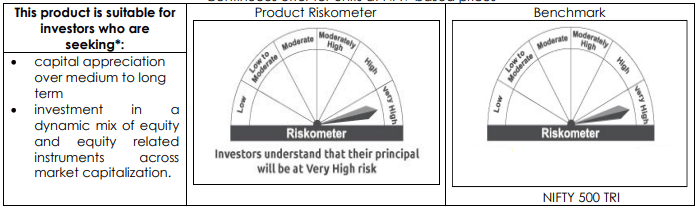
*Investors should consult their financial advisers if in doubt about whether the product is suitable for them
Market caps are defined as per SEBI regulations as below: a. Large Cap: 1st -100th company in terms of full market capitalization. b. Mid Cap: 101st -250th company in terms of full market capitalization. c. Small Cap: 251st company onwards in terms of full market capitalization.
Mutual Fund Investments are subject to market risks, read all scheme related documents carefully.
Calculator
View All