Atmanirbhar Bharat and the defence sector: A possible10-year investment opportunity you can't afford to miss


Most of us understand Atmanirbhar Bharat at a headline level: about self-reliance, Make in India, and reducing imports on a broader level. But when making an investment call based on this theme, more specific questions come forward: what has actually changed in how India does business? How do key sectors benefitting from this theme like defence companies earn money, how far along are we in this shift, and is the investment opportunity still ahead or has the market already priced most of it in?
When it comes to India’s defence sector, the simple answers to these questions require you to look at the production data, export trajectories, and order book composition. When you do that, the picture that emerges is of a sector in the middle of a real industrial transition, with meaningful earnings runway ahead alongside risks that belong in any reasonable assessment.
From Importer to Producer: What Has Actually Changed
For most of India’s post-independence history, we were among the list of world’s largest defence importers. Fighter jets, submarines, helicopters, and missile systems came largely from Russia, the US, France, and Israel. India had the budget and the demand but not the industrial capability to manufacture complex military systems at scale. The companies that could have built this capability didn’t have access to defence contracts, and foreign capital wasn’t allowed in. (https://www.vifindia.org/print/10696#:~:text=In%202022%20the%20IAF%20ranked,of%20The%20Great%20Chhatrapati%20Shivaji).
Over the past decade, the government opened defence manufacturing to private companies, allowed foreign investment, reserved a large portion of procurement spending for domestic suppliers, and built programmes. As a result, private listed companies are now part of the defence manufacturing base in a way they simply weren’t before.
The specific policy changes that made this possible: (https://www.pib.gov.in/PressReleasePage.aspx?PRID=2004475®=3&lang=2):
- 100% private sector participation is now permitted in defence manufacturing.
- FDI up to 74% is allowed under the automatic route.
- ~75% of the capital acquisition budget is reserved for domestic industry.
- The iDEX programme has brought over 600 startups and MSMEs into the defence supply chain.(https://www.pib.gov.in/PressReleasePage.aspx?PRID=1694844).
These developments represent India moving up the value chain in defence manufacturing with a clear trajectory visible in the production numbers.
Why This Is a 10-Year Cycle, Not a 2-Year Trade
Typical defence procurement timelines are long. A contract signed today for fighter jets or submarines is likely to generate revenues across the next five to ten years, with technology development and testing phases often running even longer.
These features make the defence sector behave fundamentally differently from consumer or technology themes, where cycles can be short and sentiment-driven as once export relationships are established, they tend to deepen over time rather than reset after each deal.
- Private sector share of production: Policy has actively opened doors for private manufacturers, and their share of total production has been climbing steadily.
- Global demand environment: NATO’s 5% of GDP defence commitment by 2035 creates sustained export tailwinds for Indian manufacturers. (https://www.govconexec.com/2026/02/global-defense-spending-2025/).
Exports add a second layer to this picture with numbers that show clear growth over time:
- India’s defence exports in FY2016-17: ₹1,521 crores
- India’s defence exports in FY2023-24: ₹23,622 crores
- Government target for defence exports by FY2028-29: ₹50,000 crores
- Number of countries India exports defence equipment to: 85+
What these export numbers alone do not capture is the nature of these relationships. Selling a complete weapons platform to a foreign government is a different commercial event from supplying a component. It reflects three specific shifts in how the sector is now operating:
- Capability build-out: Exporting full platforms signals that Indian companies have crossed a significant threshold in indigenous design, manufacturing, and system integration. These are capabilities that sovereign buyers evaluate carefully before signing contracts, and companies that have cleared this bar are now embedded in long-duration supply relationships.
- Market diversification: Export revenues from 85+ countries add a second demand source on top of the domestic procurement budget, giving Indian manufacturers two distinct order pipelines running simultaneously, each with its own multi-year contracting rhythm.
- Long-term engagement: When a country procures a platform, the commercial relationship extends well beyond the initial delivery through spare parts, maintenance, crew training, and eventual upgrades which typically runs two to three decades.
These three dynamics collectively point to why the sector's earnings runway extends well beyond a single budget cycle. The potential compounding happens across contract timelines, export relationships, and supply chain depth, all of which take years to fully build out and years more to fully reflect in earnings.
However, several risks to be kept in mind:
- Policy dependency: The government decides spending, procurement priorities, and export approvals. Any change in these can quickly affect order flow and visibility across the sector.
- Execution risk: Large defence contracts take time and involve multiple stages of delivery. Revenue from these contracts is usually spread over several years, and delays can affect timelines and cash flows.
- Valuation risk: This sector has already re-rated significantly. If earnings don't grow into what the market is pricing in, multiples can come down even if the underlying business is doing fine.
- Geopolitical sensitivity: A lot of the urgency around defence spending is tied to regional tensions. If that changes, procurement priorities can shift faster than most people expect.
Axis Nifty India Defence Index Fund: What It Is and Why It Matters
Getting exposure to the defence sector through individual stock selection requires tracking order books, procurement decisions, export approvals, and government policy across multiple companies simultaneously. For most investors that level of active monitoring isn’t realistic while managing a busy life already.
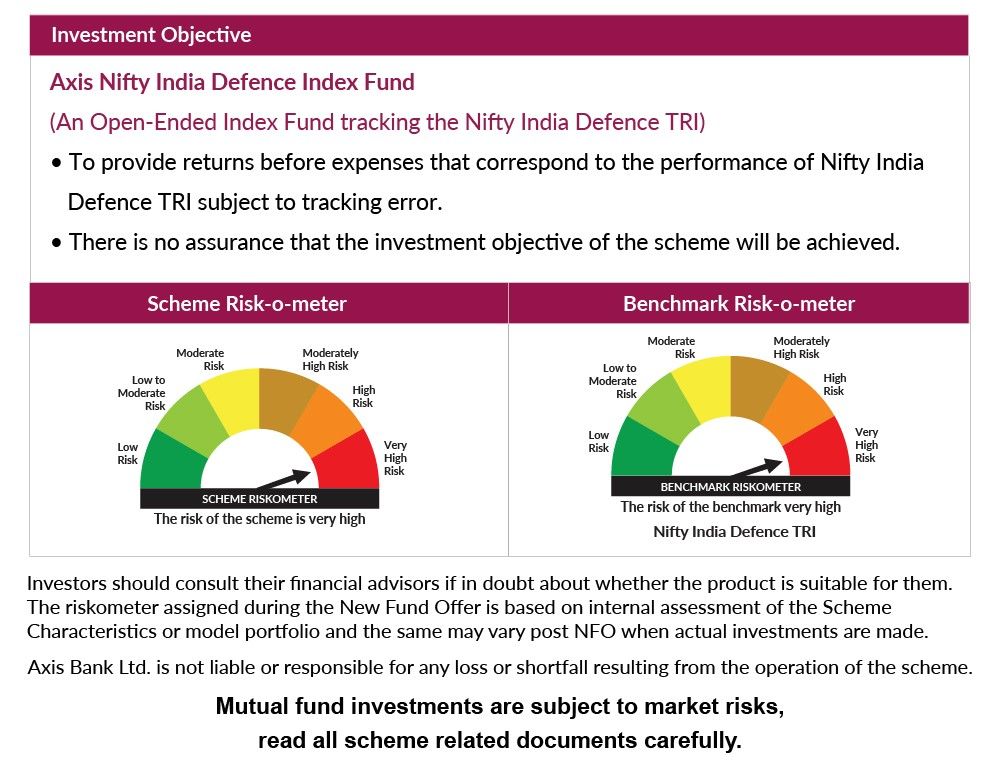
Axis Nifty India Defence Index Fund is a passive, open-ended fund designed to give you structured exposure to this sector through the Nifty India Defence TRI, without requiring you to make individual stock calls.
Why the index approach suits this sector:
- Transparent eligibility: You know exactly what you own as companies qualify only if they earn at least 10% of revenues from defence, or fall under aerospace, explosives, or shipbuilding.
- Diversified within the sector: The portfolio spans large-caps, mid-caps, and small-caps, so the exposure is spread across the sector rather than concentrated in a handful of well-known names.
- Disciplined rebalancing: The composition gets reviewed every six months, which means the fund stays current with how the sector is actually shifting rather than locking into a snapshot from years ago.
- Low cost: No active management means lower expenses, and over a holding period of several years, that difference potentially compounds in your favour.
Conclusion
India has gone from being one of the world's largest defence importers to building fighter jets, cruise missiles, and warships at home, and exporting them to over 85 countries. This shift did not happen overnight and is here to stay. Axis Nifty India Defence Index Fund offers a straightforward way to seamlessly stay invested in this theme.
Calculator
View All