What Makes ELSS A Better Tax Saving Tool?


Generally, investors find it difficult to ascertain which tax saving tools to invest in. Tax planning must be an integral part of one’s financial plan and is something that an individual must consider well in advance. The biggest mistake most individuals make is that they come to a realization only when they have to submit investment proof to their respective employers. During such moments, one may end up making an impulsive decision and invest in a tax saving instrument that might not be ideal for their investment needs.
One way to ensure that you not only seek tax benefits but also earn long term capital appreciation is by investing in Equity Linked Savings Scheme. Young investors prefer investing in ELSS as it not only brings down their gross taxable income but also gives them exposure to a diversified portfolio of stocks.
Let us find out what makes ELSS an ideal tax saving tool?
Saving Tax With Equity Linked Savings Scheme
Also referred to as ELSS, an Equity Linked Savings Scheme is a mutual fund that comes with dual benefits of a tax rebate and long term capital appreciation. An individual can invest up to Rs. 1.5 Lac every fiscal year in ELSS funds and claim for a tax deduction on the amount invested. ELSS funds has the shortest lock-in period among other tax saving instruments under section 80C of the Indian Income Tax Act 1961.
Features of ELSS
ELSS is a tax saving tool that predominantly invests in equity and equity related instruments of publicly listed companies. According to the capital market regulator SEBI, all ELSS funds must invest a minimum of 80% of their total assets in equity and equity related instruments. The fund may also invest the remaining of its assets in fixed income securities. ELSS has maximum exposure to the stock market making it a highly volatile investment scheme. However, it might be able to generate inflation adjusted returns in the long run.
ELSS has a lock-in period of three years. This is the shortest among other tax saving tools under Section 80C that have lock-ins ranging from 5 years to 15 years. Investors can redeem their investments as soon as the three year lock-in is over. However, there are no facilities for ELSS investors to redeem any sum during the lock-in period. Other tax saving instruments offer partial withdrawal facilities, but ELSS does not have any such facility.
One can make an investment in an ELSS scheme either through a one-time lump-sum investment or through the Systematic Investment Plan (SIP) option. A lump-sum investment is favored by those who have irregular income or by businessmen whose revenue is not determined and is seasonal. On the other hand, SIP is the easiest way to invest in ELSS funds and almost anyone can invest in this tax saver fund via SIP. That’s because you need not have a large surplus to commence your SIP investment journey. These days, the minimum monthly SIP investment criteria for ELSS is low enough for almost any individual to afford an investment in this tax saving scheme.
Since ELSS is a mutual fund that invests majority of its investible corpus in the equity market, one can even consider this fund for achieving their life’s long term financial goals. For example, if you have not planned for your retirement yet, you can continue to invest in ELSS till you retire and then use the accumulated corpus to enjoy retirement with financial freedom. One can also consider ELSS for long term wealth creation or any similar long term financial goal that needs systematic and long term investing.
Axis Long Term Equity Fund
An open ended equity linked saving scheme with a statutory lock-in of 3 years and tax benefit
Investment objective
To generate income and long-term capital appreciation from a diversified portfolio of predominantly equity and equity-related securities. However, there can be no assurance that the investment objective of the Scheme will be achieved.
Benefits
• Axis Long Term Equity Fund is a diversified equity linked saving scheme (ELSS) that invests in a mix of large caps and select midcaps
• The fund has a 3-year lock-in which is the lowest among other tax saving instruments
• A 3-year lock-in ensures that the money stays invested in equities and does not get perturbed by market ups and downs
• Being an ELSS scheme, the scheme comes with dual advantage of building wealth and saving tax
• Investors can target long term goals such as children’s education and their future, retirement, or any other long term financial plan
• Axis Long Term Equity Fund has a 3-year lock-in which is one of the lowest amongst other tax saving instruments
Axis Long Term Equity Fund
(An open ended equity linked saving scheme with a statutory lock-in of 3 years and tax benefit)
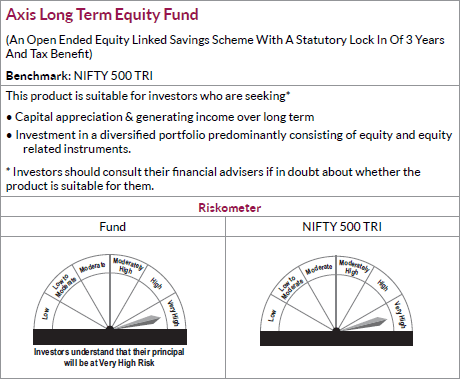
Investors should consult their financial advisers if in doubt about whether the product is suitable for them.
Mutual Fund Investments are subject to market risks, read all scheme related documents carefully.
Calculator
View All