How Union Budget 2026 Affects Equity, Debt & Hybrid Mutual Funds


Union Budget day often creates two immediate reactions among mutual fund investors:
- Equity investors wonder: Will markets rally or correct?
- Debt investors ask: Will yields rise or fall?
- Hybrid investors get confused: Should I stay balanced or shift?
Union Budget 2026 didn’t bring flashy surprises, but it has delivered something more meaningful:
- Long-term manufacturing and capex push
- Fiscal discipline with credibility
- Borrowing numbers that matter for debt markets
- Sectoral tailwinds for equities
Let’s break down how Budget 2026 impacts different mutual fund categories.
Budget 2026 Snapshot: Growth + Discipline Together
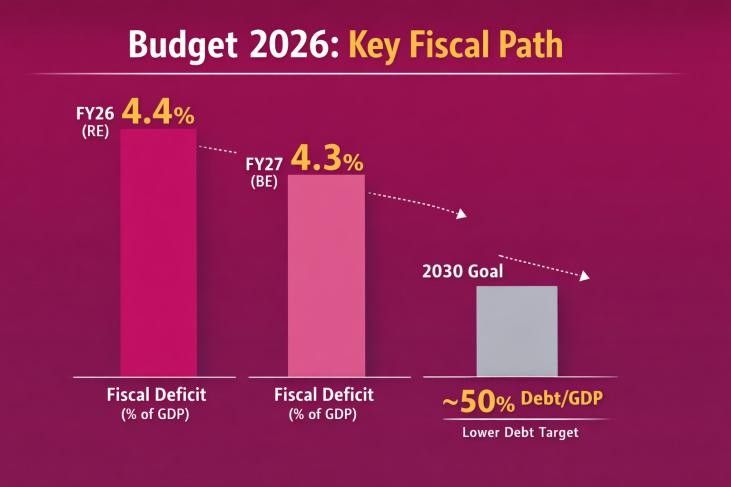
The government has anchored fiscal consolidation on realistic assumptions:
- Nominal GDP growth of ~10%
- Tax revenue growth of ~8%
- Fiscal deficit projected at 4.3% in FY27 (vs 4.4% in FY26)
- Public capex allocations increased by ~9%
1. Impact on Equity Mutual Funds
Equity markets reacted mildly because there were no major near-term catalysts.
But long-term, Budget 2026 strengthens equity themes through:
A. Manufacturing + Capex Tailwinds
Budget 2026 signals a decisive shift towards:
- Capacity creation
- Self-reliance
- Sunrise sectors
- Global supply chain competitiveness
Key capex allocation:
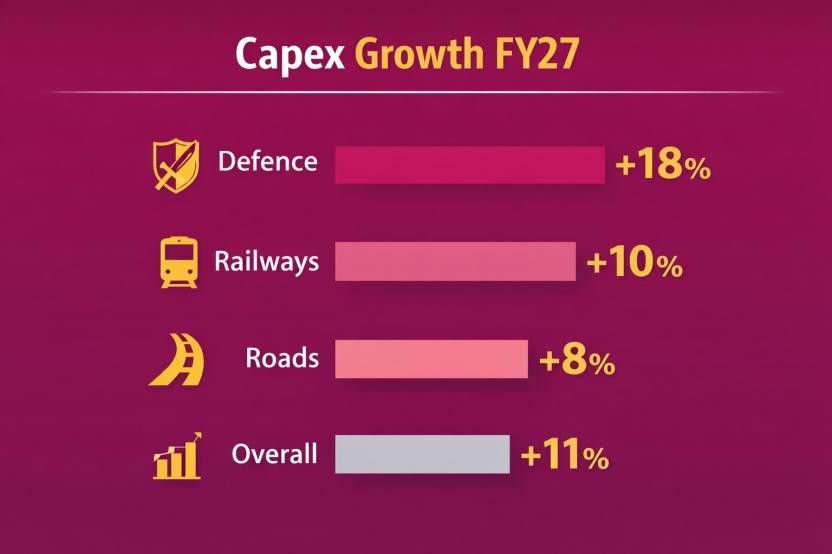
Government capex at ₹12.2 trillion (Estimated +11% YoY)
Equity funds that may benefit structurally:
- Large & Midcap Funds
- Manufacturing & Infrastructure-oriented themes
- Sector funds with industrial exposure (selectively)
B. Electronics & Semiconductor Boost
The Electronics Manufacturing Scheme outlay has increased sharply:
₹22,919 crore → ₹40,000 crore
ISM 2.0 also aims to strengthen the semiconductor ecosystem with R&D and full-stack Indian supply chains.
This improves long-term prospects for EMS, electronics and high-value manufacturing.
C. EV & Auto Supply Chain Support
PLI allocation tripled:
₹20 bn → ₹59.4 bn in FY27
Rare-earth corridors and battery customs duty extensions also support EV localisation.
D. Higher STT: Slight Near-Term Cost Impact
Budget increased STT on futures and options:
- Futures STT: 0.05% (from 0.02%)
- Options STT : 0.1% (from 0.0625% )
This is a minor negative for exchanges and short-term traders, but not meaningful for long-term equity fund investors.
2. Impact on Debt Mutual Funds
Debt investors should focus on one key Budget number:
Gross Borrowing is Higher Than Expected
- FY27 gross borrowing target: ₹17 trillion
- Market expectations: ₹16–16.5 trillion
What this means:
Higher borrowing typically leads to:
- Higher bond supply
- Slight upward pressure on yields
- Short-term volatility in long-duration debt funds
Debt Fund Strategy Post Budget 2026
| Debt Fund Category | Likely Impact |
| Short Duration Funds | More stable |
| Corporate Bond Funds | Benefit from carry |
| Long Duration/Gilt Funds | Volatility if yields rise |
| Target Maturity Funds | Depends on yield movement |
The fiscal consolidation path (4.3% deficit) provides medium-term comfort, but borrowing remains elevated.
3. Impact on Hybrid Mutual Funds
Hybrid funds sit at the intersection of equity growth and debt stability — and Budget 2026 supports that balance well.
Why?
- Equity gets structural manufacturing tailwinds
- Debt faces near-term yield pressure but macro credibility remains
- Market reaction muted, so hybrids offer smoother participation
Budget reinforces medium-term growth through capex continuity:
- Defence capex up ~17.6% YoY
- Roads and railways allocations rising again
Suitable hybrid options:
These categories help investors participate without needing to time equity cycles or rate cycles.
Final Takeaway: What Should Mutual Fund Investors Do After Budget 2026?
Budget 2026 is not about immediate market relief.
It is about building India’s next growth runway through:
- Manufacturing expansion
- Capex-driven investment cycle
- Fiscal consolidation credibility
- Sunrise sector support
Source & Date: Indiabudget.gov.in and Axis MF Research Date: 1st February 2026
The sector mentioned herein are for general assessment purpose only and not a complete disclosure of every material fact. It should not be construed as investment advice to any party.The schemes may or may not have any investments in stocks under these sectors
Axis Bank Ltd. is not liable or responsible for any loss or shortfall resulting from the operation of the scheme.
Past performance may or may not be sustained in future. Please consult your financial advisor before investing.
Mutual Fund Investments are subject to market risks, read all scheme related documents carefully.
Calculator
View All