Portfolio Investment: 5 Reasons to have Axis Nifty ETF


If you do not have the habit of saving regularly and are one of those who are broke at the end of the month waiting for next month’s salary to get credited, it’s time to change. Young investors tend to save less and spend more, but in the long run, this trend is not ideal. Look at the bigger picture; you are going to need more money in the near future than you need now. So if you wish to increase your existing financial condition, it’s high time you start investing in tools like mutual funds especially in exchange traded funds.
But before making an investment decision, it is recommended that you first identify your ultimate financial goal. Having a defined objective always helps and gives your investments a realistic approach. You are exposed to many aspects like how many years you might possibly need to reach your financial goal, how much of a risk can you potentially take with your investments, and whether you have any existing liabilities which can back you up as you invest a fixed amount every month in some financial scheme.
Mutual funds, as we stated earlier, can be one of the financial tools for someone who wants is seeking long term capital appreciation. They may prove to be a long term investment tool, which might help average investors overcome inflation.
Exchange traded funds or ETFs a type of mutual funds which received wide acclamation in the mutual fund industry over the years. Nowadays, both young and seasoned investors are considering ETFs for long term investments. If you wish to gain some more knowledge about ETFs, you have come to the right place.
What are Exchange Traded Funds?
SEBI (Securities and Exchange Board of India), the regulatory body of mutual funds in India, categorised Exchange Traded Fund as – “an open ended scheme which replicates/tracks the particular index. Of the total assets, this fund must invest a minimum of 95 per cent in securities of a particular index (which is being replicated or tracked)”.
For the more straightforward understanding of the reader, an exchange traded fund (ETF) is like an index mutual fund; it tracks the movements of the underlying index, for example, real estate, gold, SENSEX etc. Since ETFs track the performance an index and do not involve active participation, they are known as passively managed mutual funds.
This article focuses on NITFY as an ETF and aims to give reasons as to why investments in NIFTY ETF are ideal for an investor’s portfolio.
What is NIFTY ETF?
NIFTY ETFs or exchange traded funds are a different type of mutual funds which can be traded at the stock exchange like any other stock or share. The business objective of Nifty ETF is to track the performance of the underlying index as its benchmark with minimal track errors, which in this case is the NIFTY50.
Investors seeking long term capital appreciation through mutual fund investments can consider investing in Axis NIFTY ETF. Axis NIFTY ETF is an open ended scheme replicating / tracking Nifty 50 Index. Axis NIFTY ETF shares the investment objective of providing returns before expenses that closely correspond to the total returns of the Nifty 50 Index subject to tracking errors. However, there is no assurance or guarantee that the investment objective of the scheme will be achieved.
Here are five reasons to add Axis NIFY ETF to your investment portfolio:
- Axis NIFTY ETF are easier to interpret as these mutual funds do not follow the business strategy of the fund manager. Axis NITFY ETF follows unbiased buying of stocks without any judgements and hence are easier to understand even for new investors.
- Axis NIFTY ETF offers diversification to an investor’s portfolio as it carries a basket of securities corresponding to the NIFTY 50 index. Axis NIFTY 50 invests in diversified Indian sectors, thus not only offering diversification but reducing the overall risk factor.
- Axis NITFY ETF is a passively managed fund. Passive fund management infers that an investor doesn’t have to keep track of every single investment ETF he/she owns. The fund manager ensures that the portfolio resembles the benchmark index with minimal tracking error.
- A lot of people refrain from investing as they do not possess adequate knowledge of the stock market. However, investing in Axis NIFTY ETF doesn’t require extensive research as all the fud does is buy stocks from its underlying index, which is the NIFTY50.
- Although investors do have the option of buying stocks on their own, they might need a lot of capital to invest in stocks of multiple sectors.
We request you gather as much information about the scheme as possible from Axis Mutual Fund’s website, and if need be, consult a financial advisor. It is better to take your own sweet time, especially while making investment decisions. Remember that you are investing for a stable future, not for overnight returns, which is almost impossible in case of mutual fund investments. Give you money some time to grow and who knows, you too might be one of those who manage to achieve their monetary goals through smart investments.
Axis NIFTY ETF
An open ended Scheme replicating/ tracking Nifty 50 Index
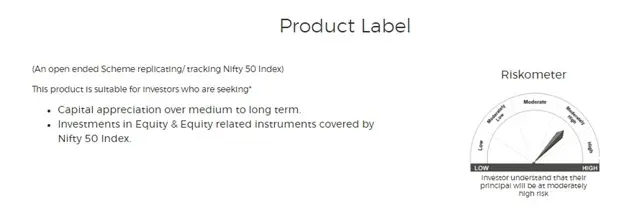
Mutual Fund Investments are subject to market risks, read all scheme related documents carefully.
Calculator
View All