Small Cap Investing Explained: Nifty Smallcap 50 Index


For investors who want to move beyond the familiar territory of large-cap names, the Nifty Smallcap 50 Index offers a more focused way to invest in the small-cap space. The index isolates the most active players in the small-cap ecosystem, potentially offering a sweet spot between high growth and liquidity.
What is the Nifty Smallcap 50 Index?
The Nifty Smallcap 50 Index pulls its constituents from the broader Nifty Smallcap 250 Index, but it doesn't simply pick names by market capitalization size. Liquidity is the main gatekeeper. Companies must trade regularly and in meaningful volume. What remains is a group of fifty companies with enough scale to matter and enough energy to grow.
The companies come from all corners of the economy. You'll usually find financial services, healthcare, and technology firms taking up a noticeable share. Names like MCX, CDSL, and Laurus Labs* have appeared frequently, although the list never stays still for very long. That is part of the appeal. A Nifty Smallcap 50 Index only works if it stays true to the segment's changing landscape.
How the Nifty Smallcap 50 Index Works?
Like most equity indices, the Nifty Smallcap 50 Index uses free-float market capitalization to assign weights. Only the shares that trade in the open market count toward the index. Promoter holdings and locked shares stay out of the calculation. Companies with larger public floats naturally carry higher weights, although caps help prevent any single name from taking up too much space.i
The index is reviewed twice a year. Companies that lose liquidity or fall too far behind their peers are replaced. Stronger names with better turnover or improving fundamentals take their place.
How to Invest in the Nifty Small Cap 50 Index?
You can exposure to this index through three primary channels.
1. Index Funds
This is the straightforward option. A small cap 50 index fund owns the same companies, in nearly the same proportions, as the index itself. Axis Nifty Smallcap 50 Index Fund is an example. Many investors prefer this route because the costs are relatively low and the funds come with transparency and liquidity.
2. Exchange-Traded Funds
If you like real-time pricing, an ETF offers similar exposure but trades like a stock. You can buy units of a small cap 50 ETF directly on the market during trading hours. Liquidity varies from fund to fund, so the experience is smoother when the ETF itself trades actively.
3. Buying All Fifty Stocks
Some experienced investors prefer to create their own version of the index. You can do it, but it takes time and money. You need to buy all fifty stocks in the correct weightings and rebalance twice a year to keep the proportions aligned. The work piles up if you are not careful, and costs can chew into returns. This route only makes sense for investors who want that level of control and are willing to maintain it.
Benefits of Nifty Smallcap 50 Index Funds
The attraction is simple. These companies are young in public-market terms and often have more room to grow. Their revenues can have potential to grow faster, their margins can expand, and they can take market share from slower competitors. Not all of them may succeed but the successes tend to surprise on the upside.
Owning all fifty businesses through a fund spreads the risk. You also avoid the biggest pitfall of small-cap investing: falling in love with a story and overlooking the numbers. An index helps you avoid this bias as it follows rules, not narratives.
Costs matter too. Passive funds have relatively lower expense ratios than actively managed small-cap funds. Lower expenses potentially give you more of the return that the underlying companies generate.
And then there is the quiet benefit of the semi-annual refresh. The index automatically walks away from weak companies and shifts capital toward the ones performing better. You don't need to actively monitor the portfolio to stay invested in the right names.
Risks of Investing in Nifty Smallcap 50 Index Funds
Nothing in investing comes free. Small caps swing far more than large caps, that is, they are more volatile. In other words, they may handle stress poorly and reward patience unevenly. Such is the nature of this segment.
Liquidity can be another challenge. Even the more active small caps can dry up when markets turn rough. You may want to sell, but the price you get during a panic might not feel fair. However, this is not a flaw of the index; it is simply how small companies behave.
Sector concentration is another point to consider. With only fifty stocks, a few industries often carry significant weight. If one of those sectors falls out of favor, the index will feel it.
Who Should Investing in Nifty Smallcap 50 Index Funds
Smallcap funds may not be for someone who loses sleep over a red portfolio. Investors who wish to invest in these index funds need a strong stomach and a long timeline. In other words, investors with a very high risk appetite and a long-term investment horizon can opt for small-cap investing.
A Nifty Smallcap 50 Index Fund may also work well as a supporting piece of a broader portfolio. Large and mid-cap funds may do the heavy lifting. A small-cap index fund can complement them and add a bit of extra horsepower when markets favor younger, faster-growing businesses.
https://www.niftyindices.com/Factsheet/ind_niftysmallcap_50.pdf
Past performance may or may not sustain in future.
*Note: Sector(s)/ Stock(s) mentioned above are for the purpose of disclosure of the portfolio of the Scheme(s) and should not be construed as recommendation. The above are constituents of the Index. Data as on Jan 2026.
NSE Disclaimer: The scheme is not sponsored, endorsed, sold or promoted by NSE INDICES LIMITED. NSE Indices Limited does not make any representation or warranty, express or implied, to the owners of the scheme or any member of the public regarding the advisability of investing in securities generally or in the Product(s) particularly or the ability of the underlying index to track general stock market performance in India. NSE INDICES LIMITED does not have any obligation to take the needs of the Issuer or the owners of the Product(s) into consideration in determining, composing or calculating the Nifty Smallcap 50 Index TRI . NSE INDICES LIMITED is not responsible for or has participated in the determination of the timing of, prices at, or quantities of the Product(s) to be issued or in the determination or calculation of the equation by which the Product(s) is to be converted into cash.NSE INDICES LIMITED do not guarantee the accuracy and/or the completeness of the underlying index or any data included therein and NSE INDICES LIMITED shall not have any responsibility or liability for any errors, omissions, or interruptions therein. For complete disclaimer, refer to the SID.
Disclaimer: This document represents the views of Axis Asset Management Co. Ltd. and must not be taken as the basis for an investment decision. Neither Axis Mutual Fund, Axis Mutual Fund Trustee Limited nor Axis Asset Management Company Limited, its Directors or associates shall be liable for any damages including lost revenue or lost profits that may arise from the use of the information contained herein. No representation or warranty is made as to the accuracy, completeness or fairness of the information and opinions contained herein. The material is prepared for general communication and should not be treated as research report. The data used in this material is obtained by Axis AMC from the sources which it considers reliable.
While utmost care has been exercised while preparing this document, Axis AMC does not warrant the completeness or accuracy of the information and disclaims all liabilities, losses and damages arising out of the use of this information. Investors are requested to consult their financial, tax and other advisors before taking any investment decision(s). The AMC reserves the right to make modifications and alterations to this statement as may be required from time to time.
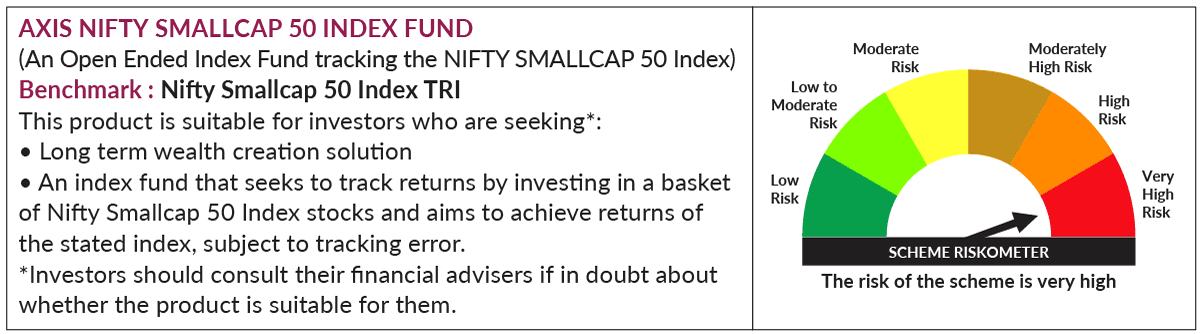
Mutual Fund investments are subject to market risks, read all scheme related documents carefully.
Calculator
View All