Nifty 50 vs Nifty50 Equal Weight: Key Differences


1. Introduction
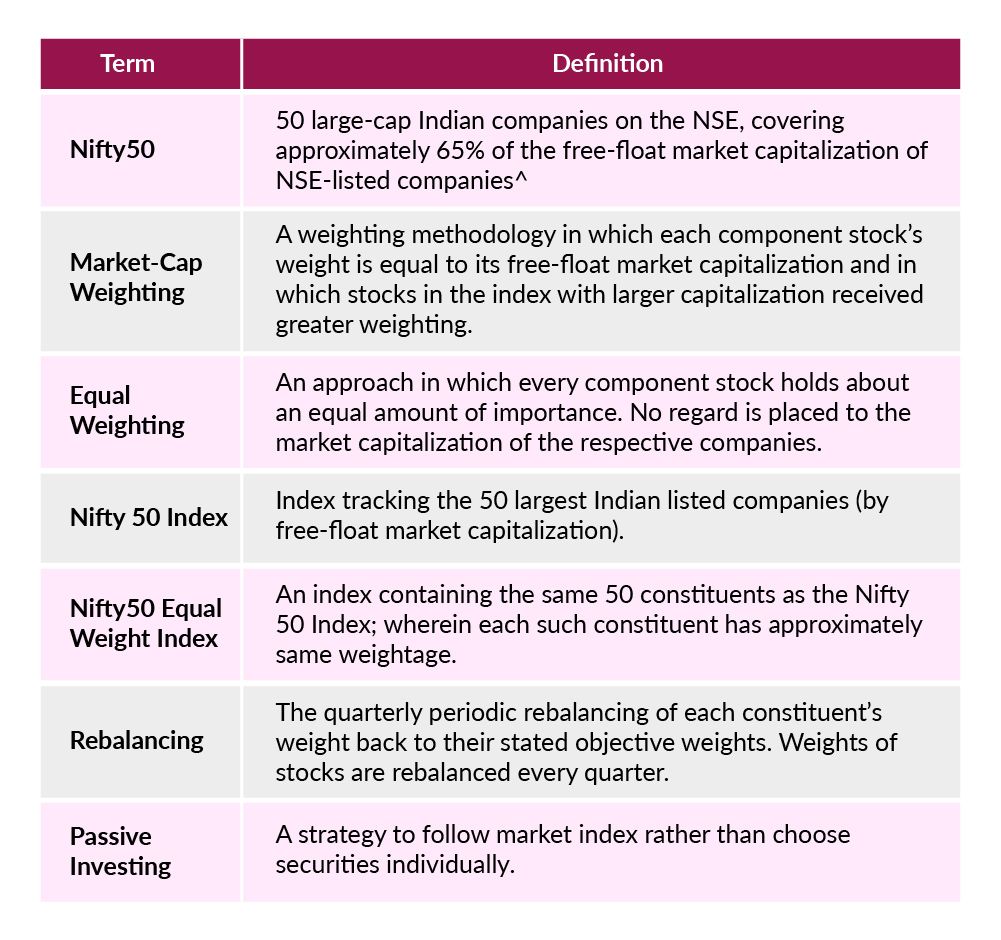
Nifty 50 Index vs Nifty50 Equal Weight IndexNifty50 Equal Weight Index- Both include the exact same Nifty 50 Companies; it's only in the weightings they differ. The Nifty 50 Index uses free-float market capitalization Weighting, whereas Nifty50 Equal Weight Index uses equally Weights for all its top 50 Companies.
2. Key Definitions
3. What Is the Nifty 50 Index?
The Largest 50 in India, the Nifty 50 Index is India's benchmark index that represents the largest 50 publicly-traded companies( by market capitalization).
Why Stock Weight Is Calculated ?
The Nifty 50 Index is a market-capitalization-weighted index, so stocks are assigned weighting by using their respective free float market cap as a portion of the total free float market capitalization of the 50, Nifty 50 companies. In other words, bigger the market cap, the more a certain stock adds to the index, making a select group of the Nifty 50 stocks often to constitute most of the overall weighting. This skew is one of the biggest strengths and weaknesses of a market-cap based index.
4. What Is the Nifty50 Equal Weight Index?
Similarly, the Nifty50 Equal Weight Index consists of the same 50 companies that make up the Nifty 50 Index, but equal weights are attributed to the index members – exactly 2% to every stock at the time of rebalancing.
Equal Weighting Methodology
Since they do not prefer big companies in terms of weight like market-cap weighting, each 50 stocks of Nifty 50 Index have same allocation weight.Rebalancing Mechanism
Stock prices move at different pace, causing over time the equal balance to slip. The Nifty50 Equal Weight index is rebalanced in a quarterly cycle-when weights of certain stocks rise beyond target, they are pared down to buy stocks which are lagging. This is built-in a sort of systematic discipline within the index creation.
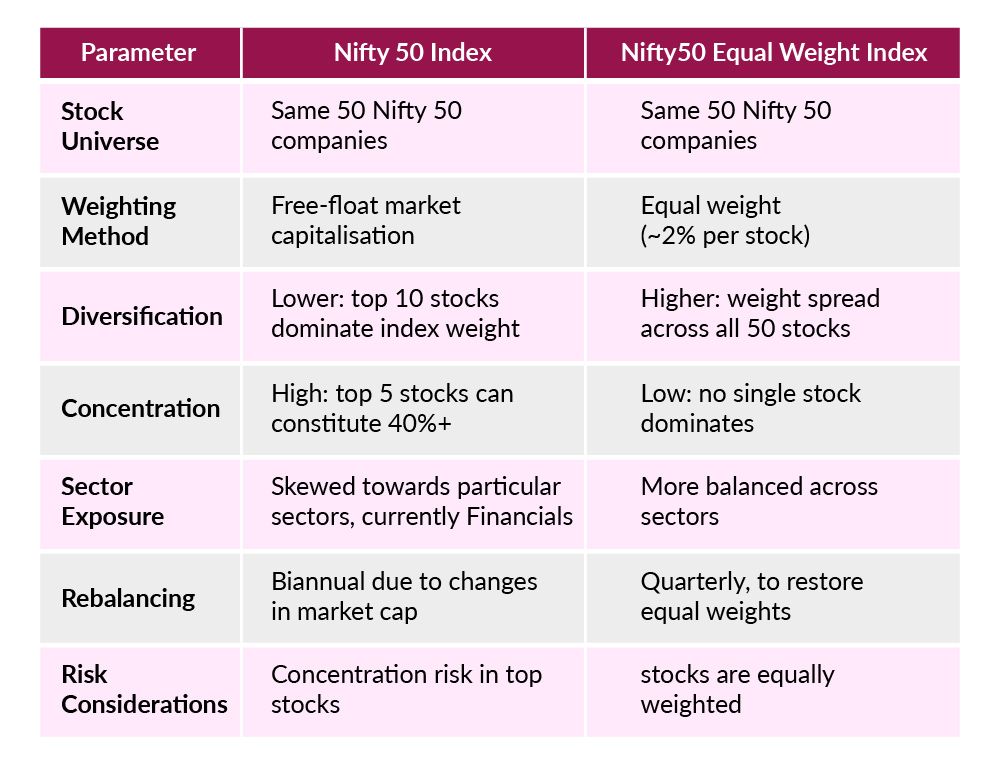
5. Nifty50 vs Nifty50 Equal Weight: Comparison Table1
Same Nifty50 companies. Different weighting methodology. Here is how the two indices compare across key parameters:
6. Market Cap vs Equal Weight: How It Works in Practice
Market-Cap Weighting
Market cap-weighted indexes automatically assign more weight to higher-valued companies. As companies grow their valuation, they will naturally increase their allocation within the index. Therefore, investors are allocated the most to companies that have already gotten big.
Equal Weighting
Weighing a particular stock equally, all constituents begin with an equivalent portfolio weight in your equal-weighting funds. This gives the small, large-cap corporations relatively greater weight than you will find with market cap weighted weighting.
Illustrative Comparison
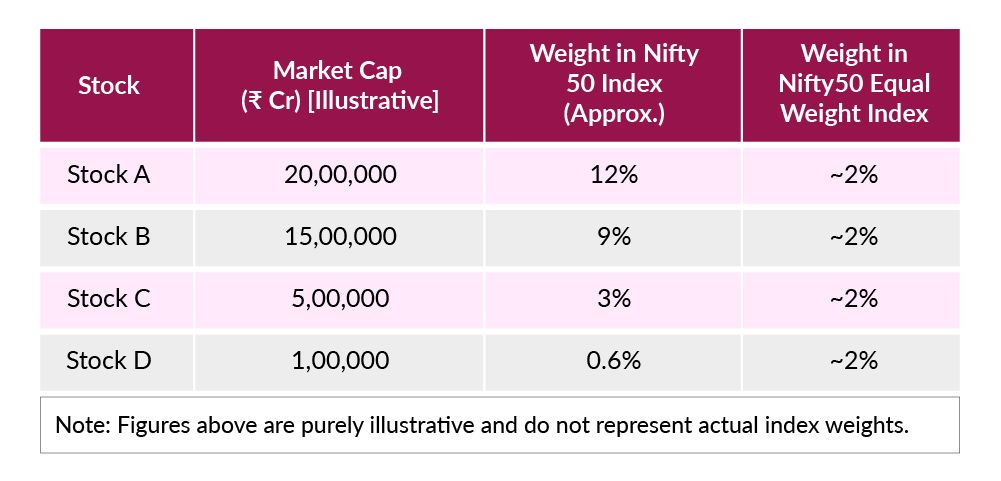
The table above illustrates that Stock D - with a relatively small market cap - receives a similar weight as Stock A in the equal-weight index, while it receives a fraction of Stock A's weight in the market-cap weighted index.
7. Why Investors Discuss Equal Weight Strategies
Equal weight index investing has generated interest because of three structural drivers:
• Better Diversification: By giving equal weight to each constituent, the equal weight index gives exposure of roughly the same amount to the constituents that make up the Nifty50 universe.
• Diversification Away from Mega-caps: For investors who worry that indices could become too concentrated in a few of the mega-caps in index, an equal weight index gives a structurally different alternative.
• Balanced Exposure to sectors: Because no segment of large caps has a bigger representation than others in equal weights, the sectors end up being more well-balanced.
• Rules-Based Trading: With Quarterly rebalancing, equal-weight indexes involve buying underperformers and trimming the outperformers which leads to disciplined and systematic trading without any emotional involvement.
Having said this, neither of the methodologies is better.
Both are different index construction philosophies and outcome depends upon market cycles.
8. Axis Nifty50 Equal Weight Index Fund NFO
NFO Opening Date: 3 July 2026
Axis Mutual Fund has announced Axis Nifty50 Equal Weight Index Fund which is an open-ended index fund that will follow the Nifty50 Equal Weight TRIWhat the Fund Offers
• Underlying Index: Nifty50 Equal Weight TRI
• Same Nifty50 Universe: The same 50 large-cap companies as the Nifty50 Index, with equal weighting
• NFO Period: 3 July 2026 to 17 July 2026
How Investors Gain Exposure
As investors opt for the Axis Nifty50 Equal Weight Index Fund, it opens the door to get a passively- managed, broad-based equity market exposure to all 50 stocks equally comprising Nifty 50 Index. The investment method does not require investors to pick and choose stocks.The fund should cater to investors who are already familiar with Nifty 50 investing but prefer an alternative index construction strategy on similar stocks.
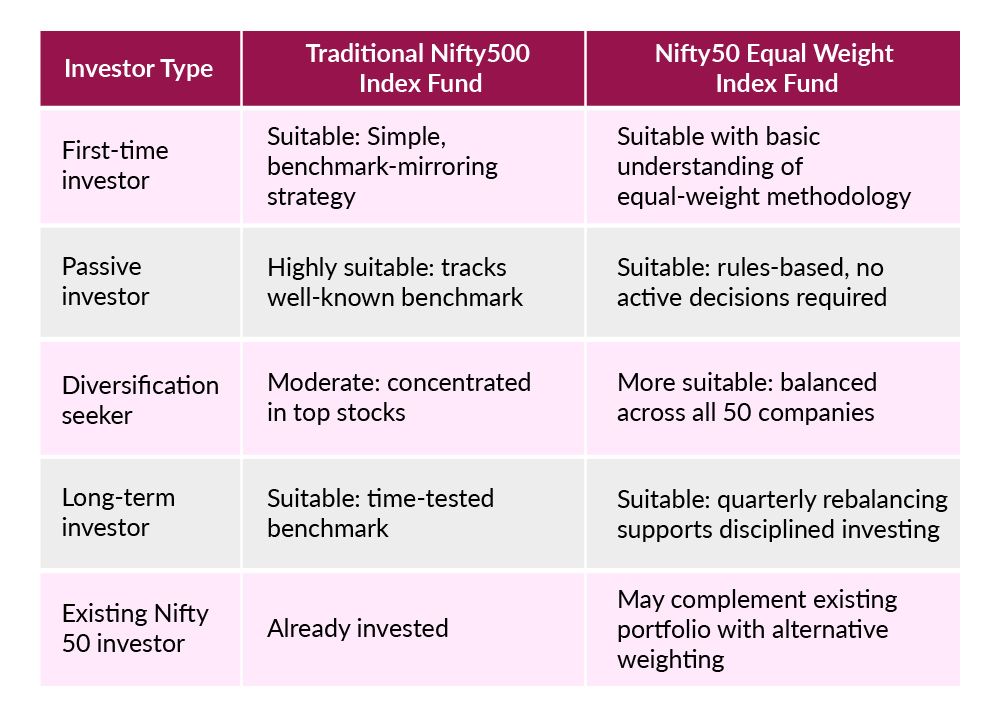
9. Who May Consider Each Approach?
10. Frequently Asked Questions (FAQs)
1.What is the difference between the Nifty 50 Index and the Nifty50 Equal Weight Index?
The 50 constituents are the same for both Weightings Nifty 50 index stocks by market cap. big companies have a bigger say in the index. This means it’s driven heavily by a few large companies. Whereas Nifty50 Equal Weight Index weighs each stock equally.
2.Do both indices contain the same companies?
Yes, both the Nifty50 Equal Weight Index and the Nifty 50 Index include the same 50 Nifty 50 companies. The methodology behind how they weigh them differs, not the companies selected.
3.Which index is more diversified?
Nifty50 Equal Weight Index can give relatively uniform weight to all the 50 Nifty 50 Companies that could lower the weightage that gets skewed towards the top Nifty 50 stocks. Whereas Nifty 50 Index gets more weight on the larger companies.
4.What is market-cap weighting?
Market cap weighting is an index methodology where each stock is given weight in proportion to their free-float market cap. Thus, the larger cap stocks are given more weight in the index.
5.What is equal weighting?
Equal weighting- Each component stock gets about equal weighting irrespective of its market capitalization. In case of a 50-stock index each stock comes in with roughly 2 percent at the time of a rebalancing.
Disclaimer
^Source: Nifty Indices, Data as of 30-Mar-2026
1Source: Nifty Indices, Data as of 29-May-2026. Past performance may or may not be sustained in the future. The above information should not be construed as promise, guarantee or forecast of returns. Table / Charts mentioned above are used to explain the concept and is for illustration purpose only. It should not be construed as investment advice to any party
For NSE disclaimer refer SID.

Calculator
View All