How ETF Funds can Help Investors with Wealth Creation?


We often see our peers climbing the ladder of financial success and always wonder, “How do they do it?” One reason behind the success of such individuals might be financial planning. Financial planning is essential for anyone who wishes to become financially independent in future. Ideally, when financial planning, one needs to first understand their short term and long term goals. Those who have a defined set of financial goals may be able to achieve financial success. While setting goals, one needs to be realistic and look at his/her existing liabilities before considering investing their hard earned money in any investments scheme.
There are several investment products in the market, most of those carrying almost traits, but different in risk profile. Hence, those who are completely new to investing might find narrowing down at a specific scheme a task in itself. To make an informed investment decision, retail investors are expected to first determine their risk appetite. A risk appetite is nothing but an individual’s ability to take a certain amount of risk with a particular investment with the hope of seeking capital appreciation in the long run.
There are some individuals who have zero risk appetite and are usually happy settling with conservative schemes. The only downside about conservative schemes is that they offer fixed interest rates that generally are on the lower side. However, if you are keen on investing in market linked investment schemes, you may consider investing in Exchange Traded Funds (ETFs).
ETFs are mutual funds, which means they offer capital appreciation through market linked investing. However, investors are expected to determine their risk appetite before investing as there is a possibility of their portfolio incurring losses.
To find out more about ETFs and how they may help you with wealth creation, continue reading:
What are exchange traded funds?
An exchange traded fund (ETF) follows a particular index, for example, the S&P 500 Index or NIFTY 50. Exchange traded funds are passively managed funds, which means that these funds do not involve the active participation of the fund manager. Exchanged traded funds are marketable security which can be traded at the exchange just like any other company stock. Unlike actively managed mutual funds, ETFs do not hold net asset value or NAV like mutual funds. Instead, they are measured in units where one unit of an ETF equals one share of the underlying index.
(SEBI) the regulator of mutual funds in India, defines ETFs as “is an open ended scheme which replicates/tracks the particular index. Of the total assets, this fund must invest a minimum of 95 per cent in securities of a particular index (which is being replicated or tracked)”.
Here is why exchange traded funds may help retail investors with wealth creation
Every mutual fund carries a unique investment strategy. Similarly, exchange traded funds follow their own investment strategy which might help investors with wealth creation. Here are some of the reasons why one may consider investing in exchange traded funds:
Exchange traded funds are passively managed funds: As mentioned earlier, ETFs do not involve any kind of active participation from the fund manager. In case of actively managed funds, the expense ratio is generally on the higher side, because the fund manager has to actively buy/sell securities to meet the scheme’s investment objective. But since ETFs are passively managed mutual funds, their expense ratio is on the lower side. They follow an algorithm that is designed to follow a particular underlying index with minimal tracking error. Investing in funds with a low expense ratio may prove beneficial in the long run.
Investing in ETFs may offer diversification
It is always better to diversify your mutual fund portfolio with a mix of equity and debt schemes depending on your risk appetite. A single ETF unit is generally a combination of stocks and other securities in smaller percentages. So even if one sector underperforms, it is less likely that other underlying assets may crash in tandem at the same time. Hence, ETFs may offer risk management as well as offer diversification which may be essential for wealth creation.
You may invest in ETF through a Systematic Investment Plan
Investors seeking long term capital appreciation generally opt for a Systematic Investment Plan. And since wealth creation is also a long term process, you may start an SIP (Systematic Investment Plan) in an exchange traded fund. SIP is an easy and hassle free way to continue investing without having to physically visit the fund house or the AMC. If you are a KYC compliant individual, you may start investing in an ETF fund through SIP from the comfort of your laptop or mobile phone. Those who opt for SIP generally have the chance of benefiting from tools like compounding and rupee cost averaging and this is why a lot of investors seeking capital appreciation prefer starting an SIP in ETF funds.
If you are seeking capital appreciation through ETF investments, you may consider Axis NIFTY ETF. The investment objective of Axis NIFTY ETF is to provide returns before expenses that closely correspond to the total returns of the Nifty 50 Index subject to tracking errors. However, there is no assurance or guarantee that the investment objective of the Scheme will be achieved. If you are keen on investing in a gold ETF fund, you may consider Axis Gold ETF. It is an open ended scheme replicating/tracking Domestic Price of Gold. The investment objective of Axis Gold ETF is to generate returns that are in line with the performance of gold.
Axis NIFTY ETF
An open ended Scheme replicating/tracking Nifty 50 Index
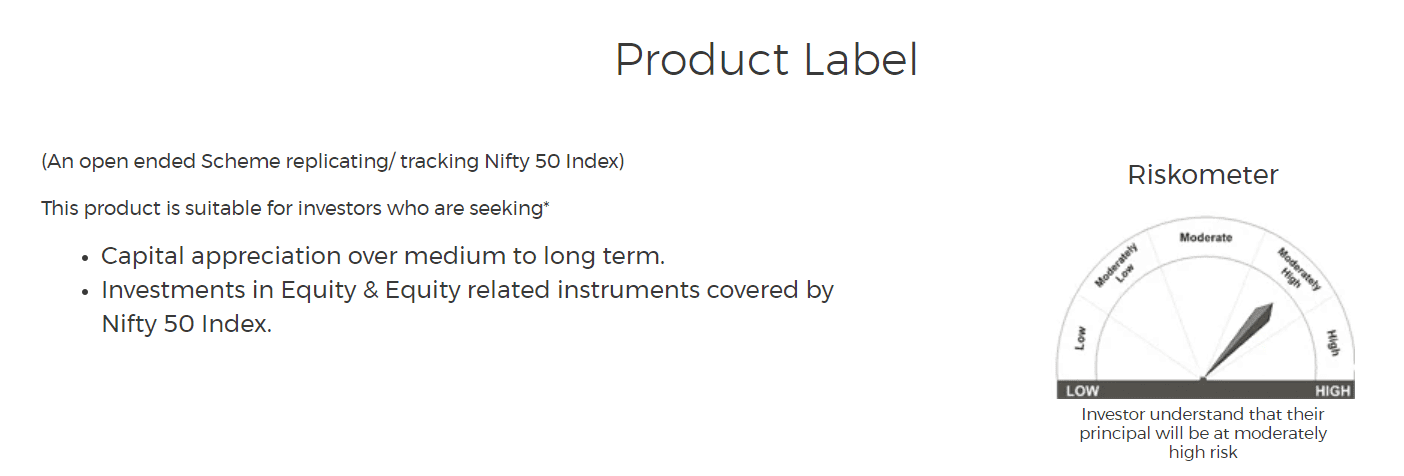
Mutual Fund Investments are subject to market risks, read all scheme related documents carefully.
Calculator
View All