Emergency Fund vs Mutual Fund Investment: What Comes First?


Emergency Fund vs Mutual Fund Investment: What Comes First?
For most beginner investors, an emergency fund should come before aggressive mutual fund investing. Keep a basic amount immediately accessible, then build a dedicated emergency corpus. Liquid or overnight funds may be considered for the portion that does not need same-day access, while SIPs can continue for long-term goals once essential liquidity is in place.
A new investor often faces a very practical question: should I start a SIP first, or should I build an emergency fund first? The simple answer is that an emergency fund usually comes first, because it protects your daily life from financial disruption. A SIP can help you invest for future goals, but an emergency fund helps you handle urgent needs without disturbing those goals.
This matters especially for salaried users, young families and first-time investors. A medical bill, job transition, urgent home repair, travel requirement or delayed income can arrive without notice. If every rupee is locked into long-term goals, an investor may be forced to redeem at the wrong time, use expensive credit, or pause essential household plans.
An emergency fund is not meant to chase returns. Emergency corpus should be easily and quickly accessible, because some emergencies require money immediately while others may allow a few hours or days to arrange funds. That distinction is important: not all emergency money has to sit in one place, but every part of it should be easy to access when needed.
In practical terms, investors can think of emergency money in layers. The first layer may be money kept in a savings account or cash equivalent for same-day needs. The second layer may be money parked in liquid solutions, including suitable debt mutual fund categories, for needs where next-business-day liquidity may be acceptable. The third layer is not emergency money at all: it is long-term investing through SIPs for goals such as retirement, children's education or wealth creation.
AMFI describes mutual funds as pooled investment vehicles that collect money from investors and invest in securities such as equities, bonds, government securities and money market instruments. This structure can serve many goals, but each category has a different role. Equity-oriented mutual funds may be useful for longer investment horizons, while liquid, overnight and money market funds are designed for short-term parking of surplus money.
So, should you build an emergency fund before starting SIP? For most beginners, yes. At least a basic emergency buffer should be in place before increasing SIP commitments. This does not mean a person must wait for a large corpus before investing anything. If income is stable, a small SIP can begin alongside an emergency fund plan. But the priority should be clear: protect essential expenses first, then scale long-term investing.
How large should the emergency fund be?
Minimum of around six to eight months of monthly expenses as an emergency corpus. A single salaried professional, a family with dependants, a household with loans, and a person with variable income may all need different levels of comfort.
The next question is where to keep the emergency fund?
The answer should start with liquidity, not return. Keep money that may be needed immediately in a bank account or other highly accessible form. For the portion that can wait for redemption processing, investors may evaluate liquid funds or overnight funds, subject to scheme documents, redemption timelines and personal suitability.
AMFI's investor education material says liquid, overnight and money market mutual funds are options for investors seeking liquidity and principal protection with commensurate returns, and that these funds invest in money market instruments with maturities not exceeding 91 days. It also notes that returns depend on short-term interest rates. This makes them relevant for short-term parking, but investors should not confuse them with guaranteed deposits or risk-free products.
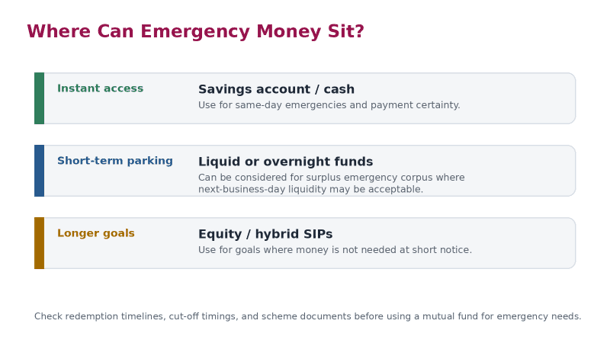
Where Can Emergency Money Sit?
Instant access
Savings account / cash
Use for same-day emergencies and payment certainty.
Short-term parking
Liquid or overnight funds
Can be considered for surplus emergency corpus where next-business-day liquidity may be acceptable.
Longer goals
Equity / hybrid SIPs
Use for goals where money is not needed at short notice.
Check redemption timelines, cut-off timings, and scheme documents before using a mutual fund for emergency needs.
Can liquid funds be used for emergency money?
They may be considered for part of the emergency corpus, especially the amount that is not required instantly. However, investors should check cut-off timings, exit load, scheme risk, portfolio quality, credit risk, interest-rate risk, redemption process and whether instant redemption facilities are available and suitable. The emergency fund should remain boring, accessible and purpose-driven.
What about SIPs?
SIPs are useful because they bring discipline to investing. For beginners, SIPs can make investing more manageable. But a SIP should not create cash-flow stress. If the SIP amount leaves no room for emergencies, the investor may be setting up a future interruption.
A good sequence is simple. First, identify unavoidable monthly expenses such as rent or EMI, groceries, utilities, school fees, insurance premiums and medical needs. Second, build a basic immediate-access buffer. Third, create or top up the larger emergency corpus using bank savings and, where appropriate, liquid or overnight funds. Fourth, start or increase SIPs for long-term goals after essential liquidity is protected.
This order also helps investors stay invested. When markets fall, investors with no emergency fund may redeem long-term investments to meet short-term needs. Investors with a separate emergency fund may be better placed to let goal-based investments continue, subject to their risk profile and financial plan. The emergency fund is therefore not a rival to SIPs; it is the foundation that can help SIPs continue more steadily.
Investors should also review the emergency fund once or twice a year, or whenever income, expenses, dependants, loans or job stability changes. A new child, a home loan, ageing parents, a move to a new city or a career break can change the required buffer. The emergency fund is a living part of the household plan, not a one-time checkbox.
The final decision is not emergency fund versus mutual fund investment. It is emergency fund before, during and alongside investing, depending on the stage of the investor. Keep urgent money accessible. Use liquid or overnight funds only where the liquidity profile matches the need. Let SIPs serve long-term goals. That balance can help new investors build confidence without overreaching.
Emergency Fund vs SIP - What Comes First?
Emergency Fund vs SIP - What Comes First?
| Investor Situation | First Priority | How SIP Fits | Practical Note |
|---|---|---|---|
| No emergency savings yet | Build immediate-access buffer | Start later or keep very small if cash flow allows | Avoid stretching monthly budget. |
| Some savings, but not enough | Continue building emergency corpus | Begin modest SIP for long-term goals if essentials are protected | Keep emergency and goal money separate. |
| Emergency fund broadly in place | Maintain and review corpus | Increase SIPs according to goals and risk profile | Review when income or expenses change. |
| Variable income or dependants | Keep a larger liquidity cushion | Use SIPs only after household cash flow is stable | Do not rely fully on redemption for same-day needs. |
Where to Keep Emergency Money
Where to Keep Emergency Money
| Bucket | Purpose | Possible Holding Place | Key Check |
|---|---|---|---|
| Immediate-access money | Same-day needs | Savings account / readily available balance | Payment certainty and instant access. |
| Short-term emergency reserve | Needs that can wait for processing | Liquid fund or overnight fund, where suitable | Check redemption timeline, risk, cut-off and scheme documents. |
| Long-term goals | Goals not linked to urgent cash needs | SIP in suitable mutual fund categories | Match goal horizon, risk profile and suitability. |
FAQs
Should I build an emergency fund before starting SIP?
For most beginners, yes. Build at least a basic emergency buffer first, then start or scale SIPs for long-term goals. A small SIP may continue alongside emergency-fund building if household cash flow remains comfortable.
Can liquid funds be used for emergency money?
Liquid funds may be considered for the portion of an emergency corpus that does not need same-day access. Investors should check redemption timelines, cut-off timings, risk factors and scheme documents before using them.
Are overnight funds useful for emergency funds?
Overnight funds may be relevant for very short-term parking because they invest in overnight securities, but they are still mutual funds and are subject to market risks. Suitability should be assessed carefully.
Where should I keep my emergency fund in India?
Keep immediate needs in a savings account or similar accessible form. For the balance, liquid or overnight funds may be evaluated where next-business-day liquidity is acceptable and the investor understands the risks.
Should I stop SIPs to build an emergency fund?
If cash flow is tight and there is no emergency buffer, reducing or pausing new SIP commitments may be practical. Once essential liquidity is in place, SIPs can be resumed or increased based on goals and risk profile.
Views and opinions expressed herein are for informational and educational purposes only and should not be construed as investment advice, recommendation, offer or solicitation to buy, sell or hold any security, mutual fund units or to adopt any investment strategy.
This content is prepared for educational and informational purposes. Final publication should be subject to internal compliance, legal, product and brand review.
Mutual Fund Investments are subject to market risks, read all scheme related documents carefully.
Calculator
View All