Does ELSS Have Any Other Benefits Apart From Tax Benefit?


(As on date 01st Jan, 2021)
Young earners are always stuck with the biggest question - where should I invest my money in order to avoid taxes. Investors need to understand that tax planning is an important aspect of financial planning. This is why tax planning automatically qualifies as a long-term financial goal. When you are young, tax deductions may not affect your earnings that much. But as you get an increment and your gross annual salary keeps increasing year after year, there will be noticeable tax deductions which will slowly start eating a decent chunk of your annual income.
There are multiple tax saving avenues out there for investors to choose from. The real question is whether you want to stick to conservative tax saving instruments or switch to a market linked tax saving schemes that was recently launched. Original tax saving instruments have been the primary choice of retail investors for a very long time. However, conservative tax saving schemes do not offer decent interest rates. What is the point of investing your capital in the scheme that isn't able to appreciate your hard earned money and offer you a commendable corpus in the long run? If your goal brings down your tax liability and at the same time on capital appreciation over the long term by investing in market linked schemes then you can consider investing in Equity Linked Savings Scheme (ELSS).
What is Equity Linked Savings Scheme?
An Equity Linked Saving Scheme (also known as ELSS), is an open ended scheme that comes with a tax benefit. ELSS is an equity related scheme that comes with a statutory lock in of three years. This means that investors cannot withdraw or redeem their ELSS units for 3 years at least. However, this statutory lock in gives ELSS fund investments an opportunity to grow.
Here is an example to help you understand how ELSS works:
Rajakumari, an independent artist who earns Rs. 15 lakhs per annum. This makes Rajakumari fall in the 30 percent tax slab. Rajakumari does some research over the internet and learns about ELSS and decides to invest Rs. 1.5 lakhs* in it. As per section 80C of the Indian Income Tax Act, 1961 investments of up to Rs. 1.5 lakhs made in an ELSS scheme are eligible for tax benefits. This way, Rajakumari's gross taxable income has come down to Rs. 13.5 lakhs and she has managed to bring down his overall tax liability by investing in ELSS.
Apart from saving tax, how can one benefit from ELSS?
If you have decided to invest in ELSS to save tax, do remember that apart from saving tax this tax saver fund holds other benefits too. ELSS comes with a three year lock in period. The three year lock in period confirms that investors cannot withdraw their funds from ELSS. Since ELSS is an equity oriented mutual fund scheme it needs a long term investment horizon to show its true potential. The three year lock in assures that the ELSS scheme gets a chance to grow.
If you have long-term goals like building a retirement corpus for planning and destination weddings for your daughter or if you want to send their children overseas for foreign education then you can consider investing in ELSS for the long run. Just because ELSS comes with a 3 year lock in period that doesn't mean that you should invest only for three years. Remember that you have to invest in a tax saving scheme for at least 15-20 years or till the time you retire. This long term investment horizon can be utilized to build a corpus so that you will not only save tax by investing in ELSS but might be able to accumulate wealth to fulfill your life's long-term financial goals. If you decide to invest for the long-term, then you can consider starting a systematic investment plan in this tax saver fund. SIP is an easy and hassle free way to invest in equity linked savings schemes. With a SIP App all you need to do is complete one time mandate with your bank following which every month on a fixed a predetermined amount is debited from your savings account and electronic transferred to ELSS.
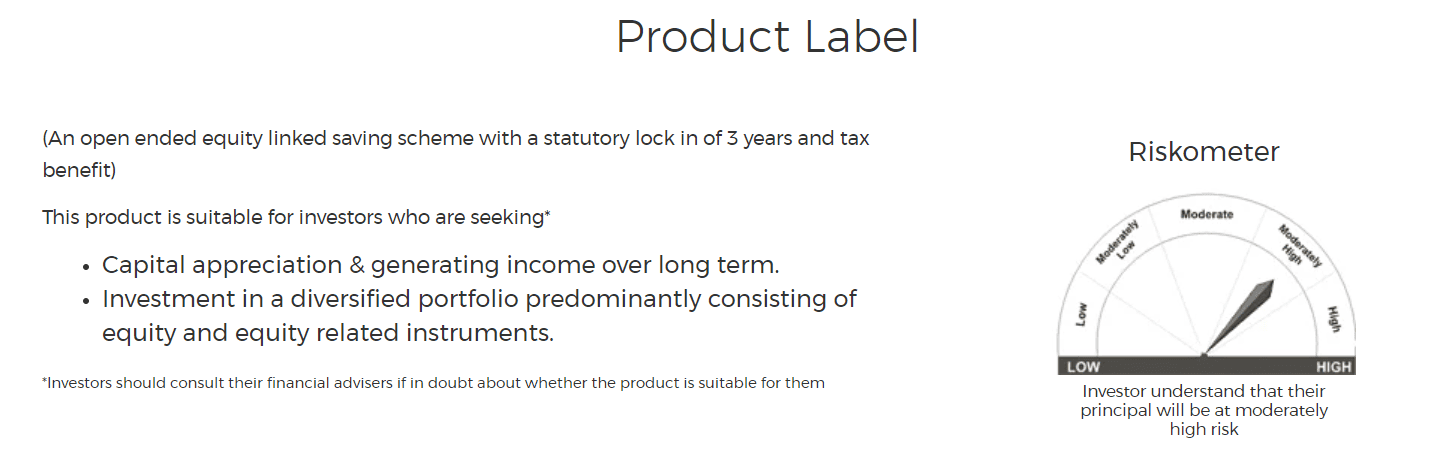
Those seeking long term capital appreciation and willing to save tax through investment in ELSS, you can take a look at Axis Long Term Equity Fund. Axis Long Term Equity Fund is an open ended equity linked saving scheme with a statutory lock in of 3 years and tax benefit. The investment objective of Axis Long Term Equity Fund is to generate income and long-term capital appreciation from a diversified portfolio of predominantly equity and equity-related securities. However, there can be no assurance that the investment objective of the Scheme will be achieved.
*As per the present tax laws, eligible investors (individual/HUF) are entitled to deduction from their gross income of the amount invested in Equity Linked Saving Scheme (ELSS) up to Rs.1.5 lakhs (along with other prescribed investments) under section 80C of the Income Tax Act, 1961.
Finance Act, 2020 has announced a new tax regime giving taxpayers an option to pay taxes at a concessional rate (new slab rates) from FY 2020-21 onwards. Any individual/ HUF opting to be taxed under the new tax regime from FY 2020-21 onwards will have to give up certain exemptions and deductions. Since, individuals/ HUF opting for the new tax regime are not eligible for Chapter VI-A deductions, the investment in ELSS Funds cannot be claimed as deduction from the total income.
Investors are advised to consult his/her own Tax Consultant with respect to the specific amount of tax and other implications arising out of his/her participation in ELSS
Axis Long Term Equity Fund
An open ended equity linked saving scheme with a statutory lock in of 3 years and tax benefit
Mutual fund investments are subject to market risk read all scheme related documents carefully.
Calculator
View All