

How to Invest in India's EV Growth Story Through an Index Fund


Quick answer: How can I invest in EV companies in India without choosing individual stocks?
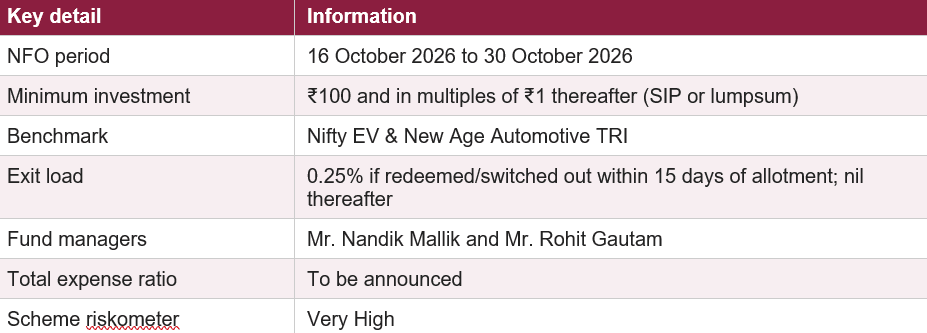
You can do it through an EV index fund. It tracks an index of companies across the electric vehicle value chain, such as vehicle makers, battery makers, component suppliers and auto-tech firms, so a single investment gives you rules-based exposure to the whole basket. For example, Axis Nifty EV & New Age Automotive Index Fund, India's first index fund on this index*, allows SIP or lumpsum investments from ₹100, without a demat account.
Look around your city. The e-rickshaw at the station, the electric scooter in your society parking, the e-bus on your route. In FY 2014-15, India registered about 2,400 EVs. In FY 2025-26, that number was 25,35,500, roughly 1,000 times more in a decade.¹
Naturally, many investors are now asking how to invest in EV stocks in India. The challenge is that the EV story is not about one company or one car brand. This guide explains, in simple terms, how the EV value chain works, the ways you can invest in it, and what to check before you do.
Why India's EV shift is getting attention
Three forces are driving electric mobility in India:
• Energy security: India meets about 88% of its crude oil needs through imports, so lower fuel dependence matters at a national level.²
• Running costs: EVs convert 85–90% of energy into motion, against about 30% for petrol or diesel vehicles. Battery prices have fallen 93% since 2010.³
Smarter vehicles: Modern EVs are increasingly software-defined and can receive feature upgrades over the air.

Source: ³ See footnotes. Figures are indicative and for illustration only.
Adoption is still at an early stage in most segments. Fewer than 1 in 20 new cars sold in India in FY26 was electric. HSBC estimates this share could rise considerably over the next decade:⁴

⁴ Source: HSBC estimates, Vahan. Estimates are not guaranteed and actual outcomes may differ.
How to invest in EV stocks in India: three routes
1. Pick individual EV stocks
You research and buy shares of specific companies through a demat account. This needs time, expertise and regular tracking. It also carries company-specific risk, because it is hard to predict which brand or technology will lead over the years.
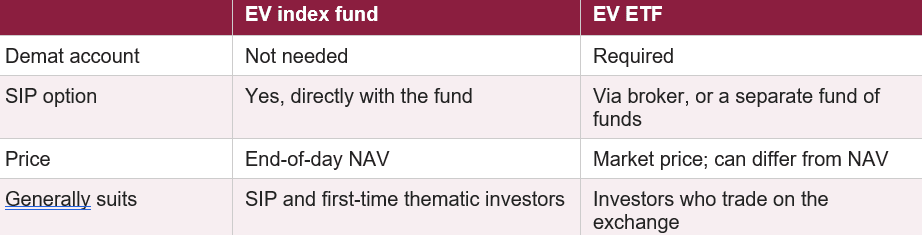
2. Buy an EV ETF
An exchange-traded fund (ETF) tracks an EV index and trades on the stock exchange like a share. You need a demat account, and the market price can differ from the fund's NAV.
3. Invest in an EV index fund
An EV index fund is a mutual fund that aims to track an EV index, subject to tracking error.
You invest and redeem at NAV, can start a SIP, and do not need a demat account.
Understanding the EV value chain in India
Remember the smartphone boom? Brands rose and fell, but every phone needed a battery, a chip and a screen. EVs work in a similar way. Whichever brand you buy, the same families of companies build what goes inside it. The EV value chain in India can be broadly seen in nine stages:⁹
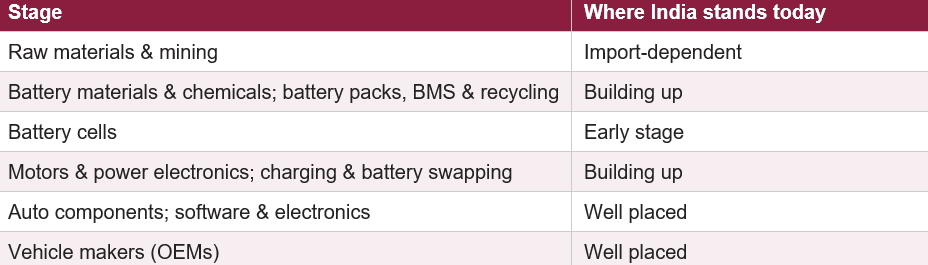
⁹ Source: India EV Value Chain Report Internal (2026). For illustration purpose only.
An investor who buys only carmakers sees one part of this chain. An index spread across the chain gives exposure to many of the businesses behind every vehicle.
What is the Axis Nifty EV & New Age Automotive Index Fund?
Axis Nifty EV & New Age Automotive Index Fund. It aims to provide returns, before expenses, that correspond to the performance of the Nifty EV & New Age Automotive TRI, subject to tracking error. There is no assurance that the investment objective will be achieved.
The index is an NSE thematic index built from Nifty 500 companies. 'New age automotive' goes beyond battery EVs to include hybrids, hydrogen fuel-based vehicles and autonomous-vehicle technology. Its basic industry mix is as follows:ⁱ
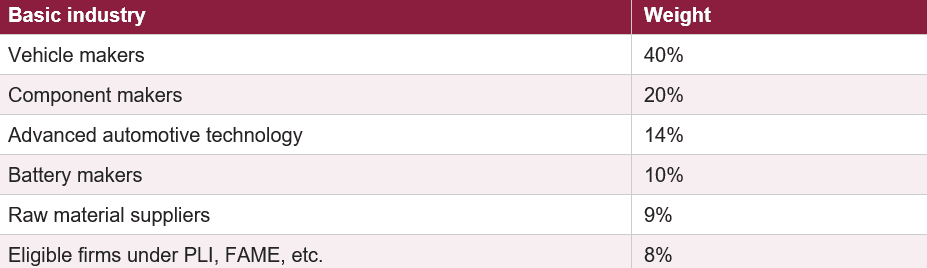
To limit concentration, each vehicle maker is capped at 8% and every other stock at 4%. The index spans large caps (44%), mid caps (29%) and small caps (27%), and the top 10 constituents make up about 48% of the index.ⁱ
How has the index performed?
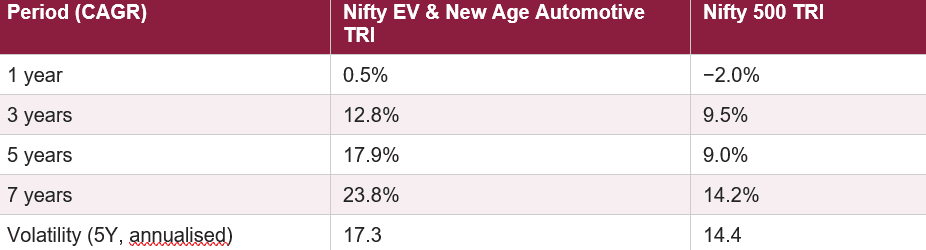
The fund is new and has no performance track record. The table below shows the index, not the fund. Fund returns may differ due to expenses and tracking error.^
^ Source: Nifty Indices, data as of 30-Sep-2026. Past performance may or may not be sustained in the future and should not be construed as a promise, guarantee or forecast of returns.
Notice the last row. The index has been more volatile than the broader market, which is typical of a thematic index. Higher potential comes with sharper ups and downs.
Risks to understand before investing in an EV index fund
• Theme concentration: The fund invests in one theme, so it is less diversified than a broad-market fund.
• Policy changes: Reductions in subsidies or incentives can affect the sector.
• Input costs and imports: Battery materials are largely imported, and restrictions or price swings can impact companies.
• Technology shifts: Today's technology may be replaced by newer ones.
• Tracking error: Fund returns may not exactly match index returns.
Is an EV index fund suitable for you?
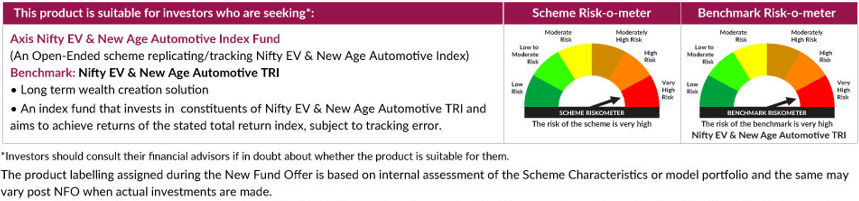
Thematic funds are usually held as a limited, satellite portion of an equity portfolio, alongside a diversified core. This fund may be considered by investors who have a long investment horizon of 5 years or more, are comfortable with very high risk, and prefer a rules-based approach over picking stocks. A SIP can help average purchase cost over time. The right allocation depends on your goals and risk profile, so consult your financial adviser.
How to invest in the NFO in four steps
1. Complete KYC: Existing Axis MF investors can skip this step.
2. Choose SIP or lumpsum: Start from ₹100.
3. Invest before 30 October 2026: Use the Axis Mutual Fund website or app, your mutual fund distributor, or supported investment platforms. Units are offered at ₹10 during the NFO.
4. Continue after the NFO: The scheme reopens for continuous purchase and redemption at NAV within five business days of allotment.
How is an EV index fund taxed?
As an equity-oriented scheme, it follows equity mutual fund tax rules. Under current laws, gains on units held for more than 12 months are taxed at 12.5% above ₹1.25 lakh a year; gains within 12 months are taxed at 20%. Tax laws can change.ⁱⁱⁱ
Frequently asked questions
Do I need a demat account to invest in an EV index fund?
No. An index fund is a mutual fund, so you invest and redeem directly at NAV. ETFs on the same index require a demat account.
Is the Nifty EV & New Age Automotive Index only about car companies?
No. Vehicle makers are capped at 40% of the index. The rest is spread across component makers, auto-tech, battery makers, raw material suppliers and other eligible firms.ⁱ
Can I start an EV fund SIP with ₹100?
Yes. The minimum investment is ₹100 and in multiples of ₹1 thereafter, for both SIP and lumpsum.
Can I invest after the NFO closes?
Yes. It is an open-ended scheme, so it reopens for continuous purchase and redemption at the applicable NAV.
The bottom line
India's EV shift involves far more than the vehicles on the road. It runs through batteries, components, electronics and materials. An EV index fund offers one way to participate in this value chain without choosing individual stocks. Before investing, understand the theme's risks, keep it as part of a diversified portfolio, and read all scheme-related documents.
Sources and disclaimers
*First Fund in the Index Category tracking the Nifty EV & New Age Automotive Index as on 7 October, 2026.
¹ Roads Reimagined: The Rise of India's Electric Vehicles Ecosystem, PIB: https://www.pib.gov.in/PressReleaseDetail.aspx?PRID=2294688®=48&lang=1
² https://sansad.in/getFile/annex/270/AU4124_gs8kNF.pdf?source=pqars ; https://ppac.gov.in/
³ US DOE, FOTW #1360 (Sept 16, 2024): https://www.energy.gov/cmei/vehicles/articles/fotw-1360-sept-16-2024-typical-ev-87-91-efficient-compared-30-conventional ; Goldman Sachs: https://www.goldmansachs.com/insights/articles/electric-vehicle-battery-prices-falling
⁴ Source: HSBC Estimates, Vahan.
⁹ Source: India EV Value Chain Report Internal (2026). Table/charts are used to explain the concept and are for illustration purpose only.
^ Source: Nifty Indices. Data as of 30-Sep-2026. Past performance may or may not be sustained in the future. The above information should not be construed as promise, guarantee or forecast of returns.
https://www.niftyindices.com/indices/equity/Thematic-indices/nifty-ev-new--age-automotive
ⁱ Source: Nifty Indices, data as of 30-Sep-2026. The Stocks/Sectors/Industries mentioned herein are for general assessment purpose only and not a complete disclosure of every material fact. It should not be construed as investment advice to any party. The scheme may or may not hold these in future.
ⁱⁱⁱ For individual nature of tax implications, investors are requested to consult their tax advisors before investing.
Axis Bank Ltd. is not liable or responsible for any loss or shortfall resulting from the operation of the scheme
Mutual Fund investments are subject to market risks, read all scheme related documents carefully.
Calculator
View All


