

EV theme Index Fund vs ETF: Which Structure Fits Your Investing Style?


Quick answer: Do I need a demat account to invest in an EV index fund?
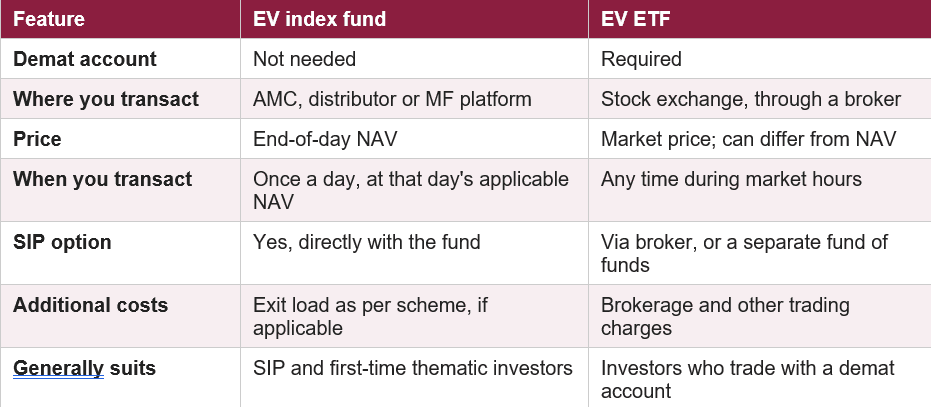
No. An EV index fund is a mutual fund, so you buy and redeem units directly at NAV, through SIP or lumpsum, without a demat account. An EV ETF tracks a similar index but trades on the stock exchange, so it needs a demat and trading account. For example, Axis Nifty EV & New Age Automotive Index Fund allows investments from ₹100, with no demat account needed.
Imagine two ways to travel the same route. A train runs on a fixed schedule and you book a seat at one set fare. A cab lets you leave any time, but the fare moves with demand. Both take you to the same destination. The difference is how you travel.
The EV ETF vs index fund choice is similar. Both can track the same EV index and hold broadly the same basket of companies. What changes is how you buy, hold and sell. This guide explains both structures so you can decide which fits your style.
First, what do both have in common?
An EV index fund and an EV ETF are both passive funds. Neither depends on a fund manager picking stocks. Each aims to track an index, such as the Nifty EV & New Age Automotive Index, subject to tracking error.
So, both give you exposure to the same EV theme: vehicle makers, component makers, battery makers, raw material suppliers and auto-tech companies.ⁱ The structure is what sets them apart.
What is an EV index fund?
An EV index fund is a mutual fund scheme. You invest with the AMC, through its website or app, a mutual fund distributor or an investment platform. Units are bought and redeemed at the end-of-day NAV. You can invest through a lumpsum or set up a SIP, which makes it a simple option for an EV SIP in India.
What is an EV ETF?
An EV ETF (exchange-traded fund) is listed on the stock exchange. You buy and sell its units through a broker during market hours, just like a share. This needs a demat and trading account. The price you pay is the market price, which can differ from the ETF's NAV.
EV ETF vs Index fund: side-by-side comparison
Four questions to find your fit
1. Do you have a demat account?
If not, an index fund lets you invest in an EV fund without demat. You only need to complete KYC. If you already actively use a demat account, an ETF is also an option.2. Do you want to invest every month?
If you prefer a fixed monthly amount, an index fund SIP is straightforward. ETF SIPs are possible through some brokers, or through a fund of funds that invests in the ETF, which can add another layer of costs.
3. Do you want to choose your price during the day?
ETFs let you buy and sell at live market prices. This flexibility can help active investors, but it also means price can move away from NAV, especially when trading volumes are low. Index fund investors get the same NAV as everyone else that day.
4. How hands-on do you want to be?
An index fund needs fewer decisions: set up a SIP and review periodically. An ETF needs you to place orders, check prices and manage your trading account.
Things that matter for both
•Expense ratio: Both charge an annual fee that reduces returns. Compare it before investing.
•Tracking error: Neither will match the index exactly, due to expenses and other factors.
•Theme risk: The structure does not change the risk of the theme. Both are concentrated in EV and new-age automotive stocks, which can be more volatile than the broad market. Over 5 years, the Nifty EV & New Age Automotive TRI had annualised volatility of 17.3 against 14.4 for the Nifty 500 TRI.^
•Tax: Both follow equity tax rules under current laws. ⁱⁱⁱ
Index fund vs ETF: a quick decision guide
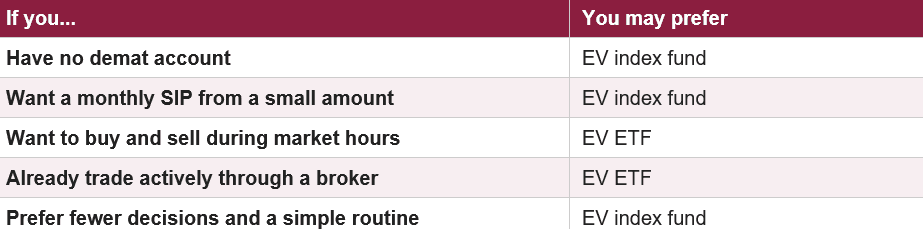
For illustration only. Not investment advice. Choose based on your goals and risk profile.
An index fund option on this index
Until recently, the Nifty EV & New Age Automotive Index was accessible only through ETFs and ETF fund of funds. Axis Nifty EV & New Age Automotive Index Fund is India's first index fund on this index.* It is an Open-Ended scheme replicating/tracking Nifty EV & New Age Automotive Index. The NFO is open from 16 to 30 October 2026, and you can invest through SIP or lumpsum from ₹100 and in multiples of ₹1 thereafter, without a demat account. The scheme riskometer is Very High.
Frequently asked questions
Can I start an EV SIP in India without a demat account?
Yes. You can start a SIP in an EV index fund directly with the fund house, distributor or platform. Only KYC is needed.
Do an EV ETF and an EV index fund on the same index hold the same stocks?
Both aim to track the same index, so their holdings are broadly similar. Returns may differ due to expenses, tracking error and, for ETFs, the market price.
Why can an ETF's price differ from its NAV?
An ETF's price is set by buyers and sellers on the exchange. Depending on demand and trading volumes, it can trade above or below its NAV.
Is an index fund safer than an ETF?
No. Both carry the same theme and market risk. The difference is in how you invest, not in the risk of the underlying stocks
.The bottom line
In the EV ETF vs index fund choice, neither structure is better for everyone. If you want a simple SIP without a demat account, an EV index fund may fit better. If you trade actively and want live pricing, an EV ETF may suit you. Either way, understand the theme's risks and keep it as a limited part of a diversified portfolio. Read all scheme-related documents before investing.
Sources and disclaimers
*First Fund in the Index Category tracking the Nifty EV & New Age Automotive Index as on 7 October, 2026.
^ Source: Nifty Indices. Data as of 30-Sep-2026. Past performance may or may not be sustained in the future. The above information should not be construed as promise, guarantee or forecast of returns.
https://www.niftyindices.com/indices/equity/Thematic-indices/nifty-ev-new--age-automotive
ⁱ Source: Nifty Indices, data as of 30-Sep-2026. The Stocks/Sectors/Industries mentioned herein are for general assessment purpose only and not a complete disclosure of every material fact. It should not be construed as investment advice to any party.
ⁱⁱⁱ For individual nature of tax implications, investors are requested to consult their tax advisors before investing.
Tables are used to explain the concept and are for illustration purpose only.
Axis Bank Ltd. is not liable or responsible for any loss or shortfall resulting from the operation of the scheme.
Mutual Fund investments are subject to market risks, read all scheme related documents carefully.
Calculator
View All


