

EV Mutual Fund in India: Meaning, Benefits and Risks


Quick answer: What is an EV mutual fund and how does it work?An EV mutual fund pools money from many investors and invests it in companies linked to electric and new-age vehicles, such as vehicle makers, battery makers, component suppliers and auto-tech firms. You buy units at NAV, and the value of your units moves with the prices of the stocks the fund holds. An EV fund can be actively managed (an EV thematic fund) or passive (an EV index fund that tracks an EV index, subject to tracking error).
Ten years ago, spotting an electric vehicle on an Indian road was rare. In FY 2025-26, India registered 25,35,500 EVs.¹ As EVs become part of everyday life, a natural question follows: is there a way to invest in this shift without researching dozens of companies?
That is where an EV mutual fund in India comes in. This guide explains what it is, how it works, the types available, and the benefits and risks you should weigh before investing.
What is an EV mutual fund?
An EV mutual fund is a type of thematic equity fund. Instead of investing across the whole market, it focuses on one idea: the move towards electric and new-age mobility.
Think of it like backing a cricket team rather than a single batter. You do not need to guess who scores the century. If the team does well, you participate. If it struggles, you feel that too. An EV fund similarly spreads money across many companies connected to the same theme, though it remains concentrated in that one theme.
A thematic fund differs from a sectoral fund. A sectoral fund stays within one sector, such as auto. A thematic fund can invest across several sectors that share a theme, for example automobiles, auto components, electrical equipment, chemicals and technology.
How does an EV mutual fund work?
1. You invest: You put in money through a lumpsum or a SIP and receive units at the fund's NAV.
2. The fund invests: Your money is pooled with other investors' money and invested in EV-linked companies, either chosen by a fund manager or as per an index.
3. The NAV moves: As share prices of these companies rise or fall, the fund's NAV changes, and so does the value of your units.
4. You redeem: In an open-ended fund, you can redeem units at the applicable NAV, subject to any exit load.
Types of EV mutual funds in India
Electric vehicle mutual fund options broadly come in three forms:
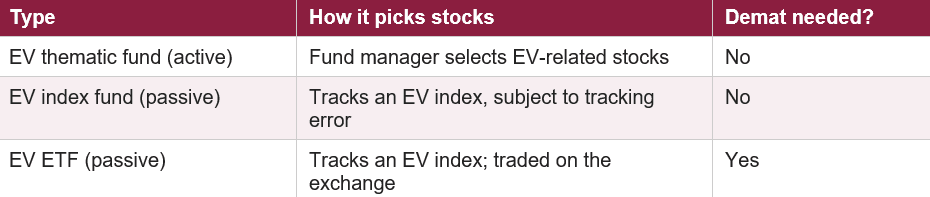
An EV index fund follows a published index methodology, so you can see which kinds of companies it holds and how much each can weigh. It does not rely on a fund manager's stock picks, and returns may differ from the index due to expenses and tracking error.
What does an EV mutual fund invest in?
An EV is more than a car brand. Every vehicle needs batteries, motors, electronics, software and raw materials. An EV fund may invest across this value chain. As an example, here is the basic industry mix of the Nifty EV & New Age Automotive Index:ⁱ
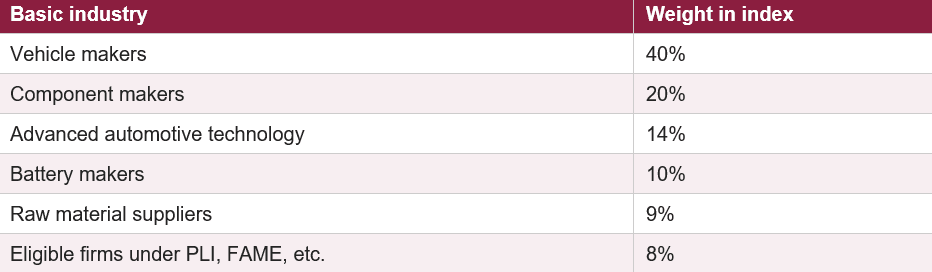
ⁱSource: Nifty Indices, data as of 30-Sep-2026. For illustration only. The scheme may or may not hold these in future.
'New age automotive' also covers hybrids, hydrogen fuel-based vehicles and autonomous-vehicle technology, not only battery EVs.
Benefits of investing in an EV mutual fund
• Access to a theme in one investment: You get exposure to many EV-linked businesses without buying each stock separately.
• Spread across the value chain: You are not depending on one carmaker or one technology. In the index above, vehicle makers are 40%, and the rest is spread across other parts of the chain.ⁱ
• Built-in concentration limits (index funds): The Nifty EV & New Age Automotive Index caps each vehicle maker at 8% and every other stock at 4%.ⁱ
• No demat account: Mutual fund units can be held without a demat account.
• Start small with SIP: Some EV funds allow SIPs from ₹100, which can help average purchase cost over time.
• Linked to a visible shift: Adoption is still early. Under 1 in 20 new cars sold in India in FY26 was electric, and HSBC estimates this could reach 1 in 4 by FY35. Estimates are not guaranteed.⁴
Risks of investing in an EV mutual fund
Every benefit above comes with a trade-off. Understand these before you invest:
• Concentration risk: One theme means less diversification than a flexi cap or large cap fund. If the theme goes through a weak phase, the whole fund can be affected.
• Higher volatility: Over 5 years, the Nifty EV & New Age Automotive TRI had annualised volatility of 17.3, against 14.4 for the Nifty 500 TRI.^
• Mid and small cap exposure: About 56% of the index is in mid and small caps, which can fall more sharply in market corrections.ⁱ
• Policy risk: Changes in subsidies, incentives or tax benefits can affect the sector.
• Import and input-cost risk: India depends on imports for many battery raw materials, so supply restrictions or price swings can hurt margins.
• Technology risk: Battery chemistries and vehicle technologies keep changing. Today's leaders may not lead tomorrow.
• Tracking error (index funds): Fund returns may not exactly match index returns.
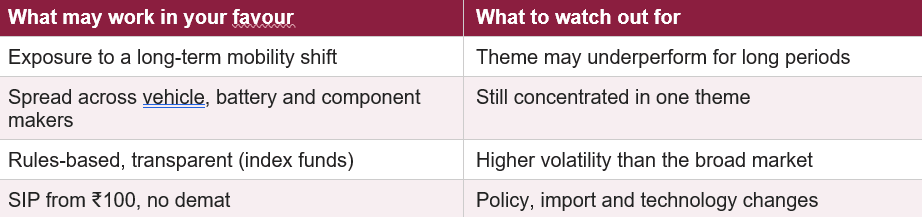
Benefits vs risks at a glance
Who may consider an EV mutual fund?
An EV fund is generally used as a small, satellite part of a portfolio, alongside a diversified core. It may be considered by investors who:
• Have an investment horizon of 5 years or more
• Are comfortable with very high risk and short-term ups and downs
• Already hold diversified equity funds and want to add a theme
How much to allocate depends on your goals and risk profile. Consult your financial adviser if in doubt.
Example: Axis Nifty EV & New Age Automotive Index Fund
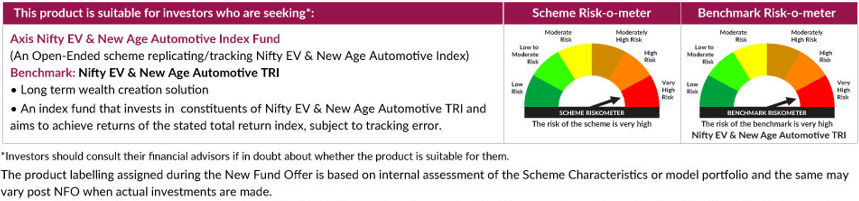
Axis Nifty EV & New Age Automotive Index Fund is an Open-Ended scheme replicating/tracking Nifty EV & New Age Automotive Index. It is India's first index fund on this index.* The NFO is open from 16 to 30 October 2026, with a minimum investment of ₹100 and in multiples of ₹1 thereafter, for SIP or lumpsum. The scheme riskometer is Very High. There is no assurance that the investment objective will be achieved.
Frequently asked questions
Is an EV mutual fund the same as an auto fund?
No. An auto fund mainly holds vehicle makers. An EV fund may also hold battery makers, component suppliers, electrical equipment and auto-tech companies.
What is the difference between an EV thematic fund and an EV index fund?
An EV thematic fund is actively managed, so a fund manager picks stocks. An EV index fund passively tracks an EV index, subject to tracking error.
Are EV mutual funds risky?
Yes, they carry high risk. Being thematic, they are concentrated in one theme and can be more volatile than diversified equity funds.
How are EV mutual funds taxed in India?
As equity-oriented funds, under current laws, gains on units held over 12 months are taxed at 12.5% above ₹1.25 lakh a year, and gains within 12 months at 20%. Tax laws can change.ⁱⁱⁱ
The bottom line
An EV mutual fund in India offers a way to participate in the electric mobility theme through a single investment. It can spread your money across the EV value chain, but it remains a concentrated, high-risk choice. Understand the theme, keep it as a limited part of a diversified portfolio, and read all scheme-related documents before investing.
Sources and disclaimers
*First Fund in the Index Category tracking the Nifty EV & New Age Automotive Index as on 7 October, 2026.
¹ Roads Reimagined: The Rise of India's Electric Vehicles Ecosystem, PIB: https://www.pib.gov.in/PressReleaseDetail.aspx?PRID=2294688®=48&lang=1
⁴ Source: HSBC Estimates, Vahan. Estimates are not guaranteed and actual outcomes may differ.
^ Source: Nifty Indices. Data as of 30-Sep-2026. Past performance may or may not be sustained in the future. The above information should not be construed as promise, guarantee or forecast of returns.
https://www.niftyindices.com/indices/equity/Thematic-indices/nifty-ev-new--age-automotive
ⁱ Source: Nifty Indices, data as of 30-Sep-2026. The Stocks/Sectors/Industries mentioned herein are for general assessment purpose only and not a complete disclosure of every material fact. It should not be construed as investment advice to any party. The scheme may or may not hold these in future.
ⁱⁱⁱ For individual nature of tax implications, investors are requested to consult their tax advisors before investing.
Axis Bank Ltd. is not liable or responsible for any loss or shortfall resulting from the operation of the scheme.
Mutual Fund investments are subject to market risks, read all scheme related documents carefully.
Calculator
View All


