
 All Articles
 All Videos
 All Infographics


Why are Tax Saving Funds Important for Wealth Creation?


(Article dated 04th feb, 2020)
It is necessary for investors to first identify the primary reason for their investment before making any type of investment. Yes, we are talking about having an investment objective and investment goal, which can allow investors to realize how much corpus they need to invest to reach the desired goal. Investors with moderately high risk appetite and eagerness to invest in equity oriented schemes like mutual funds.
What are tax saving schemes? Can they be utilized for wealth creation?
Section 80C comes under the Indian Income Tax Act, 1961. It allows taxpayers to claim a deduction on your gross taxable income by investing in various financial instruments. You can claim a tax deduction for tuition fees, insurance premiums, home loans, etc. Although these are some ways you can save tax, they cannot be considered as tools for wealth creation.
The current tax-saving schemes under Section 80C are as follows:
• Equity Linked Saving Scheme (ELSS)
• Unit Link Insurance Plan (ULIP)
• Public Provident Fund (PPF)
• Sukanya Samriddhi Yojana
• National Saving Certificate
• Senior Citizen Saving Scheme (SCSS)
• Bank Fixed Deposits (FDs)
• Insurance
Though most of the salaried employees indeed turn to tax saving schemes in the last quarter of the financial year, they fail to understand that these are just not good for saving tax, but can also be utilized for wealth creation, if invested smartly in.
Now let us focus on some schemes which can be of significant help investors with wealth creation:
- Public Provident Fund (PPF): Investors with low risk appetite and conservative investors can consider investing in PPF. Public Provident Fund (PPF) is a Central Government operated and guaranteed scheme and the most famous investment scheme opted by individuals with a long term investment horizon. PPF preponderantly invests in fixed income securities, and that churn out low but fixed returns, thus promising stability in income.
- Unit Linked Insurance Plan (ULIP): A ULIP plan is a financial product that slightly varies from your typical insurance policy. There is a premium you need to pay, and some part of this premium is invested in a variety of funds depending on what amount of risk you are will to take. If you want to bate a higher risk, you can invest in equity funds. But if your appetite for risk isn't too much, then you may want to settle for balanced funds.
- Bank fixed deposits (FDs): Investors with zero risk tolerance who do not wish to expose their finances to the vagaries of the equity markets can invest their money in bank fixed deposits.
The above investment tools under Section 80C might help you in wealth creation. But if you really want to increase your chances of making some good returns, you can consider investing in ELSS.
What is ELSS?
ELSS or Equity Linked Saving Scheme is the only mutual fund scheme that not only has the chance of returning you few gains, but it also helps in bringing down the investor's gross annual taxable income. Securities & Exchange Board of India or SEBI, ELSS as "An open ended equity linked saving scheme with a statutory lock in of 3 years and tax benefit". Of the total assets, a minimum investment of 80 percent is made in equity & equity related instruments.
ELSS, too, comes under Section 80C and is probably the only equity oriented scheme with tax benefits. If you wish to know further about ELSS and also if you want to find out why a tax saving scheme like ELSS is essential in wealth creation, read on:
Equity Linked Saving Scheme or ELSS is a mutual fund investment scheme that has a minimum lock-in period of three years and offers you a chance of investment capital appreciation in equity along with tax-saving benefits. Any individual with a moderately high-risk tolerance and long term investment goal can opt for an ELSS scheme. Under Section 80C of the Indian Income Tax Department, an individual can invest up to 1.5 lakh rupees* and claim tax benefit of up to Rs. 46,800 with ELSS.
Here's an example to further simplify how ELSS works
Lokesh Gupta is a senior manager in an international BPO with a taxable income of Rs. 12 lakh a year. That lands Lokesh's in the 30% tax bracket. Lokesh learns about ELSS and decides to invest a total amount of Rs. 1.5 lakh. As per 80C of the Indian income tax act, Lokesh's gross taxable income has now been reduced to Rs. 10.5 lakh as he can claim deductions worth 1.5 lakh rupees through his ELSS investments.
According to Section 80C, you can subtract the sum you invested in an ELSS from your annual income to decrease your overall taxable income hence, saving taxes. What many investors fail to realize that though ELSS is primarily a tax saving scheme, it is a decent investment too as well. If an individual plans to stay invested longer, they may gain some returns from ELSS.
How to invest in ELSS Fund?
You can invest in ELSS through SIP or Lump sum: When investors have a substantial amount parked in their savings account, which they wish to invest in order to fetch some better returns, may choose to pay the entire premium amount at the beginning of the investment cycle. This method of payment is known as a lump sum investment. Systematic Investment Plan or SIP is a systematic approach towards investment that can prove as an essential tool for investors. With SIP, all an investor needs to do is instruct their bank, and a certain amount will be deducted every month from their bank account and directed towards their investment. SIP is a straightforward and hassle-free process. One can ever refer to an SIP return calculator to get an approximate value of their ELSS investment. The best part about an ELSS scheme is that an investor can start his/her ELSS investment with amount mentioned in a particular Scheme as mentioned in SID This may be one way to understand the importance of savings because anyone can turn their savings into an investment. The discipline of regular savings might help an individual remain invested in their ELSS fund.
You can invest in ELSS through growth or IDCW option: ELSS funds offer two kinds of schemes for its investors: Growth and IDCW. In the growth option, if the scheme manages to make any profits, these gains are re-invested in the scheme. Over a period of time, this reinvestment may result in some growth in the net asset value of the scheme. Due to some vagaries in the market, if the scheme fails to perform, there are chances of the fund losing its NAV. When the scheme performs, the NAV of the fund increases, and in case of a loss, it goes down. Investors, if they wish to enjoy the profits, can opt to sell or redeem their investments in growth option.
On the other hand, the IDCW option refrains from re-investing your gains or profits made by the fund. Investors have a payout option where these gains or profits made by the scheme are distributed in the form of IDCW to the investor from time to time. The amount and frequency of IDCW, however, are never guaranteed. IDCW can only be declared when the scheme makes a profit. This also is solely at the discretion of the fund manager. So if you wish to benefit from the power of compounding, you can opt for growth option in an ELSS fund. But if your investments are one of the sources of your regular income, you can opt for IDCW option.
But how can I create wealth with a tax saving scheme like ELSS?
Investors with a long term investment horizon and a strong will to build a corpus usually are successful. That's because people who invest for the long run stand a chance of benefiting from the power of compounding. Investors, if they wish, can apply this strategy for all their equity oriented investments. ELSS, too, is an investment scheme that is meant for long term investment even though it has one of the shortest lock-in periods. That is because any long term mutual fund investment scheme can easily recover from market volatility as compared to short term investment schemes which can get affected by market volatility. Any market which is currently underperforming can become better in the longer run. Thus, investing in ELSS with a long term objective is essential for creating a corpus.
Now that you are aware of what ELSS is and how it functions, planning on some investment? If you have a moderately high risk appetite and seek capital appreciation through equity oriented schemes, you can consider investing in ELSS fund offered by Axis Mutual Funds. The ELSS fund offered by Axis Mutual Funds is an open ended equity linked scheme, whose investment objective is to generate income and long-term capital appreciation from a diversified portfolio of predominantly equity and equity-related securities.
Want to know more about the ELSS fund offered by Axis Mutual Funds? Here are some details
- The ELSS fund offered by Axis Mutual Funds is a diversified equity linked saving scheme (ELSS) that invests in a mix of large caps and select midcaps.
- The fund has a 3-year lock-in, which is one of the lowest amongst other tax saving instruments.
- Being an ELSS scheme, the scheme comes with dual advantages of building wealth and saving tax.
- The long term mutual fund has a 3-year lock-in, which is one of the lowest amongst other tax saving instruments.
However, there can be no assurance that the investment objective of the scheme will be achieved.
Having said that, all investments carry some amount of risk with them, and investors need not worry about bearing the losses. Having a positive attitude towards your investments might also help. There might be instances when you would have to consider withdrawing your investments, but if you manage to stay invested for the long term, you might be able to reap benefits.
Choosing the right investment scheme for wealth creation can get a bit confusing, but make sure that you opt for one that follows the same investment strategy as yours. Do some background checks like the scheme’s past performance, its benchmark, the fund size, CRISIL ranking, fund management, etc. Remember that a scheme that has proper fund management will have a good track record. But also remember that any scheme’s past performance might not replicate its current or future performance. Equity investments are constantly exposed to market volatility, and returns might fluctuate from time to time.
Tax saving schemes like ELSS not only increase your chances of growing your wealth, it also helps with tax benefits. You may stay invested in ELSS and reap tax benefits till your retirement. If you invest within your limits so that you do not become completely helpless in case your scheme isn’t able to provide capital appreciation. Also, do not invest beyond or risk appetite. Sometimes, the overachieving nature of a scheme might lure you into investing more than your limits but remember that equity investments carry high risk. Make sure you always have some backup and refrain from over investing.
Stick to your investment strategy, do not get influenced by the vagaries of the market. Remember that your money needs time to grow and hence, let the money do the hard work for you. Remember that it is your hard earned that you are investing in. Also, equity oriented investments had historically performed when people have remained invested in the long run. So hold on to your horses, and who knows, you too might be able to achieve your desirable corpus.
*As per the present tax laws, eligible investors (individual/HUF) are entitled to deduction from their gross income of the amount invested in Equity Linked Saving Scheme (ELSS) up to Rs.1.5 lakhs (along with other prescribed investments) under section 80C of the Income Tax Act, 1961. Tax savings of Rs. 46,800 mentioned above is calculated for the highest income tax slab. Investors are advised to consult his/her own Tax Consultant with respect to the specific amount of tax and other implications arising out of his/her participation in ELSS.
Axis Long Term Equity Fund
An open ended equity linked saving scheme with a statutory lock in of 3 years and tax benefit
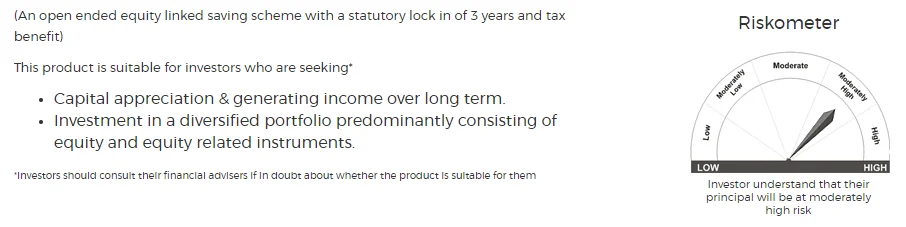
Mutual Fund Investments are subject to market risks, read all scheme related documents carefully.


Are you ready to plan and start your investment journey with Axis?



Download our app




Axis Bank Ltd. is not liable or responsible for any loss or shortfall resulting from the operation of the scheme.
Past performance may or may not be sustained in future. Please consult your financial advisor before investing.
Mutual fund investments are subject to market risks, read all scheme related documents carefully.
Copyright © 2020. All rights reserved Axis Mutual Fund.
Connect with us :


Privacy | Terms of Use | Disclaimer | Sitemap