
 All Articles
 All Videos
 All Infographics


How Investing In Mutual Funds Will Help You Save Taxes


Saving tax is probably one of the most important parts of any individual’s financial planning. Planning tax in a wise manner can allow you to save a significant amount of cash, which can be invested in gaining returns. Failing to plan taxes will make you lose a chunk of your hard-earned money.
If the primary purpose of your investment is to save tax, then you can consider investing your money in Equity Linked Saving Scheme (ELSS). Axis' ELSS Fund can be an ideal option for saving tax and gaining exposure to the equity market. Investors can choose from either the IDCW option or a growth option. Since ELSS invests in equity, which has a higher risk, it gives investors a chance to build wealth over a long investment horizon. Investors should bear in mind that ELSS is a mutual fund investment scheme, and returns from it aren’t guaranteed.
ELSS comes with a minimum lock-in period of three years. Investors can either withdraw their investment amount post the minimum lock-in period or can continue to stay invested, depending on their personal choice. Three year lock-in period means investors cannot withdraw or redeem their investments for a minimum of three years. Anyone who wants to save tax can claim a deduction of up to Rs. 1.5 lakh annually in ELSS, thus reducing their overall taxable income. There is no upper limit for investing in ELSS, and one can invest through SIP or lump sum depending on their financial situation.
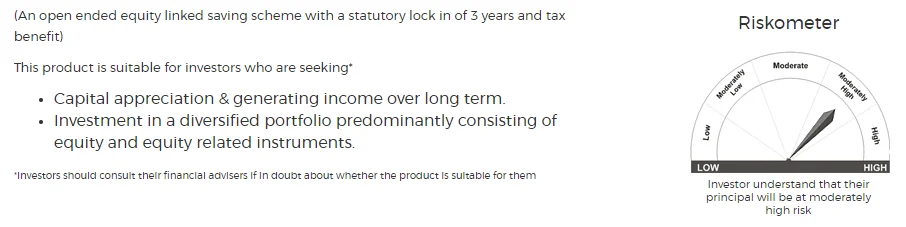
Equity Linked Saving Scheme or ELSS is a tax saving mutual fund scheme that allows investors to claim tax benefits worth Rs. 46,800 with an investment of up to Rs. 1.5 lakh as per Section 80C of the Indian Income Tax Act of 1961*. ELSS invests in equity markets, making it a moderately high-risk scheme.
How much tax can one save from investing in ELSS mutual fund scheme?
Gains are classified into long term capital gains (LTCG) and short term capital gains (STCG). Since ELSS investment has a mandatory lock-in period of three years, profits derived from ELSS investment are eligible for long term capital gains. The tax on equity gains was re-introduced in the 2018-2019 union budget. Long term capital gains derived from equity-oriented mutual fund investments above Rs. 1 lakh are subject to 10% tax deductions without indexation benefits. LTCG below Rs. 1 lakh is tax-free.
Paying income tax at the end of the financial year is a tedious task. If you fail to plan your tax, you will end up paying a significant amount in taxes of your hard-earned money. ELSS is an equity-oriented scheme which allows you to save tax and also gives you a chance to build wealth over a long investment horizon. Historically, mutual fund investments have fared well when allowed to perform for an extended period of time. Having said that, investors should also bear in mind that mutual fund investments are subject to market risks and returns are never guaranteed. Also, staying invested for long can prove beneficial as investors continue to save tax annually and at the same time, increase their chances of building a wealthy corpus, which may help them achieve their ultimate financial goal. You can easily track and manage your ELSS investments using the ELSS app.
*As per the present tax laws, eligible investors (individual/HUF) are entitled to deduction from their gross income of the amount invested in Equity Linked Saving Scheme (ELSS) up to Rs.1.5 lakhs (along with other prescribed investments) under section 80C of the Income Tax Act, 1961. Tax savings of Rs. 46,800 mentioned above is calculated for the highest income tax slab. Investors are advised to consult his/her own Tax Consultant with respect to the specific amount of tax and other implications arising out of his/her participation in ELSS.
Mutual Fund Investments are subject to market risks, read all scheme related documents carefully.


Are you ready to plan and start your investment journey with Axis?



Download our app




Axis Bank Ltd. is not liable or responsible for any loss or shortfall resulting from the operation of the scheme.
Past performance may or may not be sustained in future. Please consult your financial advisor before investing.
Mutual fund investments are subject to market risks, read all scheme related documents carefully.
Copyright © 2020. All rights reserved Axis Mutual Fund.
Connect with us :


Privacy | Terms of Use | Disclaimer | Sitemap