Axis Nifty LargeMidcap 250 Index Fund

banner-image

Axis Nifty LargeMidcap 250 Index Fund - Overview

India's Top 100 Large Caps + Top 150 Mid Caps. One Index Fund.

Invest in a rules-based portfolio that combines all companies in the Nifty 100 and Nifty Midcap 150. The index allocates 50% to each segment and resets the segment weights quarterly.

What is Axis Nifty LargeMidcap 250 Index Fund?

Axis Nifty LargeMidcap 250 Index Fund is a passive mutual fund that aims to track the Nifty LargeMidcap 250 Total Return Index. The index combines 100 large-cap and 150 mid-cap companies, with each segment carrying an aggregate 50% weight. The fund's returns may differ from the index because of expenses, cash holdings and tracking error.

Key facts at a glance

Feature Details
Scheme type An Open-Ended scheme replicating/tracking Nifty LargeMidcap 250 Index
Benchmark Nifty LargeMidcap 250 TRI
Portfolio universe All constituents of the Nifty 100 and Nifty Midcap 150
Segment allocation 50% large caps and 50% mid caps
Segment reset Quarterly
Index reconstitution Semi-annual
Minimum investment ₹100 & in multiples of ₹1 thereafter (during NFO and on an ongoing basis)
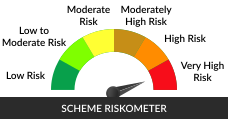
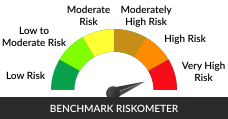
Riskometer Very High
Fund manager Mr. Nandik Mallik and Mr. Rohit Gautam
Exit load 0.25% if redeemed/switched out within 15 days from the date of allotment; Nil after 15 days

One fund. Two strengths.

LARGE CAP 50%

India's top 100 companies (Nifty 100)

  • Anchor the portfolio
  • Helps navigate weak markets
MIDCAP 50%

India's next 150 companies (Nifty Midcap 150)

  • Expand growth participation
  • Captures recovery and expansion

Why consider a 50:50 large-cap and mid-cap index?2

Two market-cap segments in one fund: Large caps can provide exposure to established businesses with relatively deeper liquidity, while mid caps can offer access to companies with room to scale. Both segments remain exposed to equity-market risk.

Rules-based quarterly reset: If one segment rises above 50%, the index resets the large-cap and mid-cap allocations to 50:50 at the scheduled quarterly reset. This is mechanical rebalancing, not a guarantee of buying at the bottom or selling at the top.

Broader stock and sector spread: The index holds 250 companies, with Financial Services (30.0%) and Consumer Discretionary (18.1%) as the largest sectors. The top 10 stocks make up 22.4% of the index.

No need to choose one segment: Holding both segments in fixed proportions reduces timing dependence, so there is no need to make a tactical choice between large caps and mid caps.

Established Strength Meets Emerging Growth. One fund.

LARGE CAPS

Stability & Resilience3

Strong profitability pool

  • Established businesses
  • Relatively stable earnings
  • Stronger balance sheets

Large cap: 1st – 100th company by full market cap

BLEND LARGE & MID CAPS

Stability meets growth

250 companies

Covers ~75%* of India's market cap

Exposure to 250 companies across sectors and business segments

MID CAPS

Growth Potential

Earnings and market growth

  • Emerging market leaders
  • Earnings growth potential
  • Greater headroom to scale

Mid cap: 101st–250th company by full market cap

Axis Nifty LargeMidcap 250 Index Fund - About the Index

About the Index

The Nifty LargeMidcap 250 Index represents India's large-cap and mid-cap segments in one rules-based index. It includes all 100 constituents of the Nifty 100 and all 150 constituents of the Nifty Midcap 150. The aggregate weight of each segment is 50%, and the 50:50 split is restored every quarter.*

Index Highlights

250 companies: all of the Nifty 100 + all of the Nifty Midcap 1501
50:50 large caps : mid caps, reset every quarter1
~75% of India's listed market value2
Semi-annual constituent review: March and September1
15.8% Total-return index 7-year CAGR1
₹15.4 lakh what ₹1 lakh invested in Oct 2005 grew to in the Nifty LargeMidcap 250 TRI (vs ₹11.3 lakh in the Nifty 50 TRI)^
7 of 7 trailing periods (1–20Y) ahead of Nifty 100 & Nifty 50 TRI^
14.7% average 5-year rolling return, vs 12.4% for the Nifty 50 TRI^

Axis Nifty LargeMidcap 250 Index Fund - Why Now?

6 reasons large + mid caps are in focus right now.


1 Valuations have cooled.

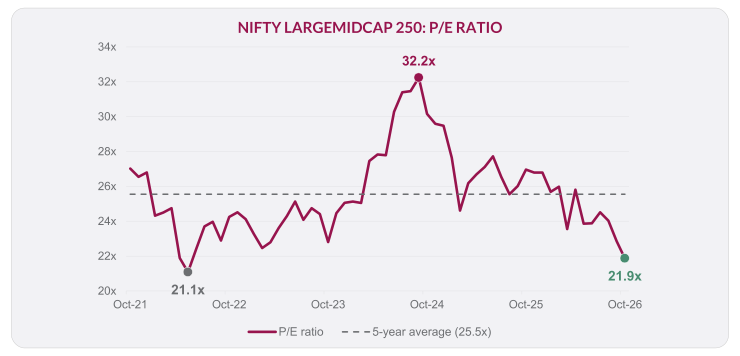
The Nifty LargeMidcap 250 P/E has eased from 32.2x at its Sep-2024 peak to 21.9x, now below its 5-year average of 25.5x.

Nifty LargeMidcap 250: P/E ratio4

2 Large caps or mid caps? Stop guessing. Own both.

The 50:50 blend keeps both engines running and reduces timing dependence, so you don't have to guess which one leads next.

3 Large Caps and Midcaps. In One SIP.5

This fund holds all of the Nifty 100 in its large-cap half, and adds the 150 companies right behind them in the other half. One fund, one SIP, and a wider slice of India's growth. Start from ₹100 in the NFO and add through SIP.

+150 mid-sized companies added alongside India's top 1001
50% weight to mid caps, reset every quarter1
~75% of India's listed market value covered by the 250 companies2
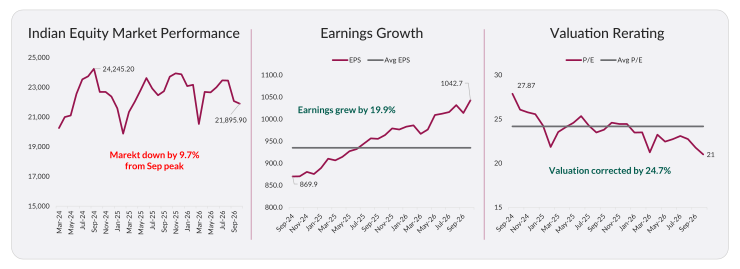
4 Valuations have become attractive led by earnings growth6

Since September 2024, Indian equities (represented by Nifty 500) have seen heightened volatility amid evolving global uncertainty but more importantly, the correction has been accompanied by an improvement in fundamentals.

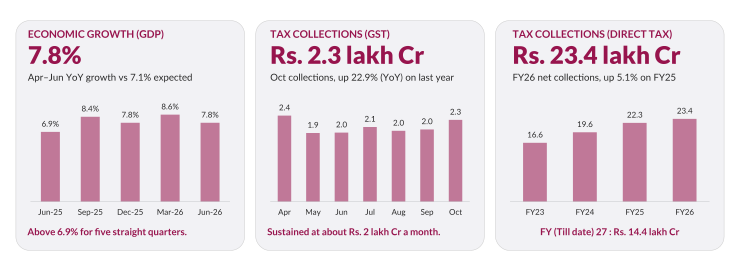
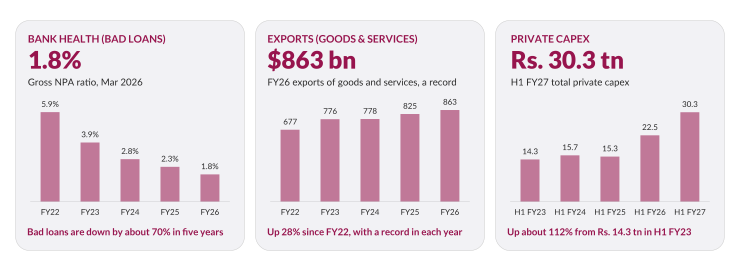
5 India's core fundamentals are strengthening.7

A stronger economy lifts growth of India's companies. GDP growth has beaten forecasts, and both GST and direct tax collections are rising.

Cleaner banks, record exports and doubled private capex signal a broad-based upswing.8

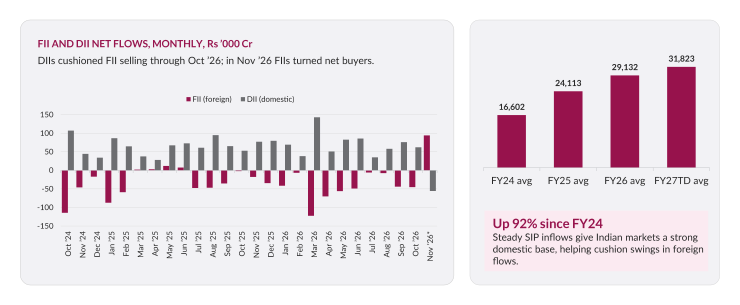
6 When Foreign Flows Wavered, Domestic Flows Held Firm

DIIs cushioned FII selling through Oct '26; in Nov '26 FIIs turned net buyers. Steady SIP inflows give Indian markets a strong domestic base, helping cushion swings in foreign flows.

FII and DII net flows, monthly (₹ '000 Cr) | Monthly SIP book: ₹29,132 Cr average monthly inflow in FY269

FIIs turned net buyers in Nov'26. Over the same period, Nifty 50 rose 10.7% and Nifty Midcap 150 rose 7.4%.

Axis Nifty LargeMidcap 250 Index Fund - Index Snapshot

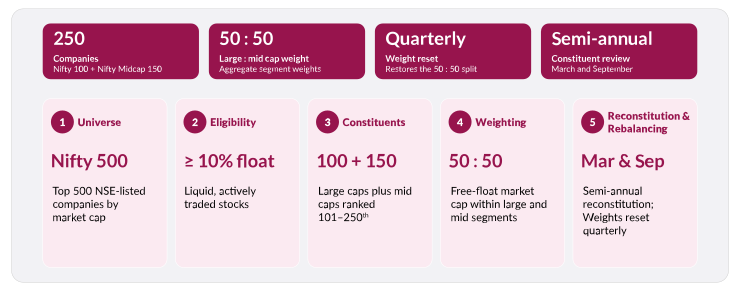
How the Nifty LargeMidcap 250 works.10

1
Pick
All Nifty 100 + all Nifty Midcap 150 stocks
2
Split
50% large caps, 50% mid caps
3
Rebalance
Reset to 50:50 every quarter
4
Review
Stock list reviewed twice a year

Index snapshot: data as of 30 October 202611

Metric Value
Companies 250
Top 10 weight 22.4%
Total-return index 7-year return 15.8%
P/E 21.9x
5-year average P/E 25.5x
Since Oct 2005 CAGR (TRI) 13.8%

Index : Methodology Snapshot12

Built-in rebalancing every quarter

Every quarter, the index restores the 50:50 split between large and mid caps. The constituent list is reviewed twice a year, in March and September.13

Top 10 constituents14

Company Weight
HDFC Bank 4.2%
ICICI Bank 3.9%
Reliance Industries 3.1%
Bharti Airtel 2.4%
Larsen & Toubro 1.8%
Infosys 1.7%
State Bank of India 1.6%
Axis Bank 1.4%
Kotak Mahindra Bank 1.3%
Laurus Labs 1.2%

Top 10 total weight: 22.4%

Sector allocation15

Sector Nifty LargeMidcap 250 (%) Nifty 100 (%) Nifty Midcap 150 (%)
Financial Services 30.0 33.7 26.1
Consumer Discretionary 18.1 12.6 24.0
Industrials 9.3 8.1 10.7
Healthcare 8.6 5.5 11.9
Commodities 8.1 7.6 8.5
Information Technology 6.7 7.9 5.5
Energy 5.5 8.5 2.4
Fast Moving Consumer Goods 5.1 5.5 4.7
Telecommunication 3.5 4.9 2.1
Utilities 3.2 3.8 2.5
Services 1.8 2.0 1.6
Diversified 0.0 0.0 0.1

Lower dependence on a handful of stocks16

In the Nifty 50, the top 10 stocks make up more than half of the index. In the Nifty LargeMidcap 250, they make up about 22%. No single stock is above 4.2%. This means more diversification, as the outcome depends less on a few large names.

50:50 large and mid-caps in equal measure
~22% Top 10 weight vs ~53% (Nifty 50)
~75% of India's listed market cap covered

Axis Nifty LargeMidcap 250 Index Fund - Index Performance

Long-term compounding17

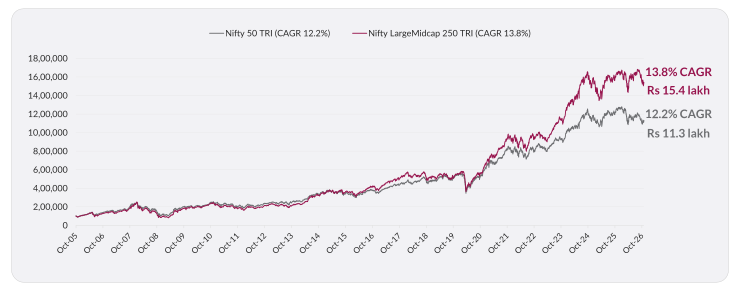
₹1 lakh invested in Oct 2005 grew to ₹15.4 lakh in the Nifty LargeMidcap 250 TRI vs ₹11.3 lakh in the Nifty 50 TRI, a CAGR of 13.8% vs 12.2%.

Performance Comparison18

CAGR

Data label Nifty 50 TRI Nifty 100 TRI Nifty Midcap 150 TRI Nifty LargeMidcap 250 TRI
1 Year -9.4% -8.2% -3.9% -6.0%
3 Years 7.7% 9.2% 13.7% 11.5%
5 Years 6.7% 7.2% 13.8% 10.6%
7 Years 11.2% 11.6% 20.0% 15.8%
10 Years 11.6% 11.7% 15.7% 13.8%
15 Years 11.6% 12.1% 17.3% 14.8%
20 Years 10.8% 11.2% 14.7% 13.0%

Annualised volatility

Period Nifty 50 TRI Nifty 100 TRI Nifty Midcap 150 TRI Nifty LargeMidcap 250 TRI
5 Years 13.8% 14.1% 16.8% 15.0%

Rolling returns19

Rolling returns 1 Year 3 Year 5 Year
Nifty LargeMidcap 250 TRI Nifty 50 TRI Nifty LargeMidcap 250 TRI Nifty 50 TRI Nifty LargeMidcap 250 TRI Nifty 50 TRI
Average 17.9% 14.7% 14.5% 12.1% 14.7% 12.4%
Median 11.9% 12.5% 15.5% 12.4% 14.9% 13.1%

CAGR ranges (% of total observations)

Range 1 Year 3 Year 5 Year
Nifty LargeMidcap 250 TRI Nifty 50 TRI Nifty LargeMidcap 250 TRI Nifty 50 TRI Nifty LargeMidcap 250 TRI Nifty 50 TRI
Negative 19.9% 19.3% 6.7% 1.7% 0.6% 0.1%
0% to 10% 26.4% 23.4% 21.7% 32.2% 21.2% 27.8%
10% to 15% 8.0% 14.7% 19.2% 34.8% 28.7% 42.7%
15% to 20% 6.7% 10.0% 23.6% 23.6% 29.7% 26.3%
Above 20% 39.1% 32.5% 28.7% 7.8% 19.9% 3.1%

A simple way to own both large and mid caps

Both in one

Both in one

Large caps and mid caps in a single fund.

Auto-rebalanced

Auto-rebalanced

Back to 50:50 every quarter. No action needed from you.

Keeps its winners

Keeps its winners

Mid caps that grow into large caps stay in the fund.

Well diversified

Well diversified

250 companies. The top 10 stocks make up 22.4% of the index.1
Low cost, passive

Low cost, passive

Tracks the index. No stock picking.

Easy to start

Easy to start

SIP from ₹100. No demat account needed.

Built for investors who want both.

icon

Starting out (25–35)

icon

Building wealth (35–50)

icon

Nifty 50 / Nifty 100 investors

icon

Mid-cap investors

icon

Long-term wealth creators

icon

SIP investors

icon

Passive investing enthusiasts

icon

Thematic & NFO investors

Axis Nifty LargeMidcap 250 Index Fund - How to Invest & Why Axis

Start investing in four simple steps.

1
KYC
Complete KYC online (skip if done).
2
Choose
SIP or lump sum, from ₹100.
3
Invest
Invest before [11th Dec].
4
Track
Track and invest anytime after the fund reopens.

Before investing, read the SID, KIM, product label, riskometer, benchmark riskometer and addendum.

Why Axis AMC?

₹4 lakh Cr+
overall AUM4
1 crore+
active investor accounts4
40+
passive funds across equity, debt & commodities4
Passive-first leadership
A committed leadership team focused on passive funds.
Index-expert research
Research led by professionals with 15+ years of experience.
New ideas, made simple
Continuous research on established and emerging ideas, such as India's first index fund on the Nifty EV & New Age Automotive Index.4
One-stop passive range
Index funds, ETFs and fund-of-funds across equity, debt and commodities, so you can build a full portfolio with one AMC.4
Built for SIP investors
Index funds with SIPs from ₹100 and no demat account needed. Invest through the Axis MF website or app, your distributor, or supported investment platforms.
Easy access
Invest through the Axis MF website or app, your distributor, or supported investment platforms.

Regulatory Info

Axis Nifty LargeMidcap 250 Index Fund

(An Open-Ended scheme replicating / tracking Nifty LargeMidcap 250 Index.)

Benchmark:Nifty LargeMidcap 250 TRI

  • To provide returns before expenses that correspond to the performance of Nifty LargeMidcap 250 TRI subject to tracking error.
  • There is no assurance that the investment objective of the scheme will be achieved.

*Investors should consult their financial advisers if in doubt about whether the product is suitable for them.

(The risk-o-meter assigned during the New Fund Offer is based on internal assessment of the Scheme Characteristics or model portfolio and the same may vary post NFO when actual investments are made)

Investors are advised to refer to the Statement of Additional Information (SAI) for details of the Axis MutualFund, Standard Risk Factors, Special Considerations, Tax and Legal issues and other general informationon www.axismf.com

riskometer
riskometer

Fund Manager

Mr. Rohit Gautam
Mr. Nandik Malik

Documents

Schemes pdf
Schemes pdf
Schemes pdf
Schemes pdf

FAQs

What is Axis Nifty LargeMidcap 250 Index Fund?
up arrow

Axis Nifty LargeMidcap 250 Index Fund is an open-ended scheme replicating/tracking the Nifty LargeMidcap 250 Index.

It aims to provide returns, before expenses, that correspond to the total returns of the Nifty LargeMidcap 250 Index, subject to tracking error. In simple terms: one fund that gives you India's top 100 companies and the next 150, balanced 50:50.

Why should I invest in Axis Nifty LargeMidcap 250 Index Fund?
arrow

What does "large cap stability and midcap speed" mean in Axis Nifty LargeMidcap 250 Index Fund?
arrow

How often is Axis Nifty LargeMidcap 250 Index Fund rebalanced?
arrow

Who should invest in Axis Nifty LargeMidcap 250 Index Fund?
arrow

When does the Axis Nifty LargeMidcap 250 Index Fund NFO open and close?
arrow

What is the minimum amount I can invest in the Axis Nifty LargeMidcap 250 Index Fund NFO?
arrow

How do I invest in the Axis Nifty LargeMidcap 250 Index Fund NFO?
arrow

Do I need a demat account to invest in Axis Nifty LargeMidcap 250 Index Fund?
arrow

Can I invest in Axis Nifty LargeMidcap 250 Index Fund after the NFO closes?
arrow

What is the risk of Axis Nifty LargeMidcap 250 Index Fund?
arrow

What is the Nifty LargeMidcap 250 Index?
arrow

How is Axis Nifty LargeMidcap 250 Index Fund different from a Nifty 100 index fund?
arrow

How is Axis Nifty LargeMidcap 250 Index Fund different from a mid-cap fund?
arrow

Does every stock have the same weight?
arrow

What happens when a mid-cap company becomes a large-cap company?
arrow

Is Axis Nifty LargeMidcap 250 Index Fund actively managed?
arrow

What is tracking error?
arrow

How is an index fund different from an ETF?
arrow

What investment horizon should I consider for Axis Nifty LargeMidcap 250 Index Fund?
arrow

Are index returns the same as fund returns?
arrow

How is Axis Nifty LargeMidcap 250 Index Fund taxed?
arrow

What is Axis Nifty LargeMidcap 250 Index Fund?

Axis Nifty LargeMidcap 250 Index Fund is an open-ended scheme replicating/tracking the Nifty LargeMidcap 250 Index.

It aims to provide returns, before expenses, that correspond to the total returns of the Nifty LargeMidcap 250 Index, subject to tracking error. In simple terms: one fund that gives you India's top 100 companies and the next 150, balanced 50:50.

Why should I invest in Axis Nifty LargeMidcap 250 Index Fund?

It gives you large cap stability and midcap speed in one fund, at a glance:

  • 250 companies: India's top 100 large caps plus the next top 150 mid caps.
  • 50:50 balance: half large caps, half mid caps, reset every quarter.
What does "large cap stability and midcap speed" mean in Axis Nifty LargeMidcap 250 Index Fund?

Large cap stability: half the fund is in India's 100 largest, well-established companies.

Midcap speed: the other half is in the next 150 companies, many still growing.

Both in one fund, so you don't have to choose.

How often is Axis Nifty LargeMidcap 250 Index Fund rebalanced?

The fund follows its index, which has two rebalancing cycles:

Every quarter: the large-cap and mid-cap halves are reset to 50:50. Whichever half ran ahead is trimmed and the other is topped up.

Twice a year: the list of 250 companies is reviewed in March and September, along with the Nifty 100 and Nifty Midcap 150.

This happens inside the fund, so you don't need to redeem or switch anything to rebalance.

Who should invest in Axis Nifty LargeMidcap 250 Index Fund?

It may suit:

  • Investors building a core equity portfolio with both stability and growth potential
  • Existing Nifty 50 / Nifty 100 investors who want to add mid-cap exposure
  • Mid-cap investors who want a large-cap cushion
  • First-time and SIP investors looking for one simple, rules-based fund

Please consult your financial adviser if in doubt about whether the product is suitable for you.

When does the Axis Nifty LargeMidcap 250 Index Fund NFO open and close?

The NFO opens on [27th Nov 2026] and closes on [11th Dec 2026]. Units are allotted during the NFO. Applications must be submitted before the cut-off time on the closing date.

After that, the scheme reopens for continuous purchase and redemption at NAV.

What is the minimum amount I can invest in the Axis Nifty LargeMidcap 250 Index Fund NFO?

The minimum investment is ₹100, and in multiples of ₹1 thereafter, both during the NFO and on an ongoing basis.

How do I invest in the Axis Nifty LargeMidcap 250 Index Fund NFO?

Through the Axis Mutual Fund website or app, your mutual fund distributor, or supported investment platforms during the NFO period. Complete KYC, choose SIP or lump sum, and invest before the NFO closes on [11th Dec 2026].

Do I need a demat account to invest in Axis Nifty LargeMidcap 250 Index Fund?

No. This is an index fund, not an ETF, so you don't need a demat or trading account. Units are bought and sold at the end-of-day NAV.

Can I invest in Axis Nifty LargeMidcap 250 Index Fund after the NFO closes?

Yes. It is open-ended, so after allotment it reopens for continuous purchase and redemption at the applicable NAV, through SIP or lump sum.

What is the risk of Axis Nifty LargeMidcap 250 Index Fund?

The scheme risk is very high. Please read the riskometer and product label in the SID/KIM before investing.

What is the Nifty LargeMidcap 250 Index?

The Nifty LargeMidcap 250 Index is an NSE index that tracks India's top 250 companies by market value in one portfolio. It combines:

  • All 100 stocks of the Nifty 100: India's largest companies (large caps, ranked 1–100).
  • All 150 stocks of the Nifty Midcap 150: the next 150 companies (mid caps, ranked 101–250).

Large caps and mid caps each get 50% weight, and that split is reset every quarter. Within each half, stocks are weighted by free-float market cap. The index universe is the Nifty 500, and the constituent list is reviewed every March and September.1

How is Axis Nifty LargeMidcap 250 Index Fund different from a Nifty 100 index fund?

A Nifty 100 index fund holds only India's 100 largest companies. Axis Nifty LargeMidcap 250 Index Fund tracks an index that holds those same 100 companies plus the next 150 mid caps, at 50% weight each.

How is Axis Nifty LargeMidcap 250 Index Fund different from a mid-cap fund?

A mid-cap fund invests mainly in mid caps. This fund keeps 50% in large caps, and other 50% in mid caps.

Does every stock have the same weight?

No. The two segments have equal aggregate weights, but individual stocks are not equally weighted. Stocks within each segment are weighted by free-float market capitalisation.

What happens when a mid-cap company becomes a large-cap company?

The company may move between the underlying Nifty Midcap 150 and Nifty 100 during scheduled index reconstitution. If it remains in either underlying index, it can continue as a constituent of the Nifty LargeMidcap 250 Index, subject to the index methodology.

Is Axis Nifty LargeMidcap 250 Index Fund actively managed?

No. It is a passive index fund. The portfolio is managed to replicate the underlying index rather than to select stocks with the aim of outperforming it.

What is tracking error?

Tracking error measures how much the fund's returns vary from the benchmark over time. Expenses, cash balances, corporate actions, trading costs and execution timing can cause differences.

How is an index fund different from an ETF?

An index fund is bought or redeemed with the mutual fund at the applicable NAV and generally does not require a demat account. An ETF trades on a stock exchange and normally requires a demat and trading account.

What investment horizon should I consider for Axis Nifty LargeMidcap 250 Index Fund?

The fund is designed for long-term equity investing. Investors should choose a horizon aligned with their goals and ability to tolerate periods of sharp market decline; no holding period can guarantee returns.

Are index returns the same as fund returns?

No. Historical index returns are hypothetical for the scheme. Actual fund returns will be after expenses and may differ because of tracking error and tracking difference.

How is Axis Nifty LargeMidcap 250 Index Fund taxed?

Tax treatment depends on the scheme's tax classification and the law applicable when units are sold. Tax laws may change. Please consult your tax adviser.

Axis Nifty LargeMidcap 250 Index Fund - Sources & Disclaimers

SOURCES & DISCLAIMERS

*Data as of 30th Oct, 2026, NiftyIndices.com and BSEIndia.com; ^ Largecaps being equity may experience volatility.. There is no assurance or guarantee of returns.

Source : https://www.niftyindices.com/indices/equity/broad-based-indices/nifty-largemidcap-250 Date : Oct 2026. Text / charts mentioned above are used to explain the concept and are for illustration purpose only.

Source : Nifty indices. https://www.niftyindices.com/indices/equity/broad-based-indices/nifty-largemidcap-250 Performance is calculated using Total Return Index (TRI), with zero cost / expenses and tracking difference / error. Date : 30-Oct-2026; Past performance may or may not be sustained in the future. The above information should not be construed as promise, guarantee or forecast of returns. Table / Charts mentioned above are used to explain the concept and is for illustration purpose only. Daily closing values rebased to Rs 1,00,000. Performance of the scheme shall vary from the index performance due to tracking error

Source : Nifty indices. Date : 30-Oct-2026; Past performance may or may not be sustained in the future. The above information should not be construed as promise, guarantee or forecast of returns. Table / Charts mentioned above are used to explain the concept and is for illustration purpose only. Performance of the scheme shall vary from the index performance due to tracking error

Source: Nifty Indices. Data period: 30-09-2005 to 30-Oct-2026. Returns are for Total Return Index (TRI). Past performance may or may not be sustained in future. The above information should not be construed as promise, guarantee or forecast of returns. Table / charts mentioned above are used to explain the concept and are for illustration purpose only. Performance of the scheme shall vary from the index performance due to tracking error

Source : Nifty Indices as on 30-Oct-2026. Past performance may or may not be sustained in future. For illustration purpose only.

1. Source: Nifty Indices, https://www.niftyindices.com/indices/equity/broad-based-indices/nifty-largemidcap-250 Date : Oct 2026. Text is used to explain the concept and is for illustration purpose only.

2. Source: Nifty Indices, https://www.niftyindices.com/indices/equity/broad-based-indices/nifty-largemidcap-250. Index structure: Oct 2026; top 10 weight and sector weights: 30-Oct-2026 (sector classification and weights as per data provided). Text / charts mentioned above are used to explain the concept and are for illustration purpose only. Past performance may or may not be sustained in future.

3. *Data as of 30th Oct, 2026, NiftyIndices.com and BSEIndia.com; ^ Largecaps being equity may experience volatility.. There is no assurance or guarantee of returns.

4. Source: NSE Indices factsheets (30 Oct 2026); Dec-23 onward: Index Screener; Oct-21 to Nov-23 P/E values are approximate. 5-year average is the mean of 61 monthly P/E readings (Oct-21 to Oct-26). Past valuations are not an indicator of future valuations or returns. The graphs/visuals are used to explain the concept and are for illustration purposes only.

5. Source: Nifty Indices, https://www.niftyindices.com/indices/equity/broad-based-indices/nifty-largemidcap-250 Date : Oct 2026 (large caps: 1st–100th and mid caps: 101st–250th company by full market cap; 50:50 weights, quarterly reset). ~75% of India's listed market cap covered: Nifty Indices as on 30-Oct-2026. Text / charts mentioned above are used to explain the concept and are for illustration purpose only.

6. Source: https://www.niftyindices.com/ Date : 30-Oct-2026; Data on Nifty 500 Index used as proxy for Indian Equity Market, since it represents more than 90% of India's listed market capitalisation. Similarly EPS and PE data is of Nifty 500 Index

7. Source: https://pib.gov.in/PressReleasePage.aspx?PRID=2304949 ; https://www.gst.gov.in/newsandupdates ; https://dor.gov.in/central-tax-collections ; https://www.incometaxindia.gov.in/documents/d/guest/direct-tax-collections-for-fy2025-26-as-on-31-03-2026-pdf. Charts are for illustration purposes only.

8. Source: https://www.rbi.org.in/Scripts/PublicationReportDetails.aspx?UrlPage=&ID=1319 ; https://www.commerce.gov.in/files/d-m-y/6pib.pdf ; https://www.deloitte.com/us/en/insights/topics/economy/asia-pacific/india-economic-outlook.html. Charts are for illustration purposes only.

9. Source: https://trendlyne.com/macro-data/fii-dii/month/cash-month/, https://www.amfiindia.com/mutual-fund, https://www.niftyindices.com/reports/historical-data (Nov '26 returns (30 Oct close → 19 Nov close)

10. Source : https://www.niftyindices.com/indices/equity/broad-based-indices/nifty-largemidcap-250 Date : Oct 2026. Text / charts mentioned above are used to explain the concept and are for illustration purpose only.

11. Source: Nifty Indices, https://www.niftyindices.com/indices/equity/broad-based-indices/nifty-largemidcap-250, data as of 30-Oct-2026. P/E and 5-year average P/E (mean of 61 monthly P/E readings, Oct-21 to Oct-26): NSE Indices factsheets. Since Oct 2005 CAGR: Total Return Index (TRI), with zero cost / expenses and tracking difference / error. Past performance may or may not be sustained in the future. Table / Charts mentioned above are used to explain the concept and is for illustration purpose only.

12. Source: https://www.niftyindices.com/indices/equity/broad-based-indices/nifty-largemidcap-250 Date: Oct 2026. Text / charts mentioned above are used to explain the concept and are for illustration purpose only.

13. Source : https://www.niftyindices.com/indices/equity/broad-based-indices/nifty-largemidcap-250 Date : Oct 2026. Text / charts mentioned above are used to explain the concept and are for illustration purpose only.

14. Source : https://www.niftyindices.com/indices/equity/broad-based-indices/nifty-largemidcap-250 Date : 30-Oct-2026. Table / Charts mentioned above are used to explain the concept and are for illustration purpose only. The Stocks/Sectors/Industries mentioned herein are for general assessment purpose only and not a complete disclosure of every material fact. The scheme may or may not hold these stocks in future.

15. Source : https://www.niftyindices.com/indices/equity/broad-based-indices/nifty-largemidcap-250. Sector classification and weights as per data provided. Table is used to explain the concept and is for illustration purpose only. Past performance may or may not be sustained in future.

16. Source : Nifty Indices as on 30-Oct-2026 (https://www.niftyindices.com/indices/equity/broad-based-indices/nifty-largemidcap-250). Past performance may or may not be sustained in future. For illustration purpose only. Stocks mentioned for illustration only; not a recommendation. The scheme may or may not hold these stocks in future.

17. Source : Nifty Indices. https://www.niftyindices.com/indices/equity/broad-based-indices/nifty-largemidcap-250 Performance is calculated using Total Return Index (TRI), with zero cost / expenses and tracking difference / error. Date : 30-Oct-2026; Past performance may or may not be sustained in the future. The above information should not be construed as promise, guarantee or forecast of returns. Table / Charts mentioned above are used to explain the concept and is for illustration purpose only. Daily closing values rebased to Rs 1,00,000. Performance of the scheme shall vary from the index performance due to tracking error

18. 1-year returns are absolute; longer periods are CAGR. Source : Nifty Indices (https://www.niftyindices.com/indices/equity/broad-based-indices/nifty-largemidcap-250). Date : 30-Oct-2026; Performance is calculated using Total Return Index (TRI), with zero cost / expenses and tracking difference / error. *These are index returns, not scheme returns. The scheme is new and has no performance track record. Past performance may or may not be sustained in the future. The above information should not be construed as promise, guarantee or forecast of returns. Table / Charts mentioned above are used to explain the concept and is for illustration purpose only. Performance of the scheme shall vary from the index performance due to tracking error

19. Source: Nifty Indices, https://www.niftyindices.com/indices/equity/broad-based-indices/nifty-largemidcap-250. Data period: 30-09-2005 to 30-Oct-2026. Returns are for Total Return Index (TRI). Past performance may or may not be sustained in future. The above information should not be construed as promise, guarantee or forecast of returns. Table / charts mentioned above are used to explain the concept and are for illustration purpose only. Performance of the scheme shall vary from the index performance due to tracking error.

20. Source: Nifty Indices, https://www.niftyindices.com/indices/equity/broad-based-indices/nifty-largemidcap-250 as on 30-Oct-2026 (top 10 weight).

21. Source: Nifty Indices, https://www.niftyindices.com/indices/equity/broad-based-indices/nifty-largemidcap-250. Date : 30-Oct-2026. 20-year CAGR and 5-year annualised volatility are for Total Return Index (TRI), with zero cost / expenses and tracking difference / error. Past performance may or may not be sustained in the future. Please consult your financial adviser if in doubt about whether the product is suitable for you.