
Axis Nifty500 Low Volatility 50 Index Fund


Overview
Investment Objective
To provide returns before expenses that correspond to the performance of Nifty500 Low Volatility 50 TRI subject to tracking error. There is no assurance that the investment objective of the scheme will be achieved.
Entry Load, Exit Load & Tax
| If redeemed/ switched out within 15 days | |
| From the date of allotment | 0.25% |
| If redeemed/ switched out after 15 days | |
| From the date of allotment | Nil |
Minimum Investment Amount
Underlying Index Details
This product is suitable for investors who are seeking*
- Long term wealth creation solution
- An index fund that invests in constituents of Nifty500 Low Volatility 50 TRI and aims to achieve returns ofthe stated total return index, subject to tracking error.
Fund Manager


Fund Quants

Tracking Difference
| Fund Names | 1 Year | 3 Year | 5 Year | 10 Year | Since Inception |
|---|---|---|---|---|---|
| Axis Nifty500 Low Volatility 50 Index Fund | N/A | N/A | N/A | N/A | -0.71 |
Tracking Error
Disclaimer : Tracking Error and Tracking Difference data powered by ICRA Analytics (Disclaimer - https://www.icraanalytics.com/terms-of-use/disclaimer)
Portfolio

Asset Cap Mix
Portfolio Summary
Holdings
| Stocks | % of holdings |
|---|---|
| State Bank of India | 4.98 |
| Sun Pharmaceutical Industries Limited | 4.92 |
| Tata Consultancy Services Limited | 4.91 |
| NTPC Limited | 4.88 |
| Bharti Airtel Limited | 4.78 |
Similar Funds


Documents
Presentation

SID
KIM
One Pager
Frequently asked questions
An open-ended index fund that tracks the Nifty500 Low Volatility 50 TRI by investing in the same 50 stocks in similar proportions, subject to tracking error. These are the 50 least-volatile, most stable stocks in the Nifty 500.
The NFO is open from 9 September 2026 (Wednesday) to 22 September 2026 (Tuesday).
Just ₹100, and in multiples of ₹1 thereafter- for both SIP and Lumpsum, during the NFO and on an ongoing basis.
A factor-based strategy that deliberately buys stocks with smaller, calmer price movements. Historically, such stocks have offered smaller drawdowns in crises and competitive long-term returns- the “low volatility anomaly.”
Not historically. Over 1Y to 20Y periods, the Nifty500 Low Volatility 50 TRI has outperformed both the Nifty 50 TRI and Nifty 500 TRI- while taking on lower risk. Past performance may or may not be sustained in future.iv
Historically ~20–30% less than the broad market. During the Global Financial Crisis the strategy fell ~48% versus ~63% for the Nifty 500 TRI, and during Covid-19 it fell ~29% versus ~37%.i
A Nifty 50/500 index fund weights stocks purely by market cap. This fund applies a low-volatility filter and weighting, tilting towards potentially stable, relatively less-jittery companies for a smoother ride and better downside protection.
Yes. A low-volatility index has historically shown steadier, more consistent rolling returns – well suited to disciplined monthly SIP investing.
No. It is predominantly large-cap (~80%) with a meaningful mid-cap (~18%) and a small small-cap (~1%) allocation – a balanced, diversified profile.iii
A diversified mix led by TCS, SBI, Sun Pharma, Bharti Airtel, NTPC, Maruti Suzuki, Power Grid, UltraTech Cement, Bajaj Auto and Apollo Hospitals, spread across healthcare, autos, financials, utilities and more (as of 31-Jul-2026).iii
Semi-annually, in June and December, as per NSE Indices’ methodology. The fund realigns its portfolio accordingly.vii
As a stable core. It may pair well with a a strategy that may behave very differently from Low Volatility strategy across market cycles.
As an index fund it aims to keep costs low. The exact BER/ TER will be announced by the AMC post re-opening of the Scheme and is subject to change within SEBI limits- please check the Axis Mutual Fund website at the time of investing.
It measures how closely the fund’s returns follow the benchmark, after expenses, cash holdings and rebalancing. A lower tracking error means more closer index replication.
Yes – 0.25% if redeemed or switched out within 15 days of allotment; Nil thereafter.
This is anopen-ended index fund, bought and redeemed at day-end NAV, and it supports SIPs – with no demat or trading account required.
The scheme is managed by Mr. Nandik Malik and Mr. Rohit Gautam.
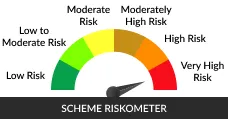
All equity investing carry market risk, and the scheme riskometer is ‘Very High’.
Stocks are picked from the Nifty 500 universe and scored on low volatility, calculated as the inverse of standard deviation of the previous 1-year price returns (log normal); the 50 highest-scoring stocks are included and weighted by that score rather than by market cap.vii
By a stock's daily price standard deviation over a 12-month period.vii
The top 10 stocks account for ~45% of index weight, with the largest single holding at 5.4%.iii
Led by Healthcare (~21.8%), Consumer Discretionary (~18.2%) and Financial Services (~13.3%), with Utilities ~11.2%, IT ~8.8%, FMCG ~8.1%, Commodities ~7.0%, Energy ~6.9% and Telecom ~4.8%.iii
Yes; 20-year annualised volatility of 15.6% versus 20.4% for the Nifty 50 TRI and 19.9% for the Nifty 500 TRI, with lower volatility across every period from 1 to 20 years.iv
Past performance may or may not be sustained in the future.
A 20-year SIP of ₹24,00,000 invested would be worth ~₹1,41,19,611 (15.5% XIRR), against ~₹1,04,05,942 (13.0% XIRR) for the Nifty 500 TRIv
Past performance may or may not be sustained in the future. Refer table above for returns


Invest Now
