
 All Articles
 All Videos
 All Infographics


Is it the right time to invest in balanced advantage funds now?


Two of the primary goals for every investor are – first, to grow their invested sum over the long term and second, to protect their invested sum throughout the investment horizon. There are several investment schemes that offer both returns and capital protection, but each carries a different type of risk and has a different rate of return. New investors are often left confused as they lack the knowledge to adequately diversify their portfolios across asset classes. Investors are often confused as they don’t know if they should consider equity as an asset class or debt asset class. Most financial experts suggest investors have a well-diversified portfolio so that the overall investment risk is mitigated. But what if there is a mutual fund that invests in both equity and debt, thus offering diversification across asset classes through a single investment?
It is now possible to invest across asset classes through balanced advantage funds.
What is a balanced advantage fund?
A balanced advantage fund that invests the majority of its investible corpus in equity and the remaining of the corpus in debt. A balanced advantage fund manager dynamically manages the portfolio by investing in the right mix of equity and debt related instruments. The fund aims to generate optimum capital appreciation while minimizing the investment risk through a diversified portfolio of mixed assets.
Is it right to invest in a balanced advantage fund?
Investors with a long term investment horizon seeking investment in a scheme that dynamically shifts their portfolio to suit the changing market conditions can consider investing in balanced advantage funds. To systematically invest in balanced advantage funds for the long haul, investors may consider opting for a Systematic Investment Plan.
SIP is a tool to invest in mutual funds like balanced advantage funds. All an investor has to do is decide on the monthly SIP sum and decide on which date of every month they want to invest this sum. If they automate their SIP transactions, every month a fixed SIP sum will be debited from the investor’s savings account and electronically transferred to their investment portfolio. Depending on the NAV, investors will receive balanced advantage fund units.
Why start a SIP in balanced advantage funds?
Investors do not need to time the market when starting their mutual fund journey with SIP. That’s because long term SIP investments are known to take advantage of volatile markets through an investment technique referred to as rupee cost averaging. The NAV of a balanced advantage fund is bound to fluctuate from time to time. Several factors determine whether a mutual fund’s NAV will go up or come down. Since the SIP investment sum remains stagnant, investors can buy more units when the NAV is low and fewer units when the NAV of the balanced advantage fund is high. This method of investing is known to give investors an opportunity to buy more units in the long run, thus averaging out their cost of purchase. These days, a retail investor can even go online and search for a SIP calculator, a free tool that shows the total estimated returns which one’s SIP investments may generate over a certain duration.
Diversify your investment portfolio with Axis Balanced Advantage Fund
Axis Balanced Advantage Fund is an open ended dynamic asset allocation fund.
Investment objective
To achieve the dual objective of capital appreciation by investing in a portfolio of equity or equity linked securities and generating income through investments in debt and money market instruments. It also aims to manage risk through active asset allocation. However, there is no assurance or guarantee that the investment objective of the Scheme will be achieved. The Scheme does not assure or guarantee any returns.
Benefits of investing in Axis Balanced Advantage Fund
- This balanced mutual fund is a hybrid fund that invests in a mix of equity and debt instruments basis market conditions using a systematic rule based model to dynamically adjust the equity allocation over time.
- This dynamic asset allocation fund removes the need for investors to time the market.
- This balanced mutual fund protects the downside by reducing drawdowns
- This hybrid fund factors inputs from multiple market variables
- Axis Balanced Advantage Fund allows you to avail equity taxation
Before investing in this fund, retail investors are expected to consult their financial advisor to determine whether this fund is ideal for their financial goals.
Axis Balanced Advantage Fund
An open ended dynamic asset allocation fund
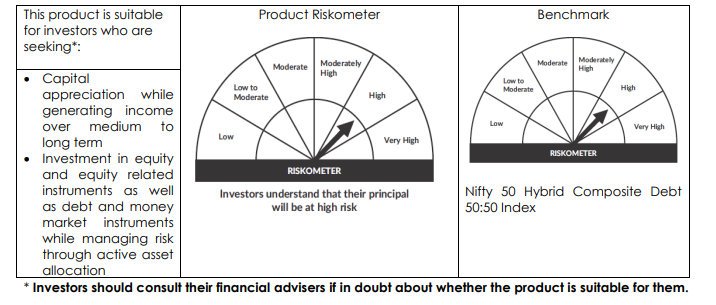
Mutual Fund Investments are subject to market risks, read all scheme related documents carefully.


Are you ready to plan and start your investment journey with Axis?



Download our app




Axis Bank Ltd. is not liable or responsible for any loss or shortfall resulting from the operation of the scheme.
Past performance may or may not be sustained in future. Please consult your financial advisor before investing.
Mutual fund investments are subject to market risks, read all scheme related documents carefully.
Copyright © 2020. All rights reserved Axis Mutual Fund.
Connect with us :


Privacy | Terms of Use | Disclaimer | Sitemap