
 All Articles
 All Videos
 All Infographics


Bluechip Fund - What are the Growth & IDCW Options?


It is true that for a lot of us, our monthly income isn’t sufficient, and hence, we look for investment schemes that might help us in attaining some financial stability in the near future. But before putting their hard earned money in any type of investment scheme, an investor must always keep her or his financial goal in mind and make sure that aligns with her or his risk appetite and investment horizon. Investing with your limits is equally essential since no investment scheme can guarantee any returns, and there is a possibility during the worst case scenario for you even to lose some of your initial investment. We are not scaring you, just making you aware of the possible risks involved. On the flip side, one may needn’t necessarily bear losses, and investors who stick to their investment strategy and a long term investment horizon can expect some returns from their investments in equity oriented schemes like mutual funds.
Mutual funds are a type of investment tool, where the money collected from investors is majorly invested in the equity market. In SEBI’s own words, “Mutual fund is a mechanism for pooling the resources by issuing units to the investors and investing funds in securities in accordance with objectives as disclosed in offer document. Investments in securities are spread across a wide cross-section of industries and sectors, and thus the risk is reduced. Diversification reduces the risk because all stocks may not move in the same direction in the same proportion at the same time. Mutual fund issues units to the investors in accordance with quantum of money invested by them. Investors of mutual funds are known as unitholders.”
What AMCs do is that they collect funds from investors sharing a common investment objective and invest this pool of funds in various money market instruments like equity, debt bonds, government securities, etc. Once you invest in a mutual fund, you are allotted units in the form of NAV. Net asset value or NAV is the current value of a fund’s outstanding shares minus its liabilities. The NAV of a fund may take a fleet or decline, depending on the performance of the scheme.
What is Axis Bluechip fund?
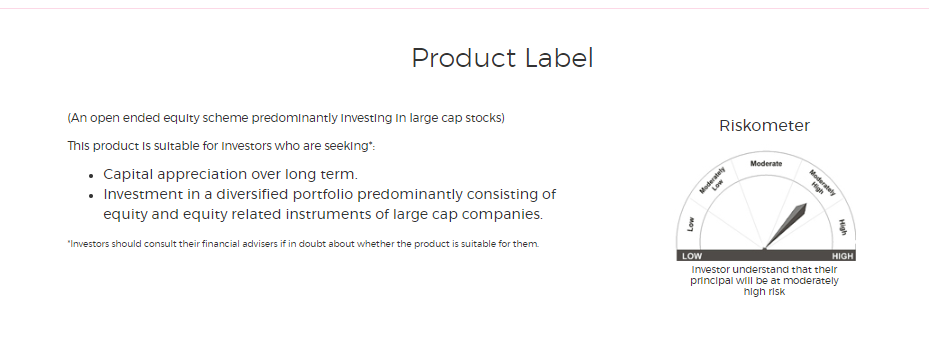
If you are an investor with moderately high risk appetite and someone who seeks capital appreciation through equity investments, you might want to consider investing Axis Bluechip Fund. Axis Bluechip Fund’s investment objective is to achieve long term capital appreciation by investing in a diversified portfolio predominantly consisting of equity and equity related securities of Large Cap companies, including derivatives. However, there can be no assurance that the investment objective of the scheme will be achieved.
Axis Bluechip Fund is available for investors in two type of schemes – Growth & IDCW. If you too are keen on investing in mutual funds and want to understand the difference between growth and IDCW plans, read further:
What is Growth & IDCW in Axis Bluechip Fund?
Axis Bluechip Fund offers two kinds of schemes: Growth and IDCW. In the growth option, if the scheme manages to make any profits, these gains are invested back into the scheme. Over time, this may result in the growth in the net asset value of the scheme. Due to some vagaries in the market, if the scheme fails to perform, the NAV of the fund goes down.
When the scheme performs, the NAV upswings, and when the market is on the decline, the NAV goes down. Investors, if they wish to enjoy the profits, can opt to sell or redeem their investments in growth option.
On the other hand, the IDCW option refrains from reinvesting your gains or profits made by the fund. Investors have a payout option where these gains or profits made by the scheme are distributed in the form of IDCW to the investor from time to time. The amount and frequency of IDCW, however, are never guaranteed. IDCW can only be declared when the scheme makes a profit. This also is solely at the discretion of the fund manager.
Should I invest in growth or IDCW?
Well, the answer to this question may depend on what type of investor you are and your requirement of funds. If you are someone who is relying on your investments for a regular income, the IDCW option might work in your favor. When the markets are all time high (which might not be the case every time), investors may benefit from the IDCW option. However, investors opting for IDCW may lose out on the benefit of the power of compounding. Investors with a long term investment horizon might find growth option a bit more suitable for them, and these investors also stand a chance of benefiting from the power of compounding.
So have you decided to invest in Axis Bluechip Fund? If so, do you wish to opt for the growth plan or IDCW plan? Whatever you choose, make sure you invest in a scheme that has the potential to help you reach your ultimate financial goal.
Mutual Fund Investments are subject to market risks, read all scheme related documents carefully.


Are you ready to plan and start your investment journey with Axis?



Download our app




Axis Bank Ltd. is not liable or responsible for any loss or shortfall resulting from the operation of the scheme.
Past performance may or may not be sustained in future. Please consult your financial advisor before investing.
Mutual fund investments are subject to market risks, read all scheme related documents carefully.
Copyright © 2020. All rights reserved Axis Mutual Fund.
Connect with us :


Privacy | Terms of Use | Disclaimer | Sitemap