
 All Articles
 All Videos
 All Infographics


Generate Long Term Capital Appreciation With Axis Small Cap Fund


In order to create wealth, one needs to have a long term investment horizon and the patience to inculcate the habit of systematic investing. This is the primary reason why most financial advisors recommend investors to first get their financial planning sorted. A financial plan is made by determining or prioritizing once short term and long term financial goals. This might be a sensible way to get your investments in the right place. For example, if you have a long term goal like building a retirement corpus, then you need to invest in a retirement fund or a retirement scheme that might help you to achieve a corpus as per your goals. Consistency in investing and patience to allow the Investments to grow over a certain span of time are two key elements of building wealth over the long term.
Mutual funds have been a part of the Indian investment industry for a while now. They are slowly gaining traction among Indian investors because of the unique quality of carrying a diversified portfolio. Financial advisors usually recommend investors to determine their risk appetite before investing in market linked schemes like mutual funds. Risk appetite is nothing but an investor's ability to take a certain amount of rest with their finances and invest in a scheme with the hope of generating capital appreciation at some point of time in the near future. What Asset Management companies do is that they collect money from investors sharing a common investment objective to invest this capital raised in the mutual fund. Since mutual funds allocate its assets across multiple sectors, industries and securities they give investors an opportunity to see capital appreciation across various markets. Market regulator SEBI (Securities and Exchange Board of India) describe mutual funds as, "a mechanism for pooling the resources by issuing units to the investors and investing funds in securities in accordance with objectives as disclosed in the offer document. Investments in securities are spread across a wide cross-section of industries and sectors and thus the risk is reduced."
Mutual Funds have been further categorised by SEBI for investors to be able to distinguish between multiple schemes and take informed investment decisions that might help them with their life's financial goals and income needs. Of all the mutual funds out there equity funds are one of the most sought after investment vehicles for aggressive investors.
. If you are seeking capital appreciation over the long-term and are able to carry a higher risk appetite then you can consider investing in Axis Small Cap Fund.
More about Axis Small Cap Fund
Axis Small Cap Fund is an open ended equity scheme predominantly investing in small cap stocks. The investment objective of Axis Small Cap Fund is to generate long-term capital appreciation from a diversified portfolio of predominantly equity and equity related instruments of small cap companies.
Benefits of investing in Axis Small Cap Fund
Here are some of the reasons one should consider investing in Axis Small Cap Fund:
- Axis Small Cap Fund follows a bottom up approach by investing in small cap companies that will the potential to improve their existing strength and business in the market
- Axis Small Cap Fund aims to generate alpha by investing in diversified portfolio of small cap stocks and other equity related instruments
- Axis Small Cap Fund builds a portfolio keeping in mind the risk and reward by containing mistakes and navigating through volatile stock movements
- Axis Small Cap Fund may be ideal for mutual fund investors who can invest patiently and are willing to absorb short term volatility
- Investors with an investment horizon of a minimum of 5 years and above may consider investing in Axis Small Cap Fund
If you are looking to generate capital appreciation over the long term by investing in Axis Small Cap Fund then you can start a systematic investment plan. SIP is a unique and modern way to invest in small cap funds. All you have to do is complete one time mandate with your respective bank following which every month on a fix date a predetermined amount will be debited from your savings account and electronically transferred to Axis Small Cap Fund. One good thing about SIP investments is that you can continue investing in a desired mutual fund till your investment objective is achieved. However investors are expected to consult their financial advisors if they are and able to make an investment decision or if they need further assistance on this fund.
Axis Small Cap Fund
An open ended equity scheme predominantly investing in small cap stocks
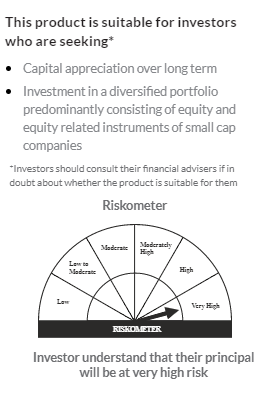
Mutual Fund Investments are subject to market risks, read all scheme related documents carefully.


Are you ready to plan and start your investment journey with Axis?



Download our app




Axis Bank Ltd. is not liable or responsible for any loss or shortfall resulting from the operation of the scheme.
Past performance may or may not be sustained in future. Please consult your financial advisor before investing.
Mutual fund investments are subject to market risks, read all scheme related documents carefully.
Copyright © 2020. All rights reserved Axis Mutual Fund.
Connect with us :


Privacy | Terms of Use | Disclaimer | Sitemap