Give direction
to your portfolio
with Factor Investing
Compass Image
Loading...

Introduction

Just as wings, enable birds to soar to new heights, Factor investing targets specific drivers of return with an aim to elevate your portfolio performance. Factors like Momentum, Value, Quality, and Low Volatility help improve outcomes, reduce volatility, and enhance diversification.

Nifty 50
27.80%
Momentum
67.70%
Low Volatility
35.20%
Quality
41.50%
Value
89.40%
1 Year CAGR Return| Data as on 16-Sep-2023 to 31-July-2024
Factors Indices > Momentum = Nifty200 Momentum 30 TR Index, Low Volatility = Nifty100 Low Volatility 30 TR Index, Quality = Nifty200 Quality 30 TR Index and Value = BSE Enhanced Value TR Index
Source: NSE and BSE Indices, Data from 16-Sep-2005 to 31-July-2024; Past performance may or may not be sustained in the future. The above information should not be construed as promise, guarantee or forecast of returns. Table / Charts mentioned above are used to explain the concept and is for illustration purpose only.
What are factors and how do they work?
A factor is a characteristic that helps explain an asset’s long-term risk and return performance. Factor funds use a set of rules to choose a portfolio of companies. Like in cricket, attacking, classic and defensive batsmen play an important role to build solid batting lineup; adding factor(s) to your portfolio, can make difference to your portfolio performance. Among many, commonly popular factors are Momentum, Low Volatility, Quality and Value.
Image
Momentum
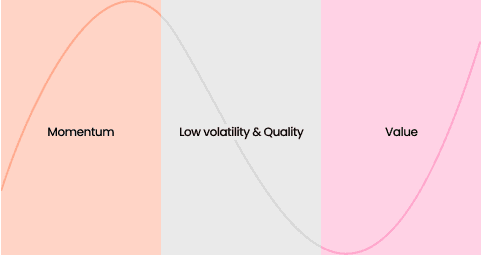
investing capitalizes aggressively during the bull markets, similar to an attacking batsman.
Image
Value
investing relates to classic approach and performs during recovery phase similar to a batsman’s class to build solid innings.
Image
Low volatility & Quality
investing aims for stable returns while reducing risk like a defensive batsman protecting their wicket.
Why Factors Investing Matters?
Factor investing looks to combine
the best of both worlds.
Passive
Investing

(β)

Passive Investing

Index based Return

Lower cost

Rule based framework

Transparent

Factor
Investing

(Smart βeta)

Factor Investing

Combination of both words

(beta and alpha)

Active
Investing

(α)

Active Investing

Aim to outperform market

Stock selection based on stock attributes

Fund Manager Bias

Identify factors to generate alpha

Chart above is to explain the concept of factor investing; however, the Index/ETF schemes based on Factor Investing follow a passive investing strategy.

Our Index Funds

Loading data Please Wait...

Quick introduction to
commonly known factors:

The Momentum FactorVector Image
The Low Volatility Factor
The Quality Factor
The Value Factor
The Momentum factor is based on the factor that winning stocks shall continue to perform well in the near term
Selects stock with strong recent performance
Expected to Work well in sustained Bull markets
Works across market cap, sector & time period
Ability to catch on to Sectoral trends
Measured using: 6M Return, 12M Return adjusted for volatility
6M = 6 months, 12M = 12 months
Historical Performance - Factor Indices
Data from 16-Sep-2005 to 31-July-2024
Performance (CAGR)
Data LabelMomentumLow VolatilityQualityValue
1 Year67.7%35.2%41.5%89.4%
3 Year26.7%19.7%19.4%44.3%
5 Year30.2%21.1%21.9%38.9%
10 Year23.8%16.1%15.5%17.0%
15 Year21.8%16.5%18.3%15.5%
Since Sep 200521.0%17.4%18.5%16.4%
Factors Indices > Momentum = Nifty200 Momentum 30 TR Index, Low Volatility = Nifty100 Low Volatility 30 TR Index, Quality = Nifty200 Quality 30 TR Index and Value = BSE Enhanced Value TR Index
Source: NSE and BSE Indices, Data from 16-Sep-2005 to 31-July-2024; Past performance may or may not be sustained in the future. The above information should not be construed as promise, guarantee or forecast of returns. Table / Charts mentioned above are used to explain the concept and is for illustration purpose only.
Different Factor works in Different Life Cycles
Factors tend to repeat their performance according to market cycles
Historical performance of factors in India
MomentumLow VolatilityQualityValue
Bull39.6%26.3%26.7%34.7%
Bear- 38.3%- 27.1%- 29.5%- 48.9%
Recovery38.6%36.4%42.4%45.1%
Vector Image

NSE and BSE Indices, Data from 16-Sep-2005 to 31-July-2024


  • Momentum tends to outperform in Bull market cycles
  • Quality and Low Volatility offers downside defence and aims to outperform in Bear markets
  • Value tends to outperform when the market is recovering from a bear phase

Factors Indices > Momentum = Nifty200 Momentum 30 TR Index, Low Volatility = Nifty100 Low Volatility 30 TR Index, Quality = Nifty200 Quality 30 TR Index and Value = BSE Enhanced Value TR Index
Source: NSE and BSE Indices, Data from 16-Sep-2005 to 31-July-2024; Past performance may or may not be sustained in the future. The above information should not be construed as promise, guarantee or forecast of returns. Table / Charts mentioned above are used to explain the concept and is for illustration purpose only.

Why should you consider factors in your portfolio?
Factor investing looks to combine the best of both worlds.
01
Strictly rule based portfolio
02
Factor portfolios exhibit high active share
03
Historically outperformed markets
04
Exhibit relatively less correlation with market and among factors
05
Tend to repeat their performance according to the market cycles
06
Works across different markets, asset classes, and time periods 
What are the advantages of
Factor based Investing?
Diversification
Factor funds offer diversity that goes beyond conventional market indices by focusing on particular factors.
Risk Management
Factors like low volatility can help reduce the overall risk of the portfolio however the performance depends on the prevailing market conditions.
Potential for Higher Returns
Over the long run, certain factors may outperform the overall market.
Customization
Investors can select funds that meet their investment goals and risk tolerance i.e. manage their own risk and return by themselves.
FAQ's

Factor investing is an investment approach that involves targeting specific drivers of return. It functions across asset classes, geographies, and time periods. Investing in factors can help improve portfolio outcomes, reduce volatility and enhance diversification, as it aims to select stocks based on various factors in strictly rule-based manner. Globally there are numerous factors available; however, the most known factors are Momentum, Low Volatility, Value, Quality, and Size.

Factor investing holds significance as it aims to optimize the returns by focusing on particular performance drivers, mitigate risk by diversifying across several factors, and aims to improve portfolio stability by offering differentiated returns subject to market conditions.

While factor-based investing can be a great option for investors, it is important to carefully consider the specific factors. Verify that these factors match your comfort level with risk and your investment goals. For instance, whilst some investors favour value or momentum strategies, others may prefer to focus on quality or low volatility.

Factor investing involves systematically selecting securities based on specific attributes or factors, like value, quality, low volatility, and momentum, which are typically associated with active management. However, it can be implemented in a more passive manner through index funds and ETFs that track these factors.

Multi-Factor Investing targets multiple stock attributes like value, quality, and momentum and low volatility to drive returns. By spreading out investments across several factors, it seeks to lower risk and produce more consistent returns. This strategy can be implemented through multi-factor ETFs or Factor Funds.

Multifactor investing is important because it diversifies risk and combines different investment factors like value, quality, low volatility, and momentum. This approach helps reduce overall portfolio volatility, improves adaptability to market changes, and is supported by empirical evidence for better risk-adjusted returns.

Investors can implement Factor investing through individual stocks, ETFs, or factor funds.

When choosing an investment, consider your time horizon, risk tolerance, and investment goals (growth, income) into account. Diversify across asset classes to reduce risk and be mindful of fees and liquidity. Make thoughtful selections by conducting in-depth research.

Examine past returns, fees, factor performance, and benchmarks to evaluate the success of your investments. It gives a sense that the investment aligns with its objectives.

While traditional mutual funds or exchange-traded funds (ETFs) usually track a broad market index or sector, factor-based funds concentrate on particular market factors like value or momentum, utilizing a systematic, rules-based approach with minimum human intervention.
Disclaimer: Past performance may or may not be sustained in future. Axis AMC is not assuring/guaranteeing returns. The above should be construed as a recommendation/advise to follow any particular strategy. Investors are requested to consult their financial adviser before taking an investment decision.