Exchange Traded Funds (ETFs)


Exchange Traded Fund (ETF), are mutual funds that trade like stocks.






How does ETF work?
Why Invest in ETFs Funds?





Frequently asked questions
Various exchange traded funds, depending on their nature may have different tax implications. Investors are requested to refer to the ETF’s Scheme Information Document (SID) to understand the taxation-related rules that apply.
Both ETFs and index funds follow a passive investment strategy, however, investors can only purchase or sell their index fund units by placing a request to the AMC. The value of units is defined based on the NAV of the index fund which is determined at the end of the day. However, in the case of ETFs investors can enter or exit their investments throughout trading hours at the fund’s current market price. Also, investors do not need a demat account to buy or sell index funds.
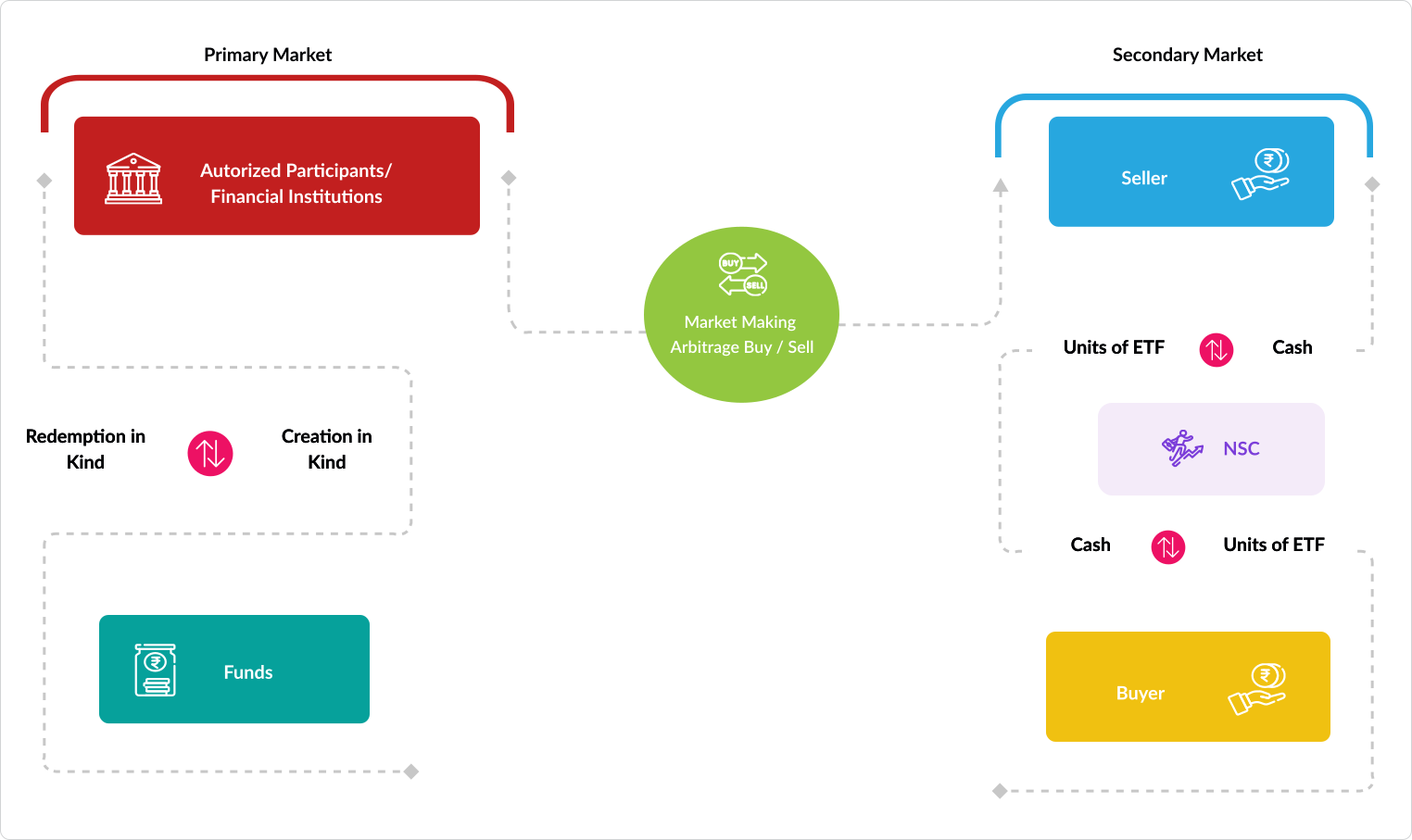
An exchange traded fund or ETF as it is commonly referred to as is an open ended mutual fund scheme whose units can be traded at the stock exchange just like company stocks. Unlike other mutual funds, ETFs are listed at the stock exchange and their units are available for trade at the fund’s current market price. Investors can buy or sell their ETF units end number of times throughout live trading hours. Investors can either be involved in intraday trading or they can buy ETF units and hold on to them like long term investors. They are considered to be a cost effective investment as investors can even purchase one single ETF unit, unlike other mutual funds where one cannot buy a single unit but can make a minimum SIP or lumpsum investment.
Below stated are all the ETF schemes currently offered by Axis Mutual Fund –
- Axis Gold ETF - An open ended scheme replicating/tracking Domestic Price of Gold
- Axis NIFTY ETF - An open ended Scheme replicating/ tracking the NIFTY 50 Index
- Axis Banking ETF - An open ended scheme replicating/tracking NIFTY Bank Index
- Axis Technology ETF - An open ended Exchange Traded Fund tracking NIFTY IT Index
- Axis AAA Bond Plus SDL ETF - 2026 Maturity - An open ended Target Maturity Exchange Traded
- Fund investing predominantly in constituents of Nifty AAA Bond Plus SDL Apr 2026 50:50 Index
- Axis Healthcare ETF - An open ended Exchange Traded Fund tracking NIFTY Healthcare Index
- Axis Consumption ETF - An open ended Exchange Traded Fund tracking NIFTY India Consumption Index
Mutual funds can be broadly categorized as actively managed funds and passively managed funds. An active fund is a mutual fund scheme where the fund manager actively buys and sells securities and maintains the portfolio of the fund. However, most ETFs are passively managed and are designed to track and replicate the performance of their underlying index/benchmark with minimum tracking error.
Exchange Traded Funds offer several benefits including –
- A feasible expense ratio
- Their units can be traded throughout the day at their fluctuating live market price during trading
hours just like people trade with company stocks - Investors can put a limit on their orders
- Investors need not do any different documentation for trading in ETFs, their bought units are stored in the demat account
- Minimum investment requirement for owning an ETF is one single unit
Individuals who wish to invest in a fund that eliminates the risk of human biases as there is no active stock picking done by any fund/portfolio manager may consider investing in exchange traded fund.
Exchange Traded Funds usually do not carry any entry or exit load. However, investors must refer to the scheme's SID (Scheme Information Document) to clarify any doubts related to entry or exit load.
Investors need to have a demat account and a trading account to trade in ETF units.